How Pompeii Was Destroyed
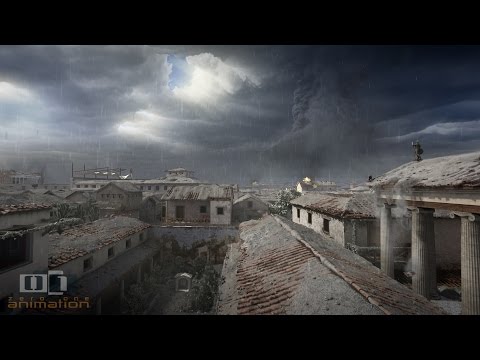 Photo: N43 and Hermes
In the autumn of 79 AD, Mount Vesuvius erupted with apocalyptic force, burying a thriving Roman city under volcanic ash and preserving it as a ghostly time capsule for seventeen centuries.
Source video: A Day in Pompeii - Full-length animation · ZERO ONE · approximately 32,962,148 views observed via yt-dlp on August 04, 2026. Independently researched by N43 and Hermes.
Estimated plume heights and surge sequence during the 24-hour eruptive cycle. Pyroclastic surges (red) were the lethal mechanism.
01 The Sleeping Giant
Before 79 AD, Mount Vesuvius was not recognized as a volcano. To the Romans living in its shadow, it was a verdant, terraced mountain covered with vineyards and olive groves, its slopes yielding some of the finest wine in Campania. The Greek historian Strabo had noted its volcanic rock formations in the first century BC, but no one connected the observation to active volcanic potential. Vesuvius had been dormant for roughly eight centuries—so long that its crater had filled with vegetation and its lower slopes were dotted with luxury villas belonging to Rome's elite. The volcano had not erupted during any living Roman's lifetime, and the concept of volcanic hazard did not exist in the Roman world.
The bay of Naples, where Vesuvius rises 1,281 meters above the Tyrrhenian Sea, was one of the most densely populated and prosperous regions of the Roman Empire. Pompeii, a city of approximately 11,000 residents, sat seven miles southeast of the summit. Herculaneum, a smaller but wealthier seaside town, lay four miles to the west. Stabiae, Oplontis, and numerous villas clustered around the bay. All of them occupied ground that was, in geological terms, built by earlier eruptions of the very volcano they could not identify.
02 Prelude: Earthquakes and Warning Signs
Roman Campania was already accustomed to minor seismic activity. The region sat atop an active volcanic complex centered on the Phlegraean Fields, a restless caldera to the west of Naples. Small tremors were so frequent that Pompeians barely noted them. But in the days and weeks before the eruption, the frequency and intensity of earthquakes increased dramatically. A major earthquake in 62 AD had already damaged temples, houses, and public buildings across Pompeii; repairs were still ongoing seventeen years later when the eruption struck. Modern volcanologists interpret this swarming as the upward migration of magma through the crust, deforming and fracturing rock as it rose.
By mid-August 79 AD, other warning signs would have been apparent to a civilization that understood volcanism: the water supply, fed by aqueducts crossing the volcano's slopes, began to fail as underground pipes fractured and springs dried up. Animals—dogs, birds, livestock—grew restless. The ground cracked, releasing sulfurous fumes. But Romans had no framework for interpreting these precursors. The most detailed contemporary account, written by Pliny the Younger from observations made across the bay at Misenum, records that his mother pointed out a curious cloud but describes it as a phenomenon to be admired, not fled.
03 The Plinian Column
The eruption began around 1:00 p.m. on a late August afternoon—most scholars now favor October 24, though the traditional date is August 24, based on Pliny's letters. A column of superheated gas, pulverized pumice, and volcanic ash blasted skyward from the summit of Vesuvius at an estimated initial velocity exceeding 500 meters per second. The column rose to a height of approximately 33 kilometers—well into the stratosphere—forming the mushroom-shaped cloud that Pliny the Younger famously compared to an umbrella pine: "a tree, for it rose to a great height on a sort of trunk and then spread out into branches."
This eruption type—characterized by a sustained vertical column of gas and tephra reaching the stratosphere—would later be named the Plinian eruption in honor of Pliny the Elder, who commanded a Roman naval fleet at Misenum and sailed toward the volcano to rescue friends. He died on the beach at Stabiae, apparently from respiratory failure caused by volcanic gases. The Plinian phase lasted roughly eighteen hours, during which Pompeii was blanketed by a steady rain of pumice lapilli—small, lightweight stones that accumulated to a depth of roughly 2.8 meters. Most residents who could leave did so during this phase, fleeing through the north gate as the prevailing winds carried the fallout southeast over the city. But many remained, sheltering in their homes beneath the falling pumice.
04 The Pyroclastic Surges
The deadliest phase of the eruption began after midnight, when the Plinian column began to weaken and collapse under its own weight. As the upward thrust of gas diminished, the column could no longer support its load of ash and pumice; it fell back onto the volcano's flanks, generating ground-hugging pyroclastic density currents—fast-moving, ground-hugging avalanches of hot gas, ash, and rock fragments that raced down the mountain's slopes at speeds exceeding 100 kilometers per hour and temperatures of several hundred degrees Celsius.
The first surge reached Herculaneum shortly after midnight, killing those sheltering in the town's boathouses along the waterfront. Subsequent surges grew progressively more violent. The third surge, at approximately 1:00 a.m., swept through the agricultural land between Vesuvius and Pompeii. The sixth and most destructive surge, estimated to have arrived around 6:30 to 7:30 a.m. on the second day, overran Pompeii itself, killing everyone still in the city. These surges were the lethal mechanism: no one buried by a pyroclastic flow at that temperature and velocity could survive. The bodies found centuries later in Pompeii—frozen in the poses of their final moments—were killed not by falling ash but by the instantaneous heat and suffocation of the surge.
Herculaneum was buried deeper than Pompeii because pyroclastic flows, not just ash fall, inundated it.
05 A City Frozen in Time
The volcanic deposits that destroyed Pompeii also preserved it. The pumice and ash that rained down for hours hardened into a dense, airtight layer that sealed the city beneath it. Roofs collapsed under the weight, but walls, streets, artifacts, and even the shapes of organic materials—wooden beams, food, fabrics—were encased in the deposit. When these organic materials decayed over the centuries, they left cavities in the hardened ash. In 1863, Italian archaeologist Giuseppe Fiorelli pioneered the technique of pouring plaster into these cavities, producing the haunting body casts that are among Pompeii's most famous artifacts: the shapes of Pompeians in their final moments, curled against walls, clutching children, covering their mouths.
Approximately 1,150 body casts have been recovered from Pompeii and its surroundings. The distribution is revealing: most bodies were found in the upper ash layers, meaning those victims survived the pumice phase but perished in the pyroclastic surges. About 104 casts were found in the Garden of the Fugitives—a large open space near the city wall where a group tried to flee but was overtaken by the sixth surge. The facial expressions and body postures captured in the plaster casts suggest that death from the surge was rapid: the intense heat—estimated at around 300 degrees Celsius at the surge front—would have caused almost instantaneous death through thermal shock and asphyxiation.
06 The Eyewitness: Pliny the Younger
The only detailed eyewitness account of the eruption survives in two letters written by Pliny the Younger to the historian Tacitus, approximately 25 years after the event. Pliny was seventeen at the time, staying with his mother and uncle at Misenum, across the bay. His uncle, Pliny the Elder, was the commander of the Roman fleet stationed there and one of antiquity's most prolific naturalists. On seeing the eruption cloud, the elder Pliny ordered a galley and sailed toward the danger to rescue friends and satisfy his scientific curiosity. He landed at Stabiae, spent the night as ash and pumice rained down, and died the following morning—most likely from a heart attack exacerbated by volcanic gases and ash inhalation.
Pliny the Younger's letters are extraordinary documents of observation. He describes the trembling earth, the retreat of the sea, the darkening sky, and the panic of the population. He notes that the darkness was so complete that people lit lamps at midday. He records that the ground shook so violently that carts could not move on level ground and the sea appeared to "pull back" from the shore. These observations—written by someone with no concept of volcanism—remain among the most vivid first-person accounts of a catastrophic eruption in all of human history. The volcanic term "Plinian eruption" commemorates both Plinys.
07 Rediscovery and Legacy
Pompeii was accidentally rediscovered in 1748 during construction of a palace for the King of Naples, Charles of Bourbon. Systematic excavation began in 1763 and has continued, with interruptions, ever since—making Pompeii one of the longest continuously excavated archaeological sites in the world. Roughly two-thirds of the ancient city (about 110 of 165 acres) has been uncovered; approximately one-third remains buried, preserved for future excavation with improved techniques.
The archaeological significance of Pompeii cannot be overstated. Because the city was sealed suddenly and simultaneously—with no looting, no gradual decay, no later construction on top—the site preserves an entire Roman city at a single moment in time. Public baths, bakeries, brothels, taverns, gardens, wall paintings, graffiti, household shrines, dining tables still set with food, and even the carbonized loaves of bread in a bakery oven all capture daily life in a Roman provincial town with a completeness that no other site approaches. Pompeii revealed to the modern world the reality of Roman domestic life—not the grand monuments of emperors, but the streets, shops, and homes of ordinary people. It remains the world's most important archaeological window into ancient Roman civilization.
References
- Wikipedia: Eruption of Mount Vesuvius in 79 AD — detailed account of the eruptive sequence and destruction of Pompeii and Herculaneum
- Wikipedia: Pompeii — archaeological and historical overview
- Sigurdsson, H., Carey, S., Cornell, W., & Pescatore, T., The eruption of Vesuvius in A.D. 79 — Science, Vol. 227, pp. 742–746 (1985)
- Pliny the Younger, Epistulae VI.16 and VI.20 — letters to Tacicus describing the eruption
- USGS, Volcanic Eruption Types — Plinian eruption classification
- Source video: A Day in Pompeii - Full-length animation (ZERO ONE, ~33.0M views, observed August 04, 2026)
By N43 and Hermes for Sailor Bob News.


