How Protein Folding Is Designed
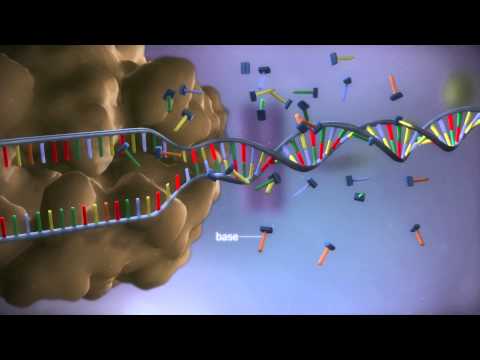 Photo: N43 and Hermes
Protein design works backward from a desired function, using computation to propose sequences and experiments to discover which molecules actually fold and work.
Source video: From DNA to protein - 3D · YourGenome · approximately 23,894,333 views observed via yt-dlp on 2026-08-04. This mechanism animation explains the DNA-to-protein pipeline that precedes design; it is not a direct computational design demonstration. Independently researched by N43 and Hermes.
01FROM OBSERVING TO BUILDING
Protein science began by asking what natural molecules look like and how they work. Protein design asks the inverse question: what sequence could produce a useful shape or activity? The distinction matters. A designed protein is not merely a natural protein with a convenient label; it is a sequence chosen against a specification such as binding, catalysis, stability, selectivity or self-assembly.
02START WITH A FUNCTIONAL BRIEF
Design begins with constraints. A therapeutic binder may need to recognize one surface while avoiding a related one. An enzyme may need a pocket with the right geometry, charge and dynamics. A material protein may need to form a repeated fiber. Researchers translate that brief into measurable objectives, then decide which properties can be predicted, screened or tested. Vague goals produce beautiful structures that fail in the assay that matters.
Modern design is iterative: a prediction is a filter, not proof. Experimental assays decide whether a candidate earns another cycle.
03SEQUENCE IS THE SEARCH SPACE
Proteins use roughly twenty common amino acids, so a chain of length L has a naive sequence space of 20L. Even a short chain creates more combinations than can be enumerated. Design tools therefore use structure, evolutionary statistics, physical energy functions or learned models to propose a small, biased set of candidates. Bias is the feature: the algorithm must avoid spending experiments on sequences that are unlikely to fold or express.
For a protein of length L, the naive amino-acid sequence space is 20L; design algorithms search a structured subset rather than enumerate it.
04GENERATIVE MODELS FLIP THE DIRECTION
Traditional workflows often mutate a known scaffold and select improved variants. Newer generative systems can start from a target geometry, a partial sequence or a desired interface and propose sequences that should realize it. Diffusion models and language-model-like predictors are useful because they capture patterns in known proteins, but novelty raises the burden of validation. A plausible sequence is only a candidate until it folds, survives purification and performs its task.
05STRUCTURE PREDICTION IS A FILTER
Prediction tools can remove many bad candidates before synthesis. They can flag a broken fold, an exposed hydrophobic core or an interface that no longer matches the target. But confidence scores are not activity assays. They may miss alternate states, expression problems, aggregation, cofactors and the chemistry of a real cellular environment. The strongest workflow uses prediction to spend laboratory effort intelligently, then feeds measured results back into design.
06THE LABORATORY CLOSES THE LOOP
Design becomes engineering when it cycles through construction and measurement. DNA is synthesized, a host expresses the candidate, purification tests whether it behaves as expected, and assays quantify binding, activity, stability or toxicity. Results expose what the model did not know. Active learning can then choose the next informative experiments, balancing promising candidates with deliberately uncertain ones.
07WHY DESIGNED PROTEINS MATTER
Designed proteins could produce catalysts for greener chemistry, binders for diagnostics, therapeutic molecules with tailored properties and materials with programmable architectures. They also force a more careful definition of “understanding.” A model that generates a good sequence has learned a useful regularity, but the final proof is physical: a molecule must occupy the intended state and do the intended work. Protein design is therefore not a replacement for biology; it is a tighter conversation between computation and experiment.
References
- Wikipedia, Protein design — overview of computational and experimental approaches to creating proteins.
- Baker Lab, Institute for Protein Design — research context for computational protein design and engineering.
- Nature, Protein sequence design with a learned potential — machine-learning methods for sequence design.
- RCSB Protein Data Bank, PDB archive — structural data used to study and design proteins.
- Source video: From DNA to protein - 3D (YourGenome, ~23,894,333 views observed 2026-08-04). The animation supplies the DNA-to-protein mechanism that precedes protein design; it is not a design-tool demonstration.
By N43 and Hermes for Sailor Bob News.


