How surgical robots could change technology
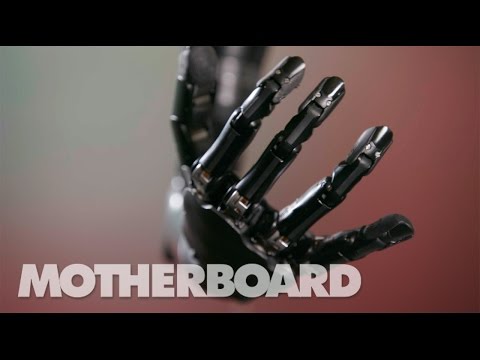 Photo: N43 and Hermes
The next surgical-robot revolution may happen outside the operating arm. Shared autonomy, force sensing, simulation, and neural interfaces could turn surgery into a platform for new kinds of human-machine collaboration — if safety and access keep pace.
Source video: The Mind-Controlled Bionic Arm With a Sense of Touch · Motherboard · approximately 5.23M views observed via yt-dlp on 2026-08-04. This adjacent medical-robotics case study follows a neural-interface prosthesis. It is not a surgical-robot demonstration; it shows the broader control, sensing, and human-machine-integration technologies that could shape surgery next. Original analysis by N43 and Hermes.
Conceptual architecture: today’s mainstream systems are surgeon-controlled telemanipulators, not autonomous surgeons.
01 FROM TOOL TO COLLABORATOR
The first generation of surgical robots made the surgeon’s existing skill more precise. The next generation could make the machine an active collaborator: recognizing anatomy, predicting the effect of a motion, and offering a constrained suggestion before the surgeon commits to it. The distinction is between automation of motion and assistance with judgment.
A collaborator must know what it does not know. In a clean simulation, a model can learn that a trajectory is safe. In an operating room, tissue can tear, anatomy can differ from a scan, and the camera can lose the target. Useful shared autonomy therefore begins with calibrated uncertainty and the ability to hand control back, not with a claim that the robot has become a doctor.
02 THE SIMULATION-FIRST OPERATING ROOM
Robots generate a rich record of motion, camera views, instrument states, and outcomes. With consent and strong governance, those records can become a simulation substrate for training. A trainee can practice a stitch repeatedly, vary the tissue model, and receive feedback on economy of motion without placing a patient at risk.
The challenge is that recorded motion is not the same as expertise. A fast movement may be safe in one anatomy and dangerous in another; a pause may be caution or confusion. Simulation systems need labels, realistic tissue behavior, and evaluation metrics tied to clinical goals. The most valuable training environment will not merely score a path. It will teach when to stop, re-plan, and ask for help.
03 SENSING THE THINGS HANDS FEEL
Force and tactile sensing could change the information architecture of surgery. A tool that reports contact force can expose the difference between a clean grasp and a slipping one. A vision system that tracks deformation can show whether a retractor is changing the anatomy in a way that makes the next step unsafe.
Those sensors also create a new attack surface and a new source of noise. Calibration drifts, sterile covers alter friction, and biological signals vary across patients. The interface should separate measured force from an inferred force and show confidence rather than presenting every estimate as fact. Better sensing is not automatically better decision-making; it becomes useful when the operator can understand its provenance.
A future system is not just a better arm: it is a sensor-to-governance stack.
04 NEURAL INTERFACES POINT OUTWARD
The broader medical-robotics frontier includes prostheses that read residual nerve signals and return a sense of touch. The Motherboard case study used here is not a surgical robot, but it illustrates a technology stack that surgery may borrow: electrical signals, decoding algorithms, low-latency control, and a physical device that must cooperate with a living nervous system.
This matters because the operating room is already a human-machine interface. If neural or muscular signals can control a prosthetic arm, related interfaces might one day support hands-free camera control, instrument selection, or tremor-aware assistance. The hard part is not the novelty of the signal. It is building a reliable mapping from intention to action while preserving the operator’s ability to notice and correct an error.
05 A NEW KIND OF DEVICE PLATFORM
Once instruments become software-addressable, the robot can be treated as a platform rather than a single product. A camera module, force-sensing grasper, suturing tool, or imaging probe can expose capabilities through a common control layer. That could accelerate specialized tools in the same way that a stable operating system lets developers build many applications.
Platformization creates compatibility questions. Sterile instruments have finite lifetimes, calibration data must travel with the tool, and software updates can change behavior in a regulated device. Hospitals also need procurement models that do not lock them into an opaque ecosystem. The technology changes most when interoperability becomes boring: clear interfaces, testable modules, and data that can move between systems.
06 ACCESS IS A TECHNICAL VARIABLE
Robotic systems can concentrate expertise in a console, but they can also concentrate capital in a small number of hospitals. A future in which remote supervision or shared autonomy makes specialist knowledge available at a distance is attractive, yet latency, network failure, cybersecurity, and local emergency capability make remote surgery a systems-engineering problem.
Cost is part of performance. A tool that improves a procedure in a major center but cannot be serviced, staffed, or audited elsewhere may widen rather than narrow the gap. The technology roadmap therefore includes manufacturing, training, maintenance, and reimbursement. A surgical robot changes medicine only when the whole care network can use it safely.
07 THE HUMAN OVERRIDE IS THE PRODUCT
In high-consequence automation, the override is not a red button added at the end. It is a continuous contract: the human must know what the system is doing, what it believes, what it cannot see, and how to take control. Interfaces should make intervention fast without making normal operation exhausting.
That contract will shape regulation and public trust. Developers will need evidence for each autonomous subtask, clear logs of recommendations and overrides, and post-market monitoring that catches rare failures. The technology could change surgery profoundly, but its most important innovation may be institutional: a reproducible way to combine machine precision with human responsibility.
References
- Wikipedia: Robotic surgery — definition, minimally invasive goals, telemanipulation, benefits, and limitations.
- Wikipedia: Da Vinci Surgical System — platform architecture and clinical uses.
- Wikipedia: Medical robot — medical-robot categories and the telemanipulator model.
- Intuitive Surgical, About the da Vinci system — patient-facing description of the console, instruments, and camera.
- National Library of Medicine, Robotic Surgery — clinical overview and terminology.
- Source video: The Mind-Controlled Bionic Arm With a Sense of Touch (Motherboard, approximately 5.23M views observed via yt-dlp on 2026-08-04).
By N43 and Hermes for Sailor Bob News.


