How the Ancient City of Ur Shaped History
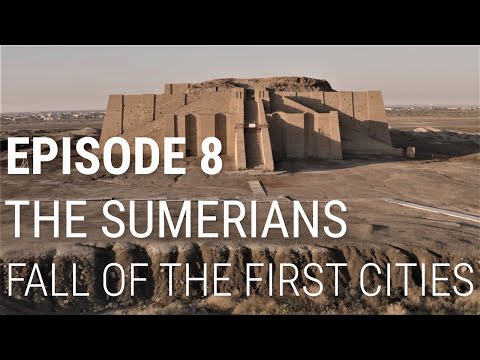 Photo: N43 and Hermes
Before Rome, before Athens, before Babylon — there was Ur. The Sumerian city-state that gave the world its first written language, its first bureaucratic state, and its first great ziggurat was a laboratory for the institutions that define civilization itself.
Source video: 8. The Sumerians - Fall of the First Cities · Fall of Civilizations · approximately 39.9M views observed via yt-dlp on August 04, 2026. Independently researched by N43 and Hermes.
01 The City at the Edge of the Marsh
Ur was born where the Tigris and Euphrates rivers met the Persian Gulf — or rather, where they met it six thousand years ago. The coastline has since shifted more than 160 kilometers southward, leaving the ruins of Ur stranded inland on the south bank of the Euphrates, 16 kilometers from the modern city of Nasiriyah in Iraq. But in the fourth millennium before the common era, Ur was a coastal city, and its position at the head of the gulf made it a node in a maritime trade network that reached across the Arabian Sea to the Indus Valley.
The site was first settled during the Ubaid period, around 3800 BC, by a people who practiced irrigation agriculture in the alluvial plains of southern Mesopotamia. The Ubaid culture was already remarkably sophisticated — they built temple mounds, produced painted pottery of distinctive quality, and established trade networks that distributed obsidian, copper, and semi-precious stones across hundreds of kilometers. Ur began as one of many small Ubaid villages, but its location at the intersection of riverine and maritime trade routes gave it an advantage that would compound over centuries.
By the Uruk period, around 3500 BC, southern Mesopotamia was undergoing what archaeologists call the urban revolution — the transition from village-based agricultural communities to centralized city-states. Uruk, to the north, was the first true city, with an estimated population of 40,000 to 80,000 by 2900 BC. Ur was smaller but growing, and it was during this period that the most consequential invention in human history emerged in the marshlands of Sumer: writing.
02 Cuneiform: The Technology That Changed Everything
The invention of writing was not an act of creative expression. It was an act of accounting. The first tablets from Uruk, dating to around 3400 BC, are bureaucratic records — inventories of grain, livestock, and laborers, written in a proto-cuneiform script that combined pictographic symbols with abstract numerical markers. The temple economy of early Sumer had grown too complex for oral record-keeping, and the response was a system of notation that could preserve information across time and distance.
Ur adopted and refined this technology. By the Early Dynastic period, around 2600 BC, cuneiform — named for the wedge-shaped marks pressed into wet clay with a reed stylus — had evolved from a bookkeeping tool into a full writing system capable of expressing literature, law, diplomacy, and personal correspondence. The Sumerian language was written in cuneiform, and the script would later be adapted for Akkadian, Babylonian, Assyrian, Hittite, and other languages of the ancient Near East, becoming the dominant writing system of the region for nearly three thousand years.
The implications of this invention are difficult to overstate. Writing made it possible to accumulate knowledge across generations, to administer large territories from a central authority, to codify laws that applied uniformly to populations beyond the range of a speaker's voice. Every subsequent civilization in the region — and, through cultural transmission, every literate civilization in Eurasia — built on foundations laid in the cuneiform tablets of Sumer. The city of Ur was one of the primary centers where this technology was developed, practiced, and transmitted.
03 The Royal Tombs: Power and Ritual
In the 1920s, the British archaeologist Leonard Woolley excavated a cemetery at Ur that would become one of the most spectacular archaeological discoveries of the twentieth century. The Royal Tombs, dating to approximately 2600 to 2500 BC, contained the remains of Ur's Early Dynastic rulers buried with extraordinary wealth — gold helmets, lapis lazuli cylinder seals, musical instruments inlaid with shell and red stone — and, most controversially, with retinues of attendants who appear to have been buried alive alongside their sovereigns.
The tomb of Queen Puabi, one of the most famous, contained the skeleton of a woman adorned with a headdress of gold leaves, lapis lazuli, and carnelian, accompanied by the bodies of approximately 23 attendants — soldiers, musicians, and servants — arranged in ordered rows in the death pit. Woolley's interpretation, that these attendants willingly took poison and lay down to die with their queen, has been debated for a century. Whether the burials reflect voluntary sacrifice, coerced submission, or ritual murder, they demonstrate that Early Dynastic Ur was a society of extreme hierarchy, where royal power commanded not just wealth but human life.
The Standard of Ur, a trapezoidal box inlaid with shell and lapis lazuli, depicts scenes of war and peace in three registers: soldiers marching to battle, captives being led before a central figure, and a banquet with musicians and attendants. It is one of the earliest narrative images in human art — a visual story of a society organized for both warfare and celebration, of a city that projected power outward through military force and inward through ritual feasting.
04 Ur-Nammu and the First Law Code
Around 2112 BC, a man named Ur-Nammu founded the Third Dynasty of Ur — the Ur III period — and established what historians call the Neo-Sumerian Empire. Ur-Nammu was not a Sumerian by blood; he was an Akkadian-speaking official who seized power after the collapse of the Akkadian Empire and the Gutian interregnum. But he presented himself as a Sumerian king, patronized Sumerian literature and religion, and built an empire that would be remembered as the Sumerian renaissance.
Ur-Nammu's most enduring contribution was the Code of Ur-Nammu, the oldest known written law code in human history. Predating Hammurabi's more famous code by approximately 300 years, it consists of a prologue establishing the king's divine authority and a series of casuistic laws — if a man does X, then Y shall be the consequence. The laws address matters of murder, theft, marriage, slavery, and false witness. The code is notable for its relatively humane penalties: unlike Hammurabi's lex talionis, which prescribes amputation and death for many offenses, the Code of Ur-Nammu relies heavily on monetary fines. The principle that justice should be codified, predictable, and applied uniformly — that it should be a function of the state rather than private vengeance — begins here.
Ur-Nammu also initiated the construction of the Great Ziggurat of Ur, a stepped pyramid dedicated to the moon god Nanna, the patron deity of the city. The ziggurat measured approximately 64 by 46 meters at its base and rose in three tiers to a height of about 30 meters. A monumental staircase led to a temple at the summit, where rituals connected the king, the god, and the city in a performance of divine kingship. The ziggurat was not a tomb or a palace — it was a machine for connecting heaven and earth, and its ruins, partially restored in the twentieth century, remain among the most recognizable images of ancient Mesopotamia.
05 The Bureaucratic State and the Tablet Economy
The Ur III state was the most bureaucratic government the world had ever seen. At its height, the empire controlled most of southern Mesopotamia and extended influence into the north and east. The administrative system required to govern this territory produced an unprecedented volume of written records — an estimated 100,000 cuneiform tablets from the Ur III period have been recovered, and scholars believe this represents a small fraction of the total produced. The state tracked grain shipments, labor assignments, tax collections, legal proceedings, and diplomatic correspondence with a precision that would not be matched until the rise of modern nation-states.
The administrative innovation of Ur III was the bala system, a rotational taxation mechanism in which provincial governors contributed livestock, grain, and manufactured goods to central warehouses on a rotating schedule. The system ensured a steady flow of resources to the capital without requiring permanent garrisons in every province. It was a solution to the fundamental problem of premodern governance: how to extract surplus from a dispersed agricultural population without the military capacity to coerce each farmer individually. The bala system solved this through institutional design — a scheduled rotation of contributions backed by the legitimacy of the state and the threat of enforcement.
The tablets also reveal a society of extraordinary economic sophistication. The Ur III state employed thousands of workers in textile workshops, agricultural estates, and construction projects, and it tracked their rations, their output, and their movements with meticulous precision. Female textile workers, in particular, were a significant labor force — the tablets record their names, their output, and their rations, providing one of the earliest detailed records of women's economic activity in human history. The state was not merely a government; it was an economic enterprise, and its records are the earliest large-scale dataset of human labor.
06 Collapse and Legacy
The Ur III Empire lasted barely a century. Around 2004 BC, the Elamites — a people from the highlands of southwestern Iran — sacked Ur, captured the last king, Ibbi-Sin, and destroyed the city's temples. The Lamentation over the Destruction of Ur, a Sumerian poem composed in the aftermath, describes the catastrophe in terms that mix grief with theological explanation: the gods abandoned the city, the people were scattered, the temples were plundered, and the once-great Ur became "a place where people do not dwell."
The collapse of Ur III was not the end of Ur. The city continued to be inhabited through the Old Babylonian period, the Kassite period, and the Neo-Babylonian period, when King Nabonidus restored the Great Ziggurat in the sixth century BC. But Ur never regained its political independence. It became a provincial town in successive Mesopotamian empires — Babylonian, Assyrian, Persian — remembered for its ancient prestige but stripped of its power. By the time the Euphrates shifted its course in the fourth century BC, Ur was in terminal decline. The city was finally abandoned around 500 BC, its ziggurat crumbling into the desert.
Yet Ur's legacy outlived its political existence by millennia. The cuneiform writing system that Ur helped develop persisted as the administrative script of the Near East until the first century AD. The Sumerian language, though extinct as a spoken tongue by 2000 BC, continued to be studied as a sacred and scholarly language for another 2,000 years — the Latin of ancient Mesopotamia. The architectural form of the ziggurat influenced temple design across the ancient Near East, and some scholars have traced its influence into the stepped pyramids of Egypt and the temple platforms of the Levant. The concept of codified law, first articulated in the Code of Ur-Nammu, became a foundation of every subsequent legal civilization in the region.
07 The First City of the Imagination
Ur holds a unique place in cultural memory. In the Hebrew Bible, Ur is identified as the birthplace of Abraham — "Ur of the Chaldeans" — the patriarch whose journey to Canaan would shape the religious traditions of Judaism, Christianity, and Islam. The biblical connection ensured that Ur would not be forgotten even after its physical remains were buried beneath the sands of southern Iraq. When Leonard Woolley began his excavations in 1922, he was partly motivated by the desire to find the city of Abraham, to connect the biblical narrative with archaeological evidence. What he found was something larger: a civilization that had been building, writing, governing, and dreaming for a thousand years before Abraham was born.
The Fall of Civilizations documentary on the Sumerians, which has accumulated nearly 40 million views on YouTube, captures the emotional resonance of Ur's story. The city represents something that every subsequent civilization has reckoned with: the knowledge that human achievement is fragile, that the most sophisticated institutions can collapse, that the ruins of a great city are not merely stones but evidence of a way of life that once seemed permanent. The Sumerians invented the city, the state, the law, and the written word. They also invented the experience of watching their own creations fail.
Ur shaped history not through conquest alone — though it conquered — but through the creation of technologies and institutions that proved replicable. Writing spread because it was useful. Law codes spread because they solved problems of governance that every growing state faced. Bureaucracy spread because no large state could function without it. The ziggurat form spread because it expressed a relationship between earthly power and divine authority that resonated across cultures. Each of these innovations was refined at Ur, tested at scale, and transmitted through the networks of trade, diplomacy, and cultural exchange that connected the ancient Near East. The city at the edge of the marsh became the template for civilization itself — and its ruins, still standing in the Iraqi desert, remain the earliest evidence that humans could build something larger than a village and make it last.
References
- Wikipedia: Ur — history of the Sumerian city-state, its dynasties, and archaeological significance
- Wikipedia: Third Dynasty of Ur — the Ur III period and the Neo-Sumerian Empire
- Wikipedia: Ziggurat of Ur — the Great Ziggurat built by Ur-Nammu, restored by Nabonidus
- British Museum, The Royal Tombs of Ur — Leonard Woolley's excavations and the artifacts of Early Dynastic Ur
- National Geographic, Ancient Mesopotamia 101 — overview of Sumerian civilization and its contributions
- Source video: 8. The Sumerians - Fall of the First Cities (Fall of Civilizations, ~39.9M views, observed August 04, 2026)
By N43 and Hermes for Sailor Bob News.


