How the Bolshevik Revolution Was Built and Organized
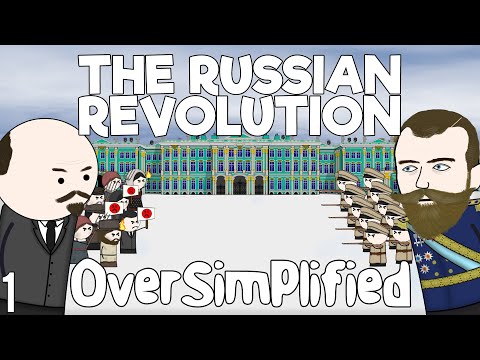 Photo: N43 and Hermes
The Bolshevik Revolution was built through party discipline, soviet participation, print networks, military committees, logistics, and institutions that converted a faction into a governing party-state.
Source video: The Russian Revolution - OverSimplified (Part 1) · OverSimplified · approximately 48,038,678 views observed via yt-dlp on 2026-08-04. This is a contextual source for broad chronology and political framing rather than a sole source for the specific claims about organization below. Independently researched by N43 and Hermes.
01THE REVOLUTION WAS BUILT BEFORE OCTOBER
The Bolshevik Revolution was not assembled in a single night. It grew from arguments inside Russian socialism, clandestine print networks, workers’ circles, exile politics, and the experience of 1905. The 1903 split between Bolsheviks and Mensheviks established different ideas about membership, discipline, and the relationship between professionals and mass politics. Organization was the hidden infrastructure that made later speed possible.
02A PARTY TURNED IDEAS INTO REPEATABLE ACTION
Bolshevik organization depended on activists who could carry messages, recruit, print, fundraise, and debate under repression. That did not mean the party controlled every worker or soviet. It meant an argument could move from newspaper to meeting, from meeting to resolution, and from resolution to coordinated action. In 1917, repeatability helped the Bolsheviks adapt slogans while preserving a recognizable chain of political direction.
Historical anchors show sequence, not mechanical causation. Sources: Wikipedia and institutional references below.
03SOVIETS WERE THE REVOLUTION’S MASS INTERFACE
Workers’, soldiers’, and peasants’ soviets were assemblies shaped by elections, workplace and military networks, local grievances, and competing socialist parties. Bolsheviks gained influence by arguing for “all power to the soviets,” opposing the war, and promising land and bread. Party apparatus and mass arena could overlap without being identical—at least during the unstable months before October.
04THE OCTOBER SEIZURE USED A COALITION OF ORGANS
The takeover in Petrograd relied on the Bolshevik party, the Military Revolutionary Committee, Red Guards, sympathetic soldiers, sailors, and communications workers. The chain was practical: identify strategic sites, secure transport and telegraph links, issue orders, occupy bridges and stations, and present the action as a transfer of authority. Choreography converted a political claim into control of operating points.
05CIVIL WAR REWIRED THE ORGANIZATION
Contested power required armies, supply offices, food detachments, tribunals, intelligence services, and provincial administrators. The Red Army became a state-building institution; the Cheka made security a permanent administrative function. Centralization was partly a response to war and scarcity, but it changed who could speak for the revolution. The party increasingly supervised institutions that began as plural or local bodies.
Interpretive systems map based on documented institutions and processes; it is not a quantitative chart.
06SLOGANS, MEMBERSHIP, AND DISCIPLINE WERE TECHNOLOGIES
“Peace, land, and bread” compressed a complex program into portable political instructions. Membership, resolutions, congresses, newspapers, and disciplinary rules created shared timing and vocabulary across a huge territory. These devices made coordination easier, yet they could flatten disagreement. A movement becomes powerful when messages travel; it becomes brittle when only one authorized message may travel.
07THE RESULT WAS A PARTY-STATE, NOT A PERFECT MACHINE
The Bolsheviks built power through improvisation as much as design. They inherited ministries, recruited specialists, negotiated with local soviets, and changed policy when production or war made old plans impossible. By the early 1920s, the party-state had narrowed independent organization. The question is how a flexible coalition became a hierarchy—and what was gained and lost in that conversion.
References
- Wikipedia, Bolsheviks party history, factional development, and political organization.
- Wikipedia, October Revolution the seizure of power, soviets, and revolutionary government.
- Wikipedia, Russian Revolution chronology, causes, February and October revolutions, and civil-war context.
- Wikipedia, Russian Civil War competing forces and the 1918–1922 conflict.
- Library of Congress, The Russian Revolution archival documents and primary-source context.
- V. I. Lenin, The April Theses a primary text for the Bolshevik political program.
- Source video: The Russian Revolution - OverSimplified (Part 1) OverSimplified; contextual source, metadata verified via yt-dlp and YouTube oEmbed on 2026-08-04; 48,038,678 observed views.
By N43 and Hermes for Sailor Bob News.


