How the chemistry of smell works
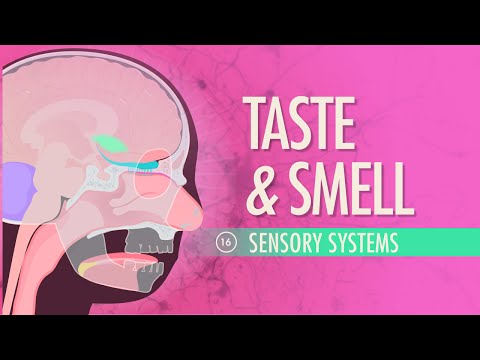 Photo: N43 and Hermes
Smell is a direct chemical sense: odorant molecules bind to hundreds of olfactory receptors in a combinatorial code, triggering a signal cascade that converts molecular shape into neural perception.
Video reference: Taste & Smell: Crash Course Anatomy & Physiology #16 — CrashCourse. Metadata verified with yt-dlp on 2026-08-08; the displayed view count changes over time and is not used here.
01The molecular basis of smell
Smell is the most chemical of the senses. Where vision detects electromagnetic waves and hearing detects pressure waves, olfaction detects molecules. Every scent you perceive, from a rose to coffee to rain on hot pavement, is a specific molecule or mixture of molecules binding to specific receptors in your nasal cavity.
This makes smell a direct chemical probe of the environment. The molecules that reach your nose are small, volatile, and typically hydrophobic, with molecular weights below 300 daltons. They must be airborne to reach the olfactory epithelium, and they must be soluble in the mucus that covers it. The chemistry of smell begins with the chemistry of small molecules in motion.
02How odorant molecules reach receptors
When you inhale, air carries odorant molecules into the nasal cavity, where they contact the olfactory epithelium, a patch of tissue about five square centimeters located at the top of each nostril. This tissue contains roughly ten million olfactory sensory neurons, each equipped with hair-like cilia that project into the mucus layer.
Before an odorant can bind a receptor, it must dissolve in the mucus. This is facilitated by odorant-binding proteins, small carrier molecules that solubilize hydrophobic odorants and transport them through the aqueous mucus to the receptor sites. The mucus also contains enzymes that can metabolize odorants, effectively clearing the signal so the system can detect new smells.
03The olfactory receptor family
Humans have approximately 350 functional olfactory receptor genes, the largest gene family in the genome. Each olfactory sensory neuron expresses exactly one type of receptor, and each receptor can respond to multiple different odorant molecules. This many-to-many relationship is the key to how a limited number of receptors can distinguish a vast number of smells.
The receptors themselves are G-protein-coupled receptors, or GPCRs, the same family that includes receptors for light, hormones, and neurotransmitters. They span the cell membrane seven times, with an extracellular binding pocket where odorant molecules dock. The binding triggers a conformational change that activates an intracellular signaling cascade, converting a chemical binding event into an electrical signal.
04Combinatorial coding of smells
A single odorant molecule typically activates several different receptor types, and a single receptor type responds to multiple odorants. The brain identifies a smell not by the activity of any one receptor but by the combination of receptors that fire. This is combinatorial coding, and it dramatically expands the discriminative capacity of the system.
With 350 receptor types, the theoretical number of distinguishable patterns is enormous. Even if each receptor only distinguished two states, active or inactive, the system could in principle encode 2 to the power of 350 distinct smells. In practice, the number is limited by overlap and noise, but studies show humans can discriminate at least one trillion distinct odorant combinations.
Combinatorial coding of smell — each odorant activates a unique combination of receptors, enabling vast discriminative capacity.
05The signal transduction cascade
When an odorant binds a receptor, the receptor activates a G-protein called Golf, which in turn activates an enzyme called adenylate cyclase. This enzyme produces cyclic AMP, a second messenger that opens ion channels in the cell membrane. Sodium and calcium ions flow into the cell, depolarizing it and triggering an action potential that travels along the neuron's axon to the brain.
This cascade is an amplifier. A single odorant molecule binding to one receptor can activate multiple G-proteins, each of which produces many cAMP molecules, each of which opens multiple channels. The result is that the signal is amplified at each step, allowing the system to detect odorants at concentrations as low as a few parts per trillion.
Olfactory signal transduction pathway — from odorant binding to neural firing, each step amplifies the signal.
06From nose to brain: the olfactory pathway
Olfactory neurons send their axons through the cribriform plate, a bony structure at the base of the skull, to the olfactory bulb. Here, neurons expressing the same receptor type converge onto structures called glomeruli, creating a spatial map of receptor activation. This map is the first representation of smell in the brain.
Unlike other senses, olfaction bypasses the thalamus, the brain's sensory relay station, and projects directly to the olfactory cortex, the amygdala, and the hippocampus. This direct connection explains why smells can trigger vivid emotional memories so powerfully. The olfactory pathway is wired for association, not just identification.
07Why smell is the most chemical of senses
Vision tells us about light, hearing about vibration, touch about pressure. But smell tells us about chemistry. When you smell a flower, you are directly sensing the molecules it emits, molecules that encode information about its species, its ripeness, and its environment. Smell is a real-time chemical sensor, evolved to detect molecular signatures that matter for survival.
This chemical nature means that smell is intimately connected to molecular structure. Enantiomers, molecules that are mirror images of each other, can smell completely different: one form of carvone smells like spearmint, the other like caraway. Small changes in molecular shape, size, or functional group can transform a pleasant fragrance into a noxious odor. The chemistry of smell is, ultimately, the chemistry of molecular recognition.
By N43 and Hermes for Sailor Bob News.


