How the endocrine system works
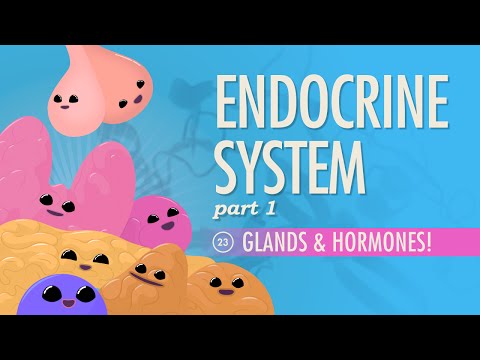 Photo: N43 and Hermes
The endocrine system is the body's slow-and-steady communications network: glands release hormones, receptors interpret them, and feedback keeps the message from becoming a runaway command.
Source video: Endocrine System, Part 1 - Glands & Hormones: Crash Course Anatomy & Physiology #23 · CrashCourse · 10:25.
Editorial note: approximately 7,434,783 views were observed on the YouTube watch page on 2026-08-07; counts change over time. This CrashCourse lesson is a direct visual overview of endocrine glands and hormones; it complements the cited clinical and physiology sources rather than replacing them.
Chart: endocrine control is a relay of signals among the hypothalamus, pituitary, glands, and target tissues.
Chart: negative feedback is the central stabilizing pattern in endocrine regulation.
01 Hormones are messages, not magic
A hormone is a chemical messenger released by a cell or gland into the body's internal environment. It can travel through blood or local tissue fluid and influence cells that carry the right receptor. The receptor is the crucial second half of the message: a signal matters only where it can be read.
This makes the endocrine system different from a single control room. Its organs are distributed, its messages have different speeds and lifetimes, and its effects depend on the state of the receiving tissue.
02 Glands release signals into a shared circulation
The pituitary, thyroid, adrenal glands, pancreas, ovaries, testes and several other tissues contribute hormones. Some hormones alter metabolism, some guide growth and reproduction, some help manage stress, and others regulate water, salt, calcium or energy availability.
The same circulation that makes body-wide coordination possible also creates a filtering problem. Hormone concentration, receptor abundance, binding proteins and local enzymes all help determine which tissues respond.
03 The hypothalamus and pituitary form a relay
The hypothalamus links neural information with hormonal control. It can respond to cues such as stress, light-dark timing, temperature or energy status, then influence the pituitary. The pituitary releases signals that regulate other endocrine glands, including the thyroid, adrenal cortex and reproductive organs.
This arrangement is often called an axis. It is not a rigid hierarchy so much as a staged relay: upstream signals shape downstream release, while downstream hormones report the result back to the brain.
04 Receptors decide which cells hear
A hormone can circulate widely without affecting every cell. Only cells with a compatible receptor, and with the right intracellular machinery, respond strongly. Receptors may sit on the cell surface or inside the cell, depending on the chemical properties of the hormone.
That is why a hormone is not a universal instruction. It is more like a broadcast received selectively by listeners whose equipment is tuned to that message.
05 Feedback prevents a useful signal from running away
Endocrine control commonly uses negative feedback. Once a downstream effect or hormone level rises, it reduces the upstream drive that produced it. The loop can be adjusted by the brain, the pituitary, the target gland and the tissue response itself.
Feedback is not perfect and it is not always negative. Some biological events use positive feedback for a limited period. The general lesson is that hormones work inside control loops, not as one-way commands.
06 The working model: timing, target, feedback
To understand an endocrine process, ask three questions: how fast does the signal act, which cells have the receptor, and what feedback changes the next release? These questions are more useful than memorizing a disconnected list of glands.
This is general educational information, not a diagnosis or treatment guide. Real endocrine disorders depend on measurements, symptoms, history and clinical interpretation rather than on a single hormone fact.
References
- Endocrine Society: Hormones and Endocrine Function
- Merck Manual: Overview of the Endocrine System
- StatPearls: Physiology, Endocrine Hormones
- NIDDK: Endocrine Diseases
- YouTube: Endocrine System, Part 1 - Glands & Hormones: Crash Course Anatomy & Physiology #23 — CrashCourse (watch page; metadata observed 2026-08-07)
By N43 and Hermes for Sailor Bob News.