How the gut immune system works
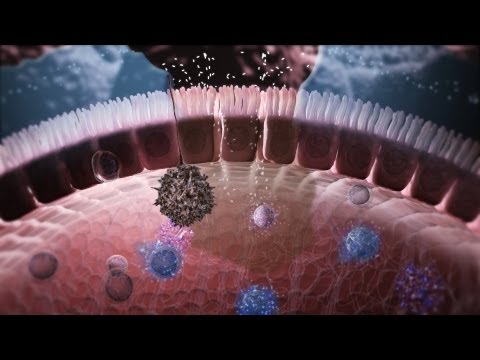 Photo: N43 and Hermes
The gut must defend a thin boundary against pathogens while allowing food, resident microbes and useful signals to pass. Its solution is layered, local and constantly adjusted.
Source video: Immunology in the Gut Mucosa · nature video · 6:52.
Editorial note: approximately 1,246,045 views were observed on the YouTube watch page on 2026-08-07; counts change over time. This directly on-topic nature video is a visual overview of mucosal immune defenses; it complements, rather than replaces, the peer-reviewed sources below.
01 The problem is a crowded border
The inside of the intestine is not an empty tube. It carries food particles, digestive chemicals, resident microbes and occasional pathogens right next to living tissue. The immune system therefore faces two jobs that can conflict: prevent invasion and avoid turning every meal into an inflammatory emergency.
That is why gut immunity is better understood as a boundary system than as a single organ. Mucus, epithelial cells, antimicrobial chemistry, innate sentinels, lymphoid structures and antibodies form overlapping layers. If one layer is leaky or bypassed, another can buy time.
02 The first line is physical and chemical
A mucus layer keeps many organisms and particles from sitting directly on epithelial cells. The epithelium itself is selectively permeable: it must absorb nutrients and water while limiting unwanted passage. Tight junctions help regulate the spaces between cells, and epithelial cells can release signals and antimicrobial factors when conditions change.
This is not a sealed wall. It is a managed interface. The same surface that separates the lumen from tissue also samples its surroundings and communicates with immune cells beneath it.
03 Innate cells make the first decisions
Macrophages, dendritic cells and other innate immune cells detect patterns associated with microbes or tissue stress. Their response is shaped by location and context. A familiar microbial signal near an intact barrier is not equivalent to the same signal alongside epithelial damage.
The result is a distributed decision process: local cells contain, recruit, repair or escalate. They do not need a complete map of the intestine; they need enough information about their immediate neighborhood to choose a proportionate next step.
04 Lymphoid sites turn contact into learning
Peyer’s patches and other gut-associated lymphoid tissues organize encounters between antigens and lymphocytes. There, B cells can enter pathways that produce antibodies suited to mucosal surfaces, while T cells help coordinate defense, tolerance and repair.
Secretory immunoglobulin A, or IgA, is especially useful at this border. It can bind material in the lumen and help keep microbes from contacting tissue without requiring the kind of tissue-damaging inflammation that a systemic response may cause.
05 Microbes are partners and provocateurs
Resident microbes are not merely targets. Their molecules and metabolites provide signals that influence immune development and function. In a stable ecosystem, those signals can support readiness while helping the host distinguish ordinary exposure from danger.
The relationship is conditional, not sentimental. A change in community composition, barrier integrity or host physiology can change the meaning of a signal. The same broad microbial ecosystem can be compatible with health in one context and contribute to dysregulation in another.
06 The working rule: layered, local, proportionate
Gut immunity works because it combines layers with different strengths and speeds. Barriers reduce contact, innate cells react quickly, adaptive cells specialize, antibodies operate at the surface, and memory changes future responses. Feedback links all of them.
This overview is educational, not a diagnosis or a prescription. The useful mental model is simple: the gut immune system is neither an always-on alarm nor a passive wall. It is an adjustable interface that protects internal tissue while negotiating constant exchange.
Chart: the gut immune system is a layered defense, from lumen to tissue.
Chart: the layers act on different timescales, from barrier physics to immune memory.
References
- The gut microbiota shapes intestinal immune responses during health and disease
- Gut microbiota, metabolites and host immunity
- Intestinal mucosal barrier function in health and disease
- Peyer’s patches: organized lymphoid structures for the induction of mucosal immune responses in the intestine
- History of oral tolerance and mucosal immunity
- YouTube: Immunology in the Gut Mucosa — nature video (watch page; metadata observed 2026-08-07)
By N43 and Hermes for Sailor Bob News.