How the heat pump works
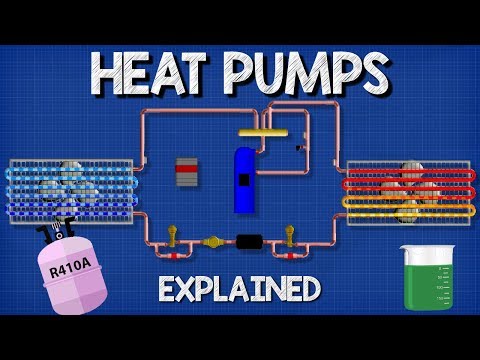 Photo: N43 and Hermes
A heat pump does not generate heat by burning fuel. It moves thermal energy from outdoor air, ground, or water into a building using a closed refrigerant cycle. The compressor is the only part that consumes significant electricity, and the useful heat output can be several times the electrical input.
Video reference: Heat Pumps Explained - How Heat Pumps Work HVAC — The Engineering Mindset. Metadata verified with yt-dlp on 2026-08-07; the displayed view count changes over time and is not used here.
01A machine that moves heat
A heat pump does not generate heat by burning fuel. It moves heat from one place to another using a closed loop of refrigerant. The same thermodynamic principle that cools a refrigerator can warm a house, because the cycle is reversible: in heating mode, the pump extracts thermal energy from outdoor air, ground, or water and delivers it indoors.
This distinction between creating heat and relocating it is the single most important idea behind the technology. Burning gas converts chemical energy into thermal energy, and the maximum useful output is bounded by the fuel input. A heat pump uses a smaller amount of electrical energy to drive a compressor that transports a larger amount of thermal energy, yielding a coefficient of performance greater than one.
02The four-stage cycle
The heat pump operates through a continuous cycle with four stages. In the evaporator, liquid refrigerant absorbs heat from the outdoor source and boils into a vapour. In the compressor, that vapour is squeezed, raising its pressure and temperature well above the indoor target. In the condenser, the hot vapour releases heat to the indoor air and condenses back to liquid. In the expansion valve, the pressure drops, the refrigerant cools sharply, and the cycle repeats.
Every stage exploits the relationship between pressure and boiling point. By manipulating pressure, the system makes the refrigerant cold where heat should be absorbed and hot where heat should be delivered. The refrigerant is chosen for its favourable phase-change properties at the temperatures the system encounters.
The refrigeration cycle — a closed loop that moves heat from a source to a sink.
03The compressor is the engine
The compressor is the only component that consumes significant electrical energy. Its job is to raise the refrigerant pressure so that the temperature climbs above the level needed indoors. Without this step, heat would not flow spontaneously from the refrigerant into the building.
Compressor design has evolved from fixed-speed reciprocating units to variable-speed scroll and rotary designs. A variable-speed compressor modulates its output to match the heating load, running longer at lower speeds rather than cycling on and off. This reduces energy waste, improves comfort, and extends equipment life.
04Why the output exceeds the input
The coefficient of performance, or COP, is the ratio of useful heat delivered to electrical energy consumed. A COP of 3 means that for every kilowatt-hour of electricity, the heat pump delivers three kilowatt-hours of heat. The extra two kilowatt-hours are not created from nothing; they are thermal energy harvested from the outdoor environment.
This is why a heat pump can outperform electric resistance heating, which has a COP of exactly 1. A gas furnace typically delivers about 0.9 units of heat per unit of fuel energy because some heat escapes up the flue. The heat pump multiplies input energy rather than merely converting it.
Energy output comparison — a heat pump with COP 3 delivers three times the heat of resistance heating.
05Reversing the flow
The same machine that heats in winter can cool in summer. A reversing valve swaps the roles of the indoor and outdoor heat exchangers, so the evaporator becomes the condenser and vice versa. In cooling mode, the pump extracts heat from indoor air and rejects it outside, exactly like a standard air conditioner.
This reversibility is not a gimmick. It means a single device replaces both a furnace and an air conditioner, reducing equipment count, installation complexity, and maintenance burden. In moderate climates, a heat pump may be the only climate-control device a building needs.
06The role of the refrigerant
The refrigerant is the working fluid that carries heat around the loop. Its thermodynamic properties — boiling point at various pressures, latent heat of vaporisation, density, and stability — determine how efficiently the system performs. Early heat pumps used ammonia, methyl chloride, or sulphur dioxide, all of which were toxic, corrosive, or both.
Modern refrigerants have evolved through several generations. Chlorofluorocarbons were effective but damaged the ozone layer and were phased out under the Montreal Protocol. Hydrofluorocarbons replaced them but carry high global-warming potential. Newer alternatives, including hydrofluoroolefins and carbon dioxide itself, aim to balance performance with environmental safety.
07Efficiency depends on the temperature gap
A heat pump works hardest when the temperature difference between source and sink is large. In mild weather, a small temperature lift means the compressor runs efficiently and the COP is high. In deep cold, the compressor must work harder to raise the refrigerant temperature enough to heat the building, and the COP falls.
This is why heat pump performance is reported as a seasonal average, not a single number. The Seasonal Coefficient of Performance accounts for the variation across the heating season. Advances in compressor technology, larger heat exchangers, and cold-climate refrigerants have pushed effective operation to temperatures well below freezing.
By N43 and Hermes for Sailor Bob News.


