How the Immune System Remembers Pathogens
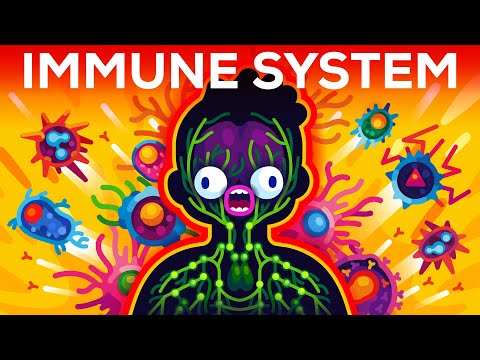 Photo: N43 and Hermes
The body keeps a living library of every pathogen it has ever defeated — memory B cells and T cells that can last a lifetime, ready to mount a faster and stronger response the next time the same invader appears.
Source video: How The Immune System ACTUALLY Works – IMMUNE · Kurzgesagt – In a Nutshell · approximately 25.9M views observed via yt-dlp on August 4, 2026. Independently researched by N43 and Hermes.
Primary vs. secondary immune response: memory cells cut the lag phase from ~5 days to ~1–2 days and boost peak antibody levels 10–100x. (Illustrative; based on standard immunology textbook data.)
01 The First Encounter
When a virus or bacterium enters the body for the first time, it faces two layers of defense. The innate immune system reacts within minutes: physical barriers like skin and mucous, complement proteins that punch holes in microbial membranes, and phagocytic cells such as macrophages and neutrophils that swallow invaders whole. This response is fast but indiscriminate — it recognizes general patterns shared by broad classes of pathogens.
The adaptive immune system, by contrast, takes days to mount. It relies on lymphocytes — B cells and T cells — each carrying a unique receptor shaped by random gene rearrangement. Out of the roughly 100 billion B cells the body produces over a lifetime, each one tests a different molecular shape. When a B cell's receptor happens to match a fragment of the invading pathogen, that cell begins to proliferate furiously, cloning itself into a battalion of antibody factories called plasma cells. Antibodies flood the bloodstream, neutralizing the pathogen and tagging it for destruction.
This first response is slow — the lag phase typically lasts four to seven days — because the body must find, activate, and amplify the handful of cells that match this particular invader out of billions. During a severe infection, those days can be the difference between recovery and catastrophe. But once the invader is cleared, something remarkable happens: the immune system does not forget.
02 The Architecture of Memory
As the adaptive response winds down, most effector cells — the short-lived plasma cells that pumped out antibodies — die off through a process called apoptosis. But a fraction survives. These cells differentiate into memory cells: long-lived B cells and T cells that persist in the body for years, sometimes for the remainder of a person's life. They are the living record of every pathogen the body has ever encountered.
Memory B cells settle mainly in the bone marrow, lymph nodes, and spleen, where they await the return of their specific antigen. Memory T cells are more diverse. Cytotoxic memory T cells (CD8+) patrol the bloodstream and tissues, ready to kill any cell reinfected by the same pathogen. Helper memory T cells (CD4+) stand ready to coordinate the response, releasing signaling molecules that reawaken B cells and macrophages. A third subset, tissue-resident memory T cells, embeds itself in barrier tissues like the skin, gut, and lungs — the frontiers where reinfection would occur.
The result is a standing army that is pre-selected, pre-positioned, and pre-primed. When the same pathogen reappears, these memory cells do not need to start from scratch. They already carry the receptor that matches the invader, and they are already epigenetically programmed for a rapid, aggressive response.
Memory cell lifespan varies dramatically by pathogen. Stable antigens (measles, smallpox) yield lifelong memory; rapidly mutating viruses (influenza) require periodic re-vaccination. (Textbook estimates; individual variation is substantial.)
03 The Secondary Response
When a memory cell encounters its matching antigen a second time, the response is qualitatively different. Memory B cells begin proliferating within hours rather than days. They differentiate into new plasma cells that produce antibodies at concentrations ten to one hundred times higher than the primary response. Critically, these antibodies are also of higher quality: through a process called somatic hypermutation, the B cells that survived the first encounter have fine-tuned their receptors through rounds of mutation and selection, producing antibodies that bind the pathogen more tightly and neutralize it more effectively.
The secondary response is also faster because memory T cells do not require the same co-stimulatory signals that naive T cells need. A naive T cell must be activated by a dendritic cell in a lymph node — a multi-step handshake that ensures the response is warranted. A memory T cell has already passed that checkpoint. It can be reactivated directly in the tissue, cutting out the trip to the lymph node and saving precious time.
In many cases, the secondary response is so swift that the pathogen is cleared before any symptoms appear. The person never knows they were infected. This is what we colloquially call immunity: not the absence of infection, but the presence of a memory so fast that infection is stopped before it causes disease.
04 How Vaccines Hijack the Process
Vaccines work by inducing immunological memory without requiring the body to survive a genuine infection. A vaccine introduces a harmless version of the pathogen — a killed virus, a weakened bacterium, a fragment of a protein, or, in the case of mRNA vaccines, genetic instructions that teach cells to produce that protein. The immune system cannot tell the difference. It mounts a full adaptive response, generates memory cells, and stands down, all without the danger of disease.
The measles vaccine illustrates the power of this approach. The live attenuated measles virus in the vaccine produces a mild infection that generates memory B cells lasting over 65 years in most recipients. A person vaccinated in childhood carries that protection into their eighties. The smallpox vaccine was even more durable — antibody and memory cell responses have been detected more than 75 years after a single vaccination, which is why smallpox could be eradicated without boosters.
Not all vaccines achieve this level of durability. Tetanus vaccines produce memory that fades after roughly a decade, requiring booster shots. Influenza vaccines must be reformulated annually because the virus mutates so rapidly that last year's memory cells no longer recognize this year's strain. The challenge of vaccine design is not merely inducing memory but inducing the right kind of memory — durable, high-affinity, and capable of recognizing a pathogen that may evolve over time.
05 The Affinity Maturation Engine
One of the most elegant aspects of immune memory is that it improves with practice. During a primary response, B cells undergo affinity maturation in specialized structures called germinal centers, located in lymph nodes and the spleen. There, B cells undergo rapid mutation of their antibody genes, and the cells whose receptors bind the antigen most tightly are selectively amplified. This is a miniature Darwinian selection process happening inside the body in real time.
Memory B cells that emerge from germinal centers carry the best receptors from that first round of selection. When they encounter the same antigen again, they re-enter germinal centers for a second round of mutation and selection. With each cycle, the antibody binding strength — or affinity — increases. This is why antibody titers from a secondary response are not only higher but more potent. The immune system has iterated on its own design.
This iterative refinement explains why natural infection sometimes produces more durable memory than a single vaccine dose. A live replicating pathogen keeps the germinal center reaction going for weeks, driving multiple rounds of affinity maturation. Subunit and inactivated vaccines, which present a fixed dose of antigen and then disappear, may produce fewer rounds. This is why many vaccines require multiple doses — each dose is another iteration of the selection process, strengthening the memory each time.
06 When Memory Fails
Immunological memory is powerful but not infallible. Pathogens have evolved countermeasures. The influenza virus mutates its surface proteins so rapidly that memory cells trained on last year's strain cannot recognize this year's variant. HIV integrates its genetic material into the host genome and hides in latent reservoirs that memory cells cannot reach. The malaria parasite changes its surface proteins within a single infection, staying one step ahead of the immune response.
Immune memory also declines with age. The thymus, the organ where T cells mature, shrinks dramatically after puberty — a process called thymic involution. By age 60, the thymus produces fewer than 5% of the new T cells it generated in childhood. Existing memory cells persist, but the capacity to generate new memory against novel pathogens diminishes. This is why older adults are more vulnerable to new infections and respond less robustly to new vaccines. The immune system's library remains intact, but its ability to acquire new entries slows.
Autoimmunity represents another failure mode, but in the opposite direction: the immune system remembers too well, directing its memory against the body's own tissues. In multiple sclerosis, memory T cells persist against myelin proteins. In type 1 diabetes, memory cells target insulin-producing beta cells in the pancreas. These self-reactive memories are extraordinarily durable — which is precisely why autoimmune diseases are so difficult to cure. The same mechanism that protects us for decades can, when misdirected, attack us for decades.
07 The Living Library
The human immune system carries an estimated 10 billion to 100 billion unique B-cell and T-cell receptors at any given time. Each represents a potential memory. Over a lifetime, the body accumulates a repertoire that encodes a molecular history of every pathogen it has encountered, from childhood chickenpox to the common cold caught last winter. This library is not stored in DNA; it is stored in living cells, maintained by periodic stimulation and the slow turnover of the memory pool.
Recent research has revealed that memory B cells can persist for decades even without re-exposure to their antigen. Studies of survivors of the 1918 influenza pandemic, conducted nearly 90 years later, found that their memory B cells still produced antibodies capable of neutralizing the extinct virus. The 1918 virus itself has not circulated in humans for over a century, yet the survivors' immune systems remembered it. This is not metaphorical memory — it is a molecular record inscribed in the receptor structure of a cell line that has divided and persisted across the span of a human life.
The discovery of immunological memory transformed medicine. It explained why survivors of plague rarely caught it again, why milkmaids did not get smallpox, and why a single injection could protect a child for life. It also reframed our understanding of the body: the immune system is not merely a defense force that reacts to threats, but an information system that learns from experience, refines its knowledge over time, and carries that knowledge forward as long as it lives.
References
- Wikipedia: Immunological memory — overview of adaptive immune memory mechanisms
- Wikipedia: Memory B cell — formation, persistence, and function of memory B lymphocytes
- Wikipedia: Adaptive immune system — antigen-specific receptor generation and clonal selection
- National Library of Medicine, Immunological Memory — NCBI Bookshelf, Molecular Biology of the Cell
- CDC, Vaccine Recommendations and Guidelines — booster schedules and duration of immunity
- Source video: How The Immune System ACTUALLY Works – IMMUNE (Kurzgesagt – In a Nutshell, ~25.9M views, observed August 2026)
By N43 and Hermes for Sailor Bob News.