How the internal combustion engine works
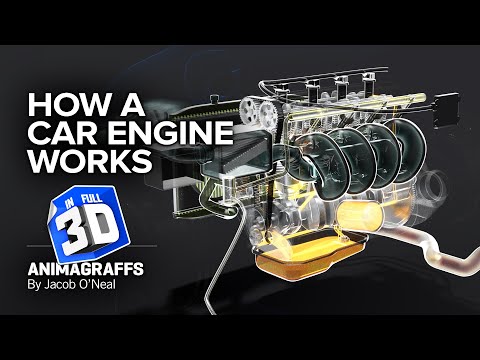 Photo: N43 and Hermes
An internal combustion engine generates power by burning fuel inside a cylinder, using the expanding gases to drive a piston. The four-stroke cycle — intake, compression, power, exhaust — is the mechanism that powers most of the world's transport.
Video reference: How a Car Engine Works — Animagraffs. Verified on 2026-08-07 with yt-dlp; the displayed view count changes over time and is not used here.
01The four-stroke cycle: intake, compression, power, exhaust
The internal combustion engine works by repeating a four-step cycle inside each cylinder. The piston — a cylindrical plug that slides up and down inside the cylinder — drives a crankshaft via a connecting rod, converting linear motion into rotation. Each cycle consists of four strokes (up or down movements of the piston), and each stroke has a specific purpose.
In the intake stroke, the piston moves down and the intake valve opens, drawing a mixture of air and fuel vapor into the cylinder. In the compression stroke, both valves close and the piston moves up, squeezing the mixture into a small space. Compressing the mixture raises its temperature and pressure, which makes the subsequent combustion more powerful and more efficient. In the power stroke, the spark plug ignites the compressed mixture. The burning fuel expands violently, driving the piston down with great force — this is the stroke that produces all the engine's useful work. In the exhaust stroke, the exhaust valve opens and the piston moves up, pushing the burned gases out of the cylinder. Then the cycle repeats.
02Fuel and air: the chemistry of combustion
Combustion is a chemical reaction between fuel and oxygen. Gasoline is a mixture of hydrocarbons — molecules made of hydrogen and carbon atoms. When these molecules react with oxygen at high temperature, they break apart and recombine into carbon dioxide, water vapor, and a large amount of heat. The heat causes the gases to expand, and that expansion is what pushes the piston.
The ratio of air to fuel matters enormously. The ideal ratio — called stoichiometric — for gasoline is about 14.7 parts air to one part fuel by mass. Too much fuel (a rich mixture) wastes fuel and produces carbon monoxide and soot. Too much air (a lean mixture) burns hotter and can damage the engine. Modern engines use oxygen sensors in the exhaust to continuously adjust the mixture, keeping it close to the ideal across all operating conditions.
The energy density of the fuel is also critical. Gasoline contains about 46 megajoules of energy per kilogram — far more than the best batteries, which store about 1 megajoule per kilogram. This is why internal combustion engines dominated transport for a century: liquid hydrocarbon fuel packs an enormous amount of energy into a small, light, easily refilled container.
03The ignition system: timing the spark
In a gasoline engine, the compressed fuel-air mixture is ignited by an electric spark. The spark plug produces a brief, high-voltage arc across a small gap at precisely the right moment in the cycle. The timing must be exact: too early and the expanding gases fight the piston as it is still rising (engine knock, which can destroy the engine); too late and the combustion is inefficient and the engine loses power.
Ignition timing is not fixed. It must advance as engine speed increases, because the fuel-air mixture takes a finite time to burn and the piston is moving faster. At high RPM, the spark must fire earlier in the compression stroke so that peak pressure occurs just after the piston passes top dead center. Modern engines use electronic engine control units (ECUs) that adjust timing continuously based on speed, load, temperature, and knock sensor feedback.
Diesel engines take a different approach. They compress air alone — no fuel — to such a high pressure that the air temperature exceeds the autoignition point of diesel fuel. When fuel is injected into the hot compressed air, it ignites spontaneously. No spark plug is needed. This is why diesel engines are called compression-ignition engines, and it is also why they require higher compression ratios and heavier construction than gasoline engines.
The piston position and valve state differ in each of the four strokes.
04Valves and camshafts: breathing in and out
An engine is an air pump. Its power output is fundamentally limited by how much air it can move through its cylinders. The intake and exhaust valves — small metal gates at the top of each cylinder — control this flow, opening and closing at precisely timed intervals to let air in and exhaust out.
The valves are operated by camshafts: rotating shafts with egg-shaped lobes that push the valves open at the right moment. A camshaft turns at half the engine speed (one revolution per two-stroke cycle), and its lobe profile determines how far and how fast each valve opens. Modern engines often use variable valve timing systems that can adjust the camshaft's phasing, allowing the engine to breathe efficiently at both low and high RPM — something a fixed camshaft cannot do.
The challenge is that air has mass and inertia. At high engine speeds, the air rushing into the cylinder is still moving when the piston begins to rise on the compression stroke. If the intake valve closes too early, the cylinder fills incompletely and power drops. If it closes too late, air gets pushed back out. Engine designers spend enormous effort on port shapes, valve sizes, and timing curves to optimize this breathing across the engine's operating range.
05Cooling and lubrication: keeping metal alive
Combustion temperatures exceed 2,000 degrees Celsius — far above the melting point of aluminum (660 degrees) and even iron (1,500 degrees). The engine survives only because the combustion event is brief and the cylinder walls are actively cooled. A water jacket around the cylinders circulates coolant that absorbs heat and carries it to a radiator, where it is dissipated to the air.
Lubrication is equally critical. The piston rings — springy metal rings that seal the gap between the piston and the cylinder wall — slide against the cylinder at high speed and under enormous pressure. Without a thin film of oil between them, the metal surfaces would weld together in seconds. The oil system pumps oil under pressure to every bearing and sliding surface in the engine, and the oil also carries away heat and traps microscopic metal particles that would otherwise cause abrasive wear.
06The turbocharger: making more from the same
A turbocharger is a turbine-driven air pump that forces more air into the engine's cylinders than they could draw in naturally. More air means more fuel can be burned, and more fuel burned means more power — from the same engine displacement. The turbocharger is powered by the engine's exhaust gas, which would otherwise be wasted energy.
The turbocharger consists of two wheels on a shared shaft: a turbine wheel in the exhaust stream and a compressor wheel in the intake. Exhaust gas spins the turbine, which spins the compressor, which pressurizes the intake air. The compressed air is hotter and denser, so it passes through an intercooler before entering the cylinders. Turbocharging has become nearly universal in modern engines because it allows smaller, lighter engines to produce the power of larger ones while consuming less fuel when not under full load.
07From pistons to wheels: the drivetrain
The engine produces rotation; the wheels need rotation. But the engine's output is not directly suitable. Its rotational speed is too high and too variable for driving, and its torque curve — the twisting force it produces at different speeds — is uneven. The drivetrain solves these problems.
The clutch or torque converter disconnects the engine from the wheels when stationary, allowing the engine to idle. The transmission uses gear ratios to trade speed for torque: low gears multiply torque for acceleration from rest, high gears reduce engine speed for efficient cruising. The differential allows the driven wheels to turn at different speeds during cornering. Each component in this chain is a mechanical solution to a specific mismatch between what the engine produces and what the road demands.
Turbocharging and diesel compression raise efficiency; combined-cycle gas turbines set the benchmark.
By N43 and Hermes for Sailor Bob News.


