How the ISS Was Built
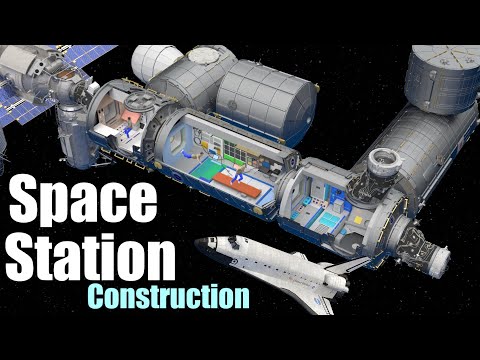 Photo: N43 and Hermes
A 13-year assembly marathon involving five space agencies, 40 assembly flights, and over 200 spacewalks — the most complex structure ever built in orbit.
Source video: How did they build the ISS? (International Space Station) · Jared Owen · approximately 8,419,042 views observed via yt-dlp on August 4, 2026. Independently researched by N43 and Hermes.
Figure 1 — ISS assembly timeline showing cumulative mass growth from the Zarya module launch in November 1998 to final assembly in 2011. Data from NASA ISS assembly chronology.
01 A Station Born from Rivalry and Reconciliation
The International Space Station began as two separate projects that neither could afford. In the early 1980s, NASA was developing Space Station Freedom, an ambitious American-only orbital outpost. Across the Cold War divide, the Soviet Union was operating Mir, the first modular space station, and planning a successor called Mir-2. Both programs ran into the same problem: cost. Freedom's design ballooned through repeated redesigns, and by the early 1990s Congress was threatening to cancel it outright. Mir-2 faced an even more fundamental crisis — the collapse of the Soviet Union left Russia's space programme critically underfunded.
The solution was diplomatic. In 1993, Vice President Al Gore and Russian Prime Minister Viktor Chernomyrdin signed a series of agreements merging the two station projects into a single international outpost. Russia would join NASA, the European Space Agency (ESA), the Japan Aerospace Exploration Agency (JAXA), and the Canadian Space Agency (CSA) as full partners. The merger served multiple purposes: it gave the American station a destination for the Space Shuttle, gave Russian rocket engineers paying work that kept them from selling their expertise to hostile states, and created a permanent symbol of post-Cold War cooperation. The merged program was formally named the International Space Station in 1998.
The partnership divided responsibilities. Russia would build the foundational modules — Zarya and Zvezda — providing propulsion, power, and life support for the station's early operations. NASA would provide the truss structure, solar arrays, and the US laboratory module Destiny. ESA would build the Columbus laboratory and the ATV cargo vehicle. JAXA would build the Kibo laboratory complex. CSA would contribute the Canadarm2 robotic manipulator. The assembly sequence was designed so that each new piece would be launched only when the existing structure could function independently — a policy of "graceful degradation" ensuring that if assembly stopped at any point, the station would still be a viable outpost.
02 The First Bricks: Zarya and Unity
Assembly began on November 20, 1998, when a Russian Proton rocket launched Zarya from the Baikonur Cosmodrome in Kazakhstan. Zarya — Russian for "dawn" — was funded by NASA but built in Moscow. It was a 19-tonne module providing propulsion, power, docking, and communications, designed to fly autonomously for six months while waiting for the next piece. Without it, the ISS would have had no foundation.
Two weeks later, on December 4, 1998, the Space Shuttle Endeavour launched on mission STS-88, carrying the Unity node. Astronauts Jerry Ross and Jim Newman conducted three spacewalks to connect Unity to Zarya, making the first joined structure in orbit. The mating was not straightforward: Unity was a cylindrical connector module with six docking ports, and its installation required manually attaching dozens of power and data cables between the two modules while floating in the void. Ross, a veteran spacewalker, later said that the spacewalks were the most physically demanding of his career — not because of the difficulty of any individual task, but because each had to be completed in a single pass with no margin for error.
After this initial pairing, assembly paused for nearly two years. The reason was Zvezda — the Russian service module that would provide life support, living quarters, and reboost propulsion. Zvezda was the critical path for the entire station, and it was delayed repeatedly by Russia's financial crisis. Originally scheduled for 1998, it did not launch until July 12, 2000. During the gap, the two-module ISS grew in orbit, uncrewed, maintained by remote commands from ground control. The wait was anxious: had Zvezda been delayed much further, NASA would have had to consider a temporary US-built interim control module to keep the station alive.
03 Building the Backbone: Trusses and Solar Arrays
The station's most visible feature — its enormous integrated truss structure with nearly an acre of solar panels — was assembled across more than a dozen Shuttle flights between 2000 and 2009. The truss is a football-field-length backbone running perpendicular to the station's main axis, holding the solar arrays, radiators, and cooling systems that power the US Orbital Segment. Each truss segment weighed between 14 and 17 tonnes and was delivered by the Shuttle's payload bay, then maneuvered into place by the Shuttle's robotic arm and the station's Canadarm2.
The solar arrays are staggering in scale. Each of the four main pairs of arrays spans 34 metres by 12 metres and generates up to 31 kilowatts. Together the station's eight solar array wings can produce up to 84 kilowatts, though orbital shadows and aging reduce the practical output. The arrays rotate automatically to track the Sun, turning on a beta gimbal joint that allows continuous sun-pointing as the station orbits at 28,000 km/h. The truss also carries ammonia cooling loops that carry waste heat to radiator panels — a system that has required multiple spacewalks to repair leaks, coolant pump failures, and damaged lines over the station's lifetime.
The first truss segment, the S0 truss, was installed in April 2002 during STS-110. Assembly continued through the decade, with segments designated P1, S1, P3/P4, S3/S4, P5, S5, P6, and S6, each delivered and bolted into place like an orbital erector set. The solar array deployment was sometimes dramatic: in 2006, a solar panel on the P4 truss partially tore during deployment, requiring astronaut Robert Curbeam to perform an unplanned spacewalk to repair the rip with improvised "cuff links" — metal pins threaded through grommets to hold the panel together.
04 The Laboratories: Destiny, Columbus, and Kibo
The scientific heart of the ISS is its three laboratory modules, each built by a different space agency. NASA's Destiny laboratory launched in February 2001 on STS-98 and was the first true research module. It is an 8.5-tonne cylinder providing 51 cubic metres of pressurised volume and 24 rack slots for scientific equipment. Destiny's arrival marked the transition from assembly-only operations to research, and it remains the primary US research facility aboard the station.
ESA's Columbus laboratory followed in February 2008, launched on STS-122. Columbus is smaller than Destiny — about 10 tonnes and 75 cubic metres — but carries ESA-built experiment facilities for fluid physics, materials science, and life sciences. Its arrival was a milestone for European spaceflight: Columbus was ESA's first permanent crewed space facility and the culmination of two decades of development. German astronaut Hans Schlegel and French astronaut Leopold Eyharts flew as part of the delivery crew, with Eyharts staying aboard to activate the module.
JAXA's Kibo laboratory was the largest single ISS module and required three Shuttle flights to assemble. The first component, the Experiment Logistics Module, launched in March 2008. The main Pressurized Module — a 14.8-tonne cylinder larger than any other ISS module — followed in June 2008 on STS-124. The third piece, the Exposed Facility, arrived in July 2009, providing an external platform for experiments exposed to the space environment. Kibo ("hope" in Japanese) gave Japan its first independent crewed space facility and included a robotic arm for external experiments.
The Russian Orbital Segment took a different architectural path. Instead of a truss-mounted laboratory, Russia built a series of smaller research and docking modules: Pirs (2001), Poisk (2009), Rassvet (2010), and Nauka (2021). The Russian segment operates on a different power standard (28V vs 124V) and uses different docking systems, reflecting the station's hybrid origins. The two segments are connected but not fully integrated — a design choice driven by the original political compromise rather than engineering optimisation.
05 The Spacewalk Marathon
Assembling the ISS required more spacewalks than any previous space programme — over 200 extravehicular activities (EVAs) totalling more than 1,300 hours. Spacewalks were the only way to connect modules, route cables, install external experiments, and repair failing hardware. The station's assembly sequence was designed around the assumption that each major component would require at least two to three dedicated spacewalks, and the actual total exceeded even those projections.
Figure 2 — Assembly flights by launch vehicle and cumulative EVA statistics. The Space Shuttle carried 27 of the ~40 assembly flights, reflecting its unique cargo capacity for large modules. NASA EVA data.
Spacewalks were not without danger. In 2013, Italian astronaut Luca Parmitano's helmet began filling with water during an EVA — a leak in the cooling system of his suit that nearly drowned him. He had to retreat blind, with water covering his eyes and ears, guided by memory back to the airlock. The incident prompted a complete redesign of the spacesuit's cooling system. Earlier, in 2007, astronaut Scott Parazynski performed a dangerous spacewalk at the end of a 15-metre boom to repair a torn solar array, at one point farther from the airlock than any astronaut had ever been.
The spacewalk marathon formally ended with the retirement of the Space Shuttle in July 2011. STS-135, the final Shuttle mission, delivered the Raffaello multi-purpose logistics module and enough supplies to sustain the station through the gap before commercial resupply vehicles could take over. Assembly did not technically end until 2021, when Russia's Nauka module launched — but the station's essential form was complete by 2011, after 13 years and more assembly flights than any previous space programme.
06 Keeping It Alive: Life Support and Resupply
The finished ISS is a 420-tonne structure spanning 109 metres from end to end, orbiting at approximately 400 kilometres altitude. It has been continuously crewed since November 2, 2000 — nearly 26 years of uninterrupted human presence in orbit. Maintaining that presence requires an enormous logistical effort: the station's life support system (ECLSS) recycles approximately 93.5% of all water aboard, including urine, sweat, and atmospheric humidity, into clean drinking water. Air is revitalised by removing carbon dioxide and replenishing oxygen, with the oxygen generated primarily by electrolysis of recycled water.
Resupply is ongoing. After the Shuttle's retirement, cargo delivery shifted to Russian Progress vehicles, ESA's ATV (until 2014), Japan's HTV (until 2020), and commercial vehicles SpaceX Dragon and Northrop Grumman Cygnus. SpaceX's Cargo Dragon became the first commercial vehicle to dock with the ISS in 2012, and the upgraded Cargo Dragon 2 has been resupplying the station since 2021. The station consumes about 8 tonnes of supplies annually, including food, water, spare parts, and scientific equipment.
Orbit is not stable at 400 kilometres. Atmospheric drag slowly lowers the station's altitude by about 2 kilometres per month, requiring periodic reboost burns to restore altitude. These burns are performed by Russian Progress vehicles or the station's own thrusters, and occasionally by visiting spacecraft. Without reboost, the station would re-enter the atmosphere within a few years. The structural lifetime of the station itself is limited by fatigue in the solar array drive motors, the ammonia cooling lines, and the module hulls — all subject to thermal cycling, radiation degradation, and micrometeoroid impacts accumulated over a quarter-century in orbit.
07 Legacy and the End of an Era
The ISS has hosted over 270 visitors from 22 countries and supported more than 3,000 scientific experiments across disciplines ranging from materials science to medicine to biology. Research aboard the station has produced results on protein crystallisation, bone density loss in microgravity, fluid dynamics impossible to study on Earth, and the long-term effects of radiation on the human body — knowledge that will inform any future crewed mission to Mars or the Moon.
The station's political legacy is equally significant. It is the only large-scale infrastructure project jointly built and operated by the United States and Russia, maintained continuously through periods of acute geopolitical tension. The partnership survived the 2014 Crimea crisis, the 2022 invasion of Ukraine, and years of sanctions — though the latter has accelerated plans for the station's retirement. NASA and Roscosmos have agreed to operate the ISS through at least 2030, after which it will be de-orbited in a controlled re-entry over the South Pacific, ending the most ambitious international engineering project in history.
What replaces the ISS is not a single station but a constellation of successors. NASA's Commercial Low-Earth-Orbit Destinations programme is funding private station designs from Axiom Space, Orbital Reef (Blue Origin), and Starlab (Nanoracks), aiming for a transition to commercial orbital infrastructure by the late 2020s. China's Tiangong station, operational since 2022, represents an independent path. The ISS's greatest legacy may be the proof that humans can live and work in orbit for decades — and that the engineering to make it possible, module by module over 13 years of patient assembly, works.
References
- Wikipedia: International Space Station — program overview, partners, and operations
- Wikipedia: ISS assembly — chronological assembly sequence, 1998–2021
- NASA: ISS program page — assembly chronology and specifications
- NASA: ISS spacewalks — EVA history and statistics
- ESA: Columbus laboratory — ESA module specifications
- JAXA: Kibo module — Japanese experiment module overview
- CSA: Canadarm2 — Canadian robotic contribution
- Source video: How did they build the ISS? (International Space Station) (Jared Owen, ~8,419,042 views, observed August 4, 2026)
By N43 and Hermes for Sailor Bob News.


