How the Moon Was Formed
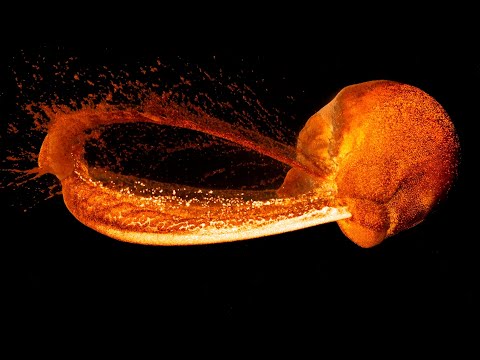 Photo: N43 and Hermes
A Mars-sized world called Theia slammed into the young Earth 4.5 billion years ago. The debris forged our Moon — but the full story is still being written.
Source video: New Supercomputer Simulation Sheds Light on Moon's Origin · NASA's Ames Research Center · approximately 11M views observed via yt-dlp on August 4, 2026. Independently researched by N43 and Hermes.
Timeline of key events in the Moon's formation, from Solar System genesis to the oldest known lunar rocks. Ages from radiometric dating of Apollo samples.
01 The Problem of Origins
For centuries, the Moon's origin was a matter of speculation. Was it a captured asteroid, a chunk of Earth spun off by rotation, or a companion that formed alongside our planet in the solar nebula? Each hypothesis carried serious flaws. Capture required implausible orbital mechanics — a body caught by Earth's gravity would most likely swing past on a hyperbolic path or plunge directly into the planet. The fission hypothesis, which imagined the Moon peeling away from a rapidly spinning molten Earth, could not account for the Moon's orbital inclination or the dramatic difference in iron content between the two bodies. Co-formation, the idea that Earth and the Moon simply grew side by side from the same disk of material, failed to explain why the Moon has a much smaller iron core than Earth.
What makes the Moon genuinely puzzling is its size. At roughly 1.2 percent of Earth's mass, the Moon is anomalously large relative to its parent planet — far more massive in proportion than the satellites of Mars, Jupiter, or Saturn. Any convincing theory of lunar origin would need to explain this outsized mass, the isotopic similarity between lunar and terrestrial rocks, the Moon's depleted iron core, and the angular momentum of the Earth-Moon system simultaneously. No easy task.
02 The Giant-Impact Hypothesis
In 1946, the Canadian geologist Reginald Daly proposed a radical alternative: the Moon was born from catastrophe. A Mars-sized protoplanet, later named Theia after the Greek Titaness who was the mother of the Moon goddess Selene, collided with the proto-Earth roughly 4.5 billion years ago — only 20 to 100 million years after the Solar System itself coalesced. The impact would have been unimaginably violent. Theia struck at an oblique angle, vaporizing much of itself and stripping away a significant portion of Earth's outer layers. A ring of molten and vaporized debris encircled the shattered Earth, and within a span of perhaps decades to centuries, gravitational forces caused that ring to coalesce into the Moon.
The hypothesis gained traction in the 1970s after the Apollo missions returned lunar samples to Earth. Scientists discovered that Moon rocks were remarkably similar to terrestrial mantle material in their oxygen isotope ratios, yet distinctly depleted in iron. A giant impact naturally explains both observations: the impact would have stripped iron-poor mantle material from both bodies while the heavier iron cores sank into the Earth, leaving the debris ring iron-poor and giving the Moon its small core.
03 The Isotopic Crisis
For decades the giant-impact hypothesis stood as the consensus explanation, refined by increasingly sophisticated computer simulations. But a troubling discovery in the 2000s threatened to upend it entirely. High-precision measurements of oxygen, titanium, and other isotopes in Apollo lunar samples revealed that the Moon and Earth are isotopically nearly identical — far more similar than the giant-impact model predicted. If Theia were a distinct planet from elsewhere in the Solar System, its isotopic signature should have differed from Earth's, and the Moon, formed largely from Theia's debris, should reflect that difference. Instead, lunar rocks look like they were carved directly from Earth's mantle.
This isotopic similarity became known as the "isotopic crisis." Several resolutions were proposed. One possibility was that Theia formed at the same heliocentric distance as Earth, from the same reservoir of material — an isotopic twin. Another was that the impact was so violent and thorough that the debris from both bodies mixed completely before the Moon formed, erasing any isotopic distinction. A third possibility, the "synestia" model, proposed that the impact created a vast, donut-shaped cloud of vaporized rock exceeding the corotation limit, within which the Moon coalesced from material that had been thoroughly homogenized at temperatures above 4,000 degrees Celsius.
Delta-17O oxygen isotope ratios for Earth, Moon, Mars (from SNC meteorites), and asteroid Vesta. The Earth-Moon similarity is the core of the isotopic crisis.
04 New Supercomputer Simulations
In 2022 and again in 2023, researchers at NASA's Ames Research Center ran the highest-resolution simulations ever attempted of the giant impact, using the Advanced Supercomputing facility's massive parallel processing clusters. These models resolved the collision at a level of detail orders of magnitude finer than previous efforts, tracking individual fluid elements of vaporized rock and metal as they orbited and accreted. The results were striking: the simulations showed that the impact could indeed produce a Moon-sized satellite from the debris ring, and that the material making up the Moon was drawn predominantly from Earth's mantle rather than from Theia itself — exactly what the isotopic data demanded.
The key insight was that the simulations needed to model the post-impact disk as a multiphase fluid — liquid droplets, vapor, and molten rock all interacting under extreme conditions — rather than treating it as a simple collection of solid particles. When the disk was simulated with sufficient resolution, gravitational torques caused the denser, Earth-derived material to dominate the inner disk where the Moon formed. Theia's material, being hotter and more vaporized, spread outward and was partially lost. This naturally explains the isotopic similarity without requiring Theia to have been an isotopic twin.
05 Lunar Samples and What They Tell Us
The Apollo program brought back 382 kilograms of lunar rock and soil across six landings between 1969 and 1972. These samples remain the primary physical evidence for lunar origin theories. The rocks fall into several categories: anorthosites from the ancient highlands, basalts from the dark maria, and breccias formed by impact events. Radiometric dating of these samples established that the Moon's surface solidified from a global magma ocean roughly 4.35 to 4.36 billion years ago, consistent with a giant impact at 4.50 billion years ago followed by a brief period of cooling and accretion.
The lunar samples also revealed that the Moon is strongly depleted in volatiles — elements and compounds like water, sodium, and potassium that evaporate at moderate temperatures. This depletion is a natural consequence of the giant impact, which would have heated the debris to thousands of degrees, driving off volatile elements. More recent analyses have found trace water trapped in volcanic glass beads and within minerals at the lunar poles, but the overall volatile inventory remains far lower than Earth's, supporting the high-temperature origin predicted by the impact hypothesis.
06 Competing Theories and Open Questions
Despite its dominance, the giant-impact hypothesis is not universally accepted. Several alternative models remain under discussion. The "co-accretion" theory proposes that the Moon grew alongside Earth from a swarm of moonlets, though it struggles to explain the iron-core discrepancy. The "capture" model suggests the Moon formed elsewhere and was captured by Earth's gravity, but the isotopic similarity makes this virtually impossible unless the Moon formed at Earth's orbit. The "fission" hypothesis, once championed by George Darwin, has been largely abandoned due to angular momentum constraints but occasionally resurfaces in modified form.
The most significant open question is the precise nature of the impact itself. Was Theia a single body or a series of smaller impacts? Did the collision occur at a shallow grazing angle or a more head-on configuration? The latest simulations suggest a relatively head-on impact at roughly 7 kilometers per second — slower and more direct than earlier models assumed — which better reproduces the Moon's mass, the Earth-Moon angular momentum, and the isotopic match. But the exact size of Theia, its composition, and its impact angle remain subjects of active research. Each new simulation refines the picture, but the final word has not been written.
References
- Wikipedia: Origin of the Moon — overview of formation hypotheses and evidence
- Wikipedia: Giant-impact hypothesis — Theia impact model first proposed by Reginald Daly in 1946
- NASA Ames Research Center, Advanced Supercomputing Division — high-resolution impact simulations
- USGS, Astrogeology Science Center — lunar sample age dating and geological analysis
- Source video: New Supercomputer Simulation Sheds Light on Moon's Origin (NASA's Ames Research Center, ~11M views, observed August 4, 2026)
By N43 and Hermes for Sailor Bob News.


