How the Panama Canal Works
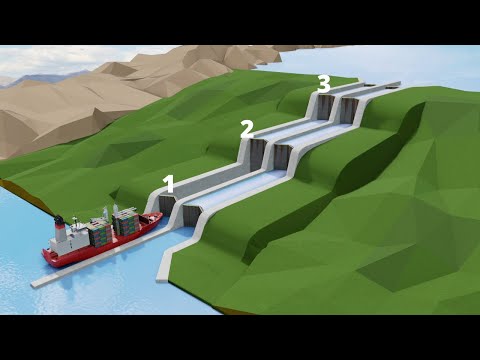 Photo: N43 and Hermes
A 48-mile waterway that lifts ships 85 feet above sea level through a system of locks, lakes, and engineering genius — connecting the Atlantic and Pacific Oceans through the narrowest point in the Americas.
Source video: The Engineering Marvel called Panama Canal · Sabin Civil Engineering · approximately 12.8M views observed via yt-dlp on August 04, 2026. Independently researched by N43 and Hermes.
01 The Problem: An Impossible Shortcut
Before the Panama Canal, a ship traveling from New York to San Francisco had to sail around the entirety of South America — a journey of roughly 22,500 kilometres through the treacherous waters of Cape Horn, where storms, currents, and ice made the passage genuinely lethal. The alternative, unloading cargo on one coast and shipping it overland across the continent, was nearly as slow and far more expensive. The narrowest point of the Americas, the Isthmus of Panama, was only about 80 kilometres wide, but it was one of the most inhospitable places on Earth: covered in dense tropical rainforest, crossed by rugged mountains, and infested with diseases that had killed countless explorers and laborers.
The fundamental challenge was not just cutting a channel through solid rock — though that was daunting enough. The problem was elevation. Unlike the Suez Canal, which sits at sea level for its entire length, the terrain of Panama rose to a height of roughly 85 metres above sea level at the Continental Divide. Any canal would have to lift ships over that barrier and lower them back down on the other side. This meant a sea-level channel, as originally attempted by the French, would require digging through the mountains to a depth that was simply not feasible with 19th-century technology. The solution — a lock-and-lake system — would become one of the great engineering innovations of the modern era.
02 The French Disaster
The first serious attempt to build a canal across Panama was launched by France in 1881, led by Ferdinand de Lesseps, the same man who had successfully built the Suez Canal. Buoyed by that triumph, Lesseps believed Panama would be a similar undertaking — a sea-level canal through relatively soft terrain. He was catastrophically wrong on both counts. The geology of Panama was nothing like the flat sand of the Suez isthmus. The land was volcanic, fractured, and prone to landslides. The Chagres River, which flooded massively during the rainy season, made excavation in the Gaillard Cut — the channel through the continental divide — essentially a Sisyphean task: every time workers dug out a section, rains would wash mud and rock back into the cut.
Even worse was the human toll. Yellow fever and malaria ravaged the workforce. The French effort had little understanding of how these diseases spread — the mosquito theory of transmission was not yet established. Workers died by the thousands. At one point, the hospital in Panama City had more patients dying of yellow fever than it could accommodate. By the time the French company collapsed in 1889, an estimated 22,000 workers had died and over 287 million dollars had been spent — a vast fortune entirely lost. The scandal destroyed reputations and ruined investors. Lesseps himself was convicted of fraud, though the conviction was later annulled.
03 The American Takeover: A Lock Canal, Not a Ditch
The United States took up the project in 1904, having negotiated a treaty with the newly independent nation of Panama (which had seceded from Colombia with American encouragement). The American engineers, led initially by John Findlay Wallace and then by John Frank Stevens, made a critical decision that separated them from the French: they abandoned the sea-level canal concept and designed a lock-and-lake system instead. This decision, championed by Stevens and approved by President Theodore Roosevelt, was arguably the single most important engineering choice in the canal's history.
The lock canal concept was elegant. Instead of digging the entire route down to sea level — which would have required removing millions of cubic metres of rock from the continental divide — the engineers would dam the Chagres River to create an artificial lake at 26 metres above sea level. Ships would enter from one ocean, be lifted in lock chambers to the level of Gatun Lake, cross the lake and the narrow Gaillard Cut through the divide, then be lowered by locks on the other side. This reduced the amount of excavation required by orders of magnitude and made the project feasible within a reasonable timeframe.
Equally important was the medical revolution. Army Colonel William C. Gorgas, working from the then-recent discoveries of Walter Reed and Carlos Finlay, implemented a massive mosquito-control program. He drained swamps, fumigated buildings, installed screens, and eliminated standing water across the canal zone. Yellow fever, which had killed thousands under the French, was effectively eradicated from the zone by 1906. Malaria rates dropped dramatically. Gorgas's work was as important as any engineering decision in making the canal possible.
04 How the Locks Work: Gravity Does the Lifting
The genius of the Panama Canal's lock system is that it uses no pumps. The locks are powered entirely by gravity and fresh water from Gatun Lake. Each lock chamber is a concrete-lined basin with massive steel gates at each end. To lift a ship, the lower gates are closed, and water from the higher level flows through culverts — tunnels built into the lock walls — into the chamber. As the water level in the chamber rises, the ship floats upward. When the water level in the chamber matches the level of the next chamber or lake, the upper gates open and the ship moves forward. The process is reversed to lower a ship.
Each lock chamber on the original canal measures 33.5 metres wide and 320 metres long — dimensions that gave rise to the term "Panamax," the maximum ship size that could fit through the canal. The gates themselves are enormous: each leaf of the original gates weighs up to 662 tonnes and stands 20 metres tall. Yet they are so precisely balanced on their hinges that a single electric motor can swing them open. The locks operate in pairs, so two ships can transit simultaneously in opposite directions, though in practice traffic flow usually favors one direction at a time for efficiency.
The scale of water involved is staggering. A single ship transit through the entire canal system consumes approximately 200 million litres of fresh water, all of it drawn from Gatun Lake. This water flows out to sea and is lost to the system. In periods of drought, when the lake level drops, the canal faces a genuine operational crisis — fewer transits, lower draft limits, and restrictions on ship size. This vulnerability to rainfall patterns is one of the most pressing challenges the canal faces in an era of changing climate.
05 The Gaillard Cut: Slicing the Continental Divide
If the locks are the canal's muscles, the Gaillard Cut — renamed the Culebra Cut — is its spine. This 13.7-kilometre channel through the Continental Divide was the most difficult excavation of the entire project. The terrain was a nightmare of volcanic rock, shale, and clay, all saturated with groundwater and prone to catastrophic landslides. The French had barely scratched it; the Americans spent years blasting, digging, and re-digging as slides repeatedly filled the channel.
At its peak, the American excavation in the Cut involved dozens of steam shovels, hundreds of drilling rigs, and a fleet of trains to haul away spoil. The Cut was widened repeatedly as slides kept narrowing it, and the final depth required removing roughly 96 million cubic metres of material from the Cut alone — more than the entire volume excavated for the Suez Canal. Even after the canal opened in 1914, slides continued to be a problem for decades, requiring ongoing maintenance excavation.
The Cut is also the narrowest point of the canal, at only about 152 metres wide in some stretches. This means ships cannot pass each other in the Cut — one-way traffic rules apply, and canal pilots coordinate transits in alternating directions. The Cut remains the bottleneck of the entire system and a testament to both the difficulty and the achievement of the canal.
06 The 2016 Expansion: Neopanamax and New Locks
By the early 2000s, the original canal was constraining global shipping. Ships had grown larger than Panamax dimensions, and a significant share of the global fleet — particularly container ships and liquefied natural gas carriers — could no longer fit through the canal. The Panama Canal Authority launched a massive expansion project in 2007, building a third set of locks on both the Atlantic and Pacific sides that could accommodate ships up to 366 metres long and 49 metres wide — a class designated "Neopanamax."
The new locks use a water-saving basin system that recycles approximately 60 percent of the water used in each transit, a crucial innovation given the canal's chronic water-supply concerns. The expanded canal opened for commercial operation on June 26, 2016. The impact was immediate: larger ships could transit, toll revenues increased, and the canal recaptured traffic that had been diverting to alternative routes. But the expansion also introduced new engineering challenges — the larger locks require more water, and the same drought vulnerability that affects the original locks now threatens the expanded system as well.
07 The Canal in Crisis: Drought and the Future
The Panama Canal's dependence on freshwater rainfall is its Achilles heel. Gatun Lake, which supplies both the lock water and drinking water for much of Panama, relies on the region's rainy season to maintain its level. In recent years, climate variability has disrupted this cycle. The El Nino drought of 2023 to 2024 was particularly severe: water levels in Gatun Lake dropped to historic lows, and the canal authority was forced to reduce daily transits from the normal 36 to as few as 22, and to restrict the draft — the depth a ship extends below the waterline — to the point that some vessels had to lighten their loads to pass.
This vulnerability raises a fundamental question about the canal's long-term future. As global trade continues to grow and climate patterns become less predictable, the canal may face more frequent and more severe disruptions. Proposals for solutions range from building a new reservoir to pump water into the system, to desalination plants, to even more aggressive water-recycling technology. But all are expensive, politically complex, and uncertain. The canal that Theodore Roosevelt built over a century ago remains one of the great engineering achievements of human history — and a fragile one, whose future depends on forces that even the best engineering cannot fully control.
References
- Wikipedia: Panama Canal — overview, history, lock specifications
- Panama Canal Authority: pancanal.com — official transit statistics and operational data
- Encyclopaedia Britannica: Panama Canal — historical overview
- Wikipedia: Panama Canal expansion project — Neopanamax locks
- Wikipedia: Culebra Cut — excavation history
- Source video: The Engineering Marvel called Panama Canal (Sabin Civil Engineering, ~12.8M views, observed August 04, 2026)
By N43 and Hermes for Sailor Bob News.


