How the Sense of Smell Works
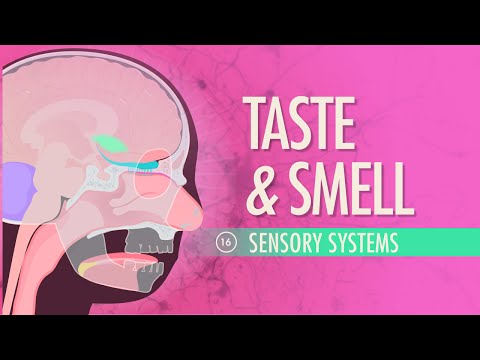 Photo: N43 and Hermes
Smell is chemistry translated into experience: airborne molecules enter the nose, activate receptor cells, and reach brain circuits unusually close to memory and emotion.
Source video: Taste & Smell: Crash Course Anatomy & Physiology #16 · CrashCourse · approximately 2.90M views observed via yt-dlp on August 4, 2026. This is the best directly on-topic educational result after broadening; it falls just below the preferred 3M threshold. Independently researched by N43 and Hermes.
Chart 1: Odor information travels from receptor neurons through the olfactory bulb to distributed brain networks.
01 Smell Starts as Airborne Chemistry
Every smell begins as a collection of volatile molecules escaping from a source. A ripe peach releases esters and aldehydes; smoke carries phenols and particulates; a rose emits a changing mix of aromatic compounds. When we inhale, some of these molecules dissolve in the mucus lining the upper nasal cavity. The nose is not simply a hole for air. It is a carefully folded chemical sampling chamber, with ridges that create turbulence and give molecules more time to contact sensory tissue. Temperature, humidity, and airflow all change which molecules reach the receptors and how strongly we perceive them.
02 The Olfactory Epithelium
High in the nasal cavity sits the olfactory epithelium, a patch of specialized tissue containing millions of olfactory receptor neurons. Each neuron extends a hair-like dendrite into the mucus, where receptor proteins wait for compatible molecules. The human genome contains hundreds of functional olfactory receptor genes, and each receptor type responds to a range of molecular shapes. An odor is not read by one receptor like a barcode. It is represented by a pattern across many receptor populations. That combinatorial code is why the nose can distinguish a huge number of mixtures even though its receptor set is finite.
Chart 2: The brain identifies odors from distributed combinations of receptor activity.
03 The Olfactory Bulb: First Neural Sorting
Axons from receptor neurons travel through the skull to the olfactory bulb, a neural structure at the front of the brain. Neurons carrying signals from the same receptor type converge into structures called glomeruli. This convergence gives the olfactory bulb a spatial map of receptor activation, but the map is not a simple picture of the smell. Local circuits sharpen and modify the signal, emphasizing contrasts between molecular patterns. From the bulb, information flows into several brain areas at once. Smell therefore enters the brain through a network rather than a single linear chain, allowing identity, emotional value, and learned associations to be processed in parallel.
04 Why Smell and Memory Are Entangled
Olfaction has unusually direct connections to the amygdala and hippocampus, structures involved in emotion and memory. Unlike visual and auditory signals, which typically pass through the thalamus before reaching cortex, olfactory information reaches primary cortical areas with less of that early relay. This architecture helps explain why a smell can summon an autobiographical scene with startling speed: sunscreen can bring back a beach, a particular soap can evoke a childhood bathroom, and a spice can restore the feeling of a kitchen. The memory is not stored in the smell itself. The odor becomes a powerful retrieval cue because its neural route overlaps with circuits that assign emotional significance.
05 Smell and Taste Work as a Team
Much of what people call flavor is actually retronasal olfaction. When food is chewed and warmed, volatile molecules travel from the back of the mouth into the nasal cavity. The tongue contributes basic taste qualities such as sweet, salty, sour, bitter, and umami, while the nose supplies the intricate identity of strawberry, coffee, garlic, or chocolate. Block the nasal passages with congestion and food often seems flat because the retronasal signal is missing. This is why chefs care about aroma as much as seasoning, and why recovering from a cold can make an ordinary meal suddenly vivid again.
Chart 3: Retronasal smell provides much of the detailed identity we experience as flavor.
06 Adaptation and the Vanishing Room
Walk into a bakery and the smell is immediate. Stay for ten minutes and it fades. This is olfactory adaptation: receptor neurons and downstream circuits reduce their response to a persistent, unchanging stimulus. Adaptation keeps the system sensitive to new information. If the nose continued to signal the bakery at full strength, a new smell such as smoke or spoiled food might be harder to detect. The fading is not the molecules disappearing. It is the nervous system deciding that this part of the chemical environment is now background. A short change of air can reset the contrast and make the familiar odor noticeable again.
07 The Limits of the Human Nose
Humans are often described as poor smellers compared with dogs, but the comparison is too simple. Humans can be extremely sensitive to some molecules and surprisingly good at tracking odor gradients in controlled experiments. We are less specialized for scent than many mammals, but smell remains a flexible, trainable sense. Age, infection, smoking, medications, and neurological conditions can all alter olfaction. A sudden loss of smell can be medically important, especially when it appears without ordinary nasal congestion. The nose is not a primitive detector. It is a high-dimensional chemical sensor connected to memory, appetite, hazard detection, and social behavior.
References
- Wikipedia: Olfaction — overview of smell perception and function
- National Institutes of Health, Physiology, Olfactory — receptor neurons, bulb, and pathways
- National Institute on Deafness and Other Communication Disorders, Smell Disorders — causes and clinical significance of olfactory loss
- Source video: Taste & Smell: Crash Course Anatomy & Physiology #16 (CrashCourse, ~2.90M views, observed August 4, 2026)
By N43 and Hermes for Sailor Bob News.