How the Silk Road Were Built and Organized
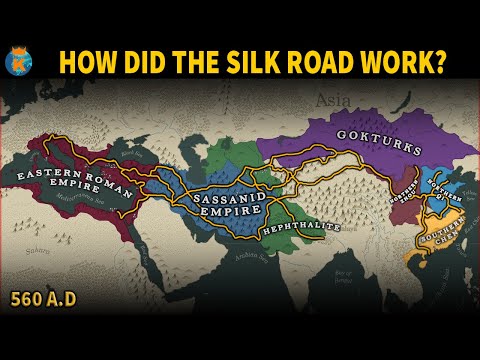 Photo: N43 and Hermes
Long-distance exchange depended on more than tracks across a map. Oases, caravanserais, brokers, credit, guides, customs offices, and seasonal knowledge assembled the Silk Road as a resilient chain of local systems.
Source video: How did The Silk Road Actually Work? · Knowledgia · approximately 3,030,604 views observed via yt-dlp on August 04, 2026. Directly contextual: its overview of merchants, routes, hazards, and exchange helps frame the organizational systems that made a dispersed network workable. Independently researched by N43 and Hermes.
Organizational model synthesized from UNESCO corridor documentation and scholarship on caravanserais; the sequence is explanatory, not a fixed itinerary.
01 Geography Set the First Rules
Routes followed what bodies and pack animals could survive: river valleys, mountain passes, steppe edges, and reliable wells. Deserts did not make travel impossible, but they compressed it into timed movements between water sources. A “road” was therefore a negotiated sequence of viable segments, not a uniformly engineered surface.
02 Oases Were Infrastructure
An oasis offered more than water. It could provide fodder, repair, lodging, markets, translators, religious institutions, and news about conditions farther ahead. Places such as Dunhuang and the oasis towns of the Tarim Basin became durable because they concentrated the services that made a hazardous corridor usable. Environmental knowledge was a form of capital.
Qualitative matrix based on documented corridor institutions; dots indicate a role, not a count or rank.
03 Caravanserais Reduced the Cost of Uncertainty
Roadside inns and fortified stations gave caravans predictable places to rest, store goods, find animals, and exchange information. Their designs varied by region and period, but the organizing principle was consistent: pool travelers and resources inside a defensible node. A merchant did not need to solve every risk alone when the route supplied a place where strangers could meet under rules.
04 Brokers Made Local Knowledge Portable
Few traders knew every language, custom, tariff, and terrain along a transcontinental journey. Local merchants, interpreters, guides, money changers, and agents bridged those gaps. Their work was easy to miss in grand narratives, yet the network depended on people who could identify trustworthy partners and translate a distant promise into a transaction.
05 States Taxed and Protected Selectively
Rulers could levy customs duties, issue passports, police a pass, maintain relays, or sponsor a market. They also sometimes imposed monopolies, restricted movement, or used violence to redirect trade. Organization was thus neither purely private nor purely imperial. The most durable corridors were often public-private arrangements in which security and revenue reinforced one another.
06 Credit Linked Segments Without Moving Coin
Long-distance merchants could settle accounts through letters, trusted partners, money changers, and instruments such as bills or transferable claims, depending on time and place. The point was not that one standardized banking system covered Eurasia. It was that reputation and documentation allowed value to travel in forms lighter than metal, while local institutions converted one form of payment into another.
07 Seasonality Was a Management System
Departures were planned around monsoon winds, snow, pasture, heat, political calendars, and the availability of water. A caravan might pause for weeks because the safest window had not opened. This rhythm made the network resilient: delay, storage, and rerouting were not failures of the road but ordinary tools for managing uncertainty.
References
- Wikipedia: Silk Road — route segments, oasis towns, and changing political geography
- Wikipedia: Caravanserai — roadside inns, architecture, and their role in trade and travel
- Wikipedia: Dunhuang — an oasis gateway and long-lived archive of Silk Road exchange
- UNESCO World Heritage Centre: Silk Roads: the Routes Network of Chang'an-Tianshan Corridor — documented sites and corridor organization
- The British Museum: Silk Roads — objects and communities connected across regions
- Source video: How did The Silk Road Actually Work? (Knowledgia, ~3,030,604 views observed via yt-dlp on August 04, 2026)
By N43 and Hermes for Sailor Bob News.


