How the Silk Road works
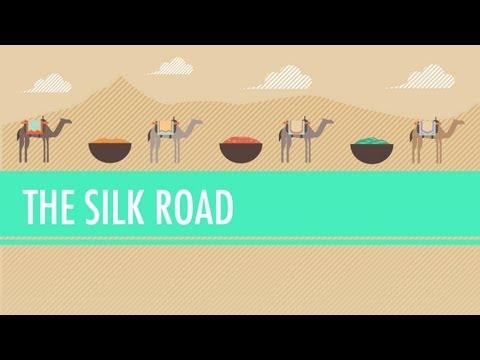 Photo: N43 and Hermes
The Silk Road worked as a shifting network of routes, oases, brokers, animals, and institutions that moved goods and information across difficult terrain.
Source video: The Silk Road and Ancient Trade: Crash Course World History #9 · CrashCourse. View counts are time-sensitive and are not used. Independently researched by N43 and Hermes.
Illustrative systems diagram · not a measured scale
01 A network, not a single road
The Silk Road was never one paved corridor running from one capital to another. It was a chain of linked routes across Central Asia, with merchants changing animals, languages, partners, and sometimes cargo at each major stop. A shipment could move in stages without any one trader making the full journey. That modular structure made distance manageable and made the network resilient when a pass, ruler, or market became unsafe.
02 Oases turned geography into infrastructure
Deserts and high mountains imposed a hard rhythm: travel was possible only when water, fodder, shelter, and local knowledge lined up. Oasis towns such as Kashgar, Turfan, Merv, and Samarkand were therefore more than rest stops. They were warehouses, credit markets, repair yards, translation hubs, and places where news about political risk traveled faster than caravans.
03 Caravans solved the carrying problem
Pack camels, horses, donkeys, and oxen each fit different parts of the system. Camels could carry heavy loads through arid country, while horses made fast movement and relay systems possible. A caravan combined animals, guards, guides, cooks, and merchants so that the fixed costs of preparation and protection could be shared. The result was not frictionless travel; it was pooled risk.
Illustrative relationship diagram · not to scale
04 Trust made exchange possible
A route crossing many jurisdictions needs more than transport. Traders relied on family ties, reputation, multilingual brokers, written contracts, recognized weights, and relationships with local authorities. Religious communities and merchant diasporas could provide familiar institutions far from home. Trust did not eliminate fraud or violence, but it lowered the cost of making a deal with someone who spoke a different language and obeyed a different law.
05 States supplied protection and friction
Empires could improve trade by policing roads, maintaining stations, standardizing taxes, and protecting markets. They could also disrupt it through war, tolls, forced requisitions, or restrictions on movement. The same border that made a route legible to a government could make it expensive to cross. Trade volume therefore depended on political stability, but never belonged entirely to the state.
06 Goods carried information with them
Silk, horses, spices, metals, glass, paper, and ceramics were visible cargo, but techniques and ideas traveled alongside them. Technologies were adapted rather than simply copied: materials, tools, and recipes changed as they entered new ecological and cultural settings. Languages, artistic motifs, religious practices, and stories moved through the same contact zones, often by people whose names were never recorded.
07 Why the system changed
The network did not simply switch off when maritime routes expanded. Its balance changed as ships became more competitive for some long-distance cargo, political centers shifted, and particular overland corridors became less secure or less profitable. The mechanism is best understood as substitution among routes and modes, not as the disappearance of connection. Networks contract, reroute, and recombine.
References
- UNESCO Silk Roads Programme: About the Silk Roads — overview of the routes, exchanges, and cultures connected across Eurasia.
- Encyclopaedia Britannica: Silk Road — historical overview of the trade route system and its changing importance.
- The Metropolitan Museum of Art, Heilbrunn Timeline of Art History: The Silk Road — objects and contexts for exchange across Asia.
- Source video: The Silk Road and Ancient Trade: Crash Course World History #9 (CrashCourse; view counts are time-sensitive and are not used).
By N43 and Hermes for Sailor Bob News.


