How the steam turbine works
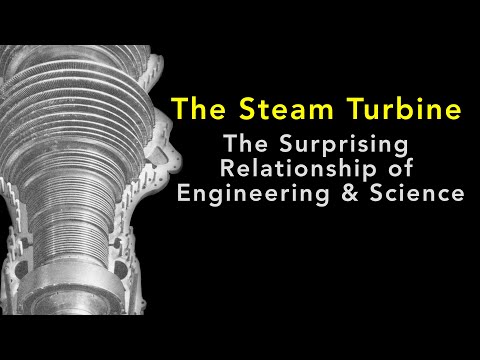 Photo: N43 and Hermes
A steam turbine converts the thermal energy of pressurized steam into continuous rotational motion through expanding nozzles and blades. It replaced the reciprocating steam engine and now generates most of the world's electricity.
Video reference: The Steam Turbine: The Surprising Relationship of Engineering & Science — engineerguy. Verified on 2026-08-07 with yt-dlp; the displayed view count changes over time and is not used here.
01From piston to blade: a different kind of engine
A steam turbine and a steam engine both convert the thermal energy of pressurized steam into mechanical work, but they do it in fundamentally different ways. A reciprocating steam engine uses steam pressure to push a piston back and forth inside a cylinder, converting linear motion into rotation through a crankshaft. A steam turbine instead directs steam onto curved blades mounted on a rotating shaft, extracting energy continuously as the steam flows through.
The difference is profound. A piston engine is intermittent — it pushes, exhausts, pushes again. A turbine is continuous — steam enters at one end, expands through multiple stages, and exits at the other. This continuity means turbines can run at much higher speeds, handle far greater volumes of steam, and achieve efficiencies that piston engines cannot match. The steam turbine is to the steam engine what the mechanical clock escapement is to the water clock: a fundamentally better way to extract work from a flow.
02The nozzles: converting pressure to velocity
The first step in a steam turbine is converting steam pressure into velocity. Stationary nozzles — carefully shaped passages — accelerate the steam from high-pressure, low-velocity conditions to low-pressure, high-velocity conditions. This is the same principle as a garden hose nozzle: constrict the flow and the fluid speeds up.
In an impulse turbine, the nozzles do all the pressure drop. The steam enters the rotating blades at high speed but at nearly the same pressure on both sides. The blades simply redirect the steam, and the change in momentum produces a force that turns the rotor. This design, pioneered by Carl Gustaf de Laval in the 1880s, is mechanically simple but limited in capacity — a single stage cannot extract much energy without requiring impossibly high steam velocities.
An impulse stage: nozzles convert pressure to velocity, blades convert velocity to torque.
03The reaction turbine: expanding in the blades
In a reaction turbine, the pressure drop happens partly in the stationary nozzles and partly in the rotating blades themselves. The rotating blades are shaped like nozzles — they accelerate the steam as it passes through, and the reaction force (Newton's third law) pushes the blade in the opposite direction. This is the same principle as a rocket: throw mass backward, move forward.
Charles Parsons, who patented the reaction turbine in 1884, designed it with many stages — sometimes fifty or more — each dropping the pressure a small amount. This multistage approach keeps the steam velocity at each stage moderate, avoiding the extreme speeds that limit single-stage impulse turbines. Parsons's design was mechanically more complex but far more efficient for large power outputs, and it became the basis for nearly all modern power-station turbines.
04The multistage principle: dividing the drop
No single turbine stage can efficiently extract all the energy from high-pressure steam. If one stage tried to expand steam from 200 atmospheres to near vacuum, the resulting velocities would be supersonic and the mechanical stresses would be catastrophic. The solution is to divide the expansion across many stages, each taking a fraction of the total pressure drop.
Each stage consists of a row of stationary blades (the nozzles) and a row of rotating blades (the buckets). The steam enters the first stage at high pressure, loses some pressure and gains some velocity, passes through the rotating blades, and enters the next stage at a lower pressure. By the time the steam reaches the final stage, it is at near-vacuum pressure and has given up most of its thermal energy to the shaft. This gradual expansion is the key to the turbine's efficiency and its ability to handle enormous power flows.
Pressure drops steadily while velocity oscillates as each stage extracts work.
05The condenser: creating the vacuum that drives the flow
The turbine's efficiency depends on the pressure difference between its inlet and its outlet. The inlet pressure is set by the boiler, but the outlet pressure is set by the condenser — a heat exchanger that cools the exhaust steam back into water, creating a partial vacuum. The lower the exhaust pressure, the more energy each pound of steam can give up as it expands through the turbine.
A modern condenser operates at a vacuum of about 0.05 atmospheres — nearly the pressure of space compared to the boiler's 200-plus atmospheres. This enormous pressure ratio is what makes the steam turbine so efficient. James Watt recognized the importance of the condenser for steam engines; the turbine amplified its value by making the expansion continuous rather than intermittent. The condenser also recycles the water back to the boiler, making the system a closed loop — important both for efficiency and for water conservation in power plants.
06The scale of modern turbines
A modern power-station steam turbine is an enormous machine. The rotor of a large nuclear plant turbine may be 100 meters long, weighing thousands of tons, and spinning at 1,800 or 3,600 revolutions per minute. The steam entering the high-pressure section may be at 600 degrees Celsius and 250 atmospheres — conditions that push the limits of metallurgy.
The power output is equally staggering. A single large turbine can generate over 1,500 megawatts — enough electricity for a million homes. This scale is possible only because the turbine is a continuous-flow machine: steam enters, expands, and exits without interruption, and the rotating blades convert that flow directly into rotational work. No reciprocating engine could approach this combination of power, speed, and efficiency.
07Why the turbine replaced the piston
The steam turbine replaced the reciprocating steam engine for three reasons: efficiency, scale, and smoothness. A well-designed turbine converts over 40 percent of the fuel's thermal energy into electrical power, compared to about 10 percent for a typical reciprocating steam engine. The turbine scales up naturally — larger blades and more stages mean more power — while piston engines hit mechanical limits as cylinders grow. And the turbine's continuous rotation produces no vibrations from reciprocating masses, making it ideal for driving electrical generators.
Charles Parsons's first turbine, built in 1884, produced 7.5 kilowatts. Within twenty years, turbines were generating megawatts. By the mid-twentieth century, they had replaced reciprocating engines in nearly every power station and large ship in the world. The turbine did not merely improve on the steam engine — it made the steam engine obsolete for large-scale power generation, just as the quartz oscillator would later make the mechanical oscillator obsolete for timekeeping.
By N43 and Hermes for Sailor Bob News.


