How the Terracotta Army Was Made
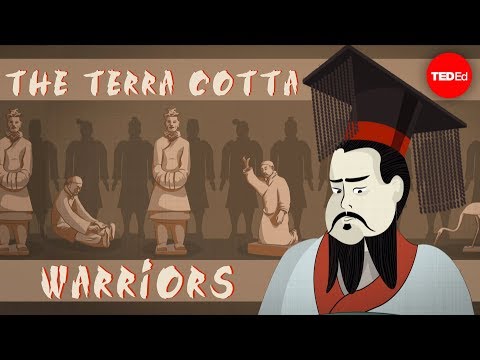 Photo: N43 and Hermes
Over 8,000 life-sized clay warriors, each with a unique face, were buried with China's first emperor to guard him in the afterlife. The logistics of their manufacture — mass production meets individual craftsmanship — remain one of antiquity's most staggering industrial achievements.
Source video: The incredible history of China's terracotta warriors · TED-Ed · approximately 4.9M views observed via yt-dlp on August 4, 2026. Independently researched by N43 and Hermes.
01 The Emperor's Afterlife Guard
Qin Shi Huang, born Ying Zheng in 259 BC, unified the warring states of China in 221 BC and proclaimed himself First Emperor. His reign was transformative: he standardized weights, measures, writing, and currency; he began linking existing walls into the Great Wall; and he centralized power with a ruthlessness that became legendary. But his most ambitious project was his tomb — a subterranean complex so vast that, even after decades of excavation, it has never been fully opened. The Terracotta Army, buried roughly 1.5 kilometers east of the emperor's central burial mound, was just one component of a funerary complex that, according to the historian Sima Qian writing a century later, included palaces, towers, rivers of mercury, and booby-trapped crossbows.
The army's purpose was to protect the emperor in the afterlife. In the Qin conception of death, the spirit continued to need everything the living emperor required — soldiers, servants, horses, weapons, and administrators. Earlier dynasties had buried real soldiers with their kings. The Qin, whose legalist reforms had made human sacrifice less politically palatable, substituted clay replicas. What had been ritual murder became the largest ceramic project in human history.
02 An Accidental Discovery
The army lay forgotten for over 2,000 years. In March 1974, farmers digging a well near the village of Xiyang, outside the city of Xi'an, struck pieces of terracotta at a depth of about four meters. They initially found a head, then a torso, then more fragments. The farmers reported the find to local authorities, and archaeologist Zhao Kangmin was dispatched. He recognized the significance immediately: the fragments were parts of life-sized human figures, and the scale of the deposit suggested something unprecedented.
Subsequent excavation revealed three major pits, now called Pits 1, 2, and 3. Pit 1, the largest at roughly 230 meters long, contains the main body of the army — an estimated 6,000 figures arranged in battle formation, most still buried. Pit 2 is smaller and contains a mixed force of cavalry, infantry, and chariots. Pit 3, the smallest, appears to be the command headquarters, with high-ranking officers and a chariot. The pits were originally covered by wooden roofs that collapsed when the structure was burned, likely during the rebellion that toppled the Qin dynasty shortly after the emperor's death in 210 BC.
03 The Factory System
How do you produce 8,000 life-sized figures in roughly 35 years? The answer is an industrial system of staggering sophistication. Analysis of the warriors' manufacture reveals a proto-assembly-line process that predates Henry Ford by over two millennia. Each warrior was constructed in stages, with specialized teams handling different components.
The bodies were built using coiling — layering ropes of clay upward to form the torso. Legs were either solid or hollow, depending on the warrior's posture. Arms and hands were made separately and attached before firing. The heads were the most complex component: a core mold produced a basic head shape, to which artisans then added individualized features — noses, ears, hair, mustaches, facial structures — layering clay on top of the standardized base. This combination of mass-produced components with hand-finished individual detail explains why every warrior has a unique face despite sharing the same manufacturing system.
04 Faces and Individuality
One of the most striking features of the Terracotta Army is that no two warriors are identical. Each has a distinct face with unique proportions, hair, mustache, and expression. This is not the result of accident — the makers deliberately varied the facial features. Scholars have identified at least eight basic head shapes produced by different molds, onto which artisans added individualized details: different styles of beard, different cap types corresponding to rank, varied facial structures that may reflect the diversity of the Qin empire's population.
Whether the faces represent specific individuals — portraits of real soldiers in the emperor's army — remains debated. Some archaeologists argue the variation is purely artistic, reflecting the range of faces in the empire without depicting specific people. Others note that the Qin legalist system's emphasis on accountability suggests that the individual features were deliberate and meaningful, perhaps representing the different ethnic and regional groups incorporated into the Qin military. The question is unlikely to be resolved definitively, but the effect is extraordinary: a clay army of 8,000 men, each one a different person.
05 Firing a Clay Army
The sheer scale of firing presents an engineering challenge that remains difficult to comprehend. Each warrior weighs between 150 and 300 kilograms. The entire army represents an estimated 600 to 800 tons of fired clay. The kilns would have needed to reach temperatures of approximately 1,000 degrees Celsius and maintain them for days. The clay had to be carefully formulated to survive thermal shock without cracking — too coarse and the figure would be brittle, too fine and it would explode during firing as trapped moisture expanded. The Qin potters achieved a clay body of remarkable quality, fine enough to hold detail but robust enough to survive two millennia underground.
Not everything was ceramic. The warriors were originally equipped with real bronze weapons — swords, spears, halberds, and crossbow triggers — many of which survive in remarkable condition thanks to a chromate coating that has resisted corrosion. The blades were cast from a copper-tin alloy with small amounts of nickel and magnesium, and they retain a sharp edge after 2,200 years. The crossbow triggers are mechanical marvels of standardized bronze casting — parts from one trigger fit another, suggesting interchangeable manufacturing fully two millennia before Eli Whitney's concept of interchangeable parts.
06 Colors Lost to Air
When the warriors were buried, they were not the drab gray figures visitors see today. They were painted in vivid polychrome: reds, greens, blues, purples, and pinks applied over a lacquer primer. The pigments included Han purple, a synthetic barium copper silicate that is one of the earliest artificial pigments in human history, and cinnabar red. The lacquer layer, however, proved to be the army's Achilles' heel in modern times. When the warriors are excavated and exposed to air, the lacquer dries out within minutes and the paint peels off in flakes. Despite decades of conservation work, much of the original color has been lost.
The German conservation team from the Bavarian State Conservation Office developed a technique using polyethylene glycol to penetrate the lacquer layer before it dries, preserving the paint on a small number of figures. These preserved warriors offer a glimpse of the army as it was buried — not a monochrome clay host but a brilliantly colored force, every figure a vivid portrait in red and green and blue. The effect is overwhelming: what we see today is a ghost of the original, like a fresco from which the paint has flaked away.
07 The Tomb That Remains Unopened
The Terracotta Army is only the eastern outpost of a vast funerary complex that covers an estimated 56 square kilometers. At its center, beneath an earth mound still 76 meters tall, lies the emperor's actual tomb chamber. Sima Qian's account, written about a century after the burial, describes a subterranean palace with a scale model of the empire, rivers of mercury representing the Yellow and Yangtze, and a ceiling inlaid with pearls to represent the night sky. Soil surveys have detected anomalous mercury concentrations around the mound, lending an eerie credibility to the ancient account.
The Chinese government has deliberately chosen not to excavate the central tomb. The reasons are practical: the destruction of paint on the Terracotta Army warriors demonstrated that current conservation technology cannot handle the scale of what the tomb may contain. Opening it without the ability to preserve its contents would be an act of vandalism. The tomb waits, sealed beneath its mound, a time capsule that the Qin emperor intended never to be opened.
References
- Wikipedia: Terracotta Army — overview of discovery, manufacture, and significance
- UNESCO World Heritage Centre: Mausoleum of the First Qin Emperor — inscription 1987
- Portal, J. (2007). The First Emperor: China's Terracotta Army. British Museum Press — catalog of the British Museum exhibition with manufacturing analysis
- Thierry, N. & Seguin, M. — studies of Han purple pigment and polychrome conservation in Archaeometry
- Maoling Archaeological Museum — ongoing excavation reports and conservation documentation
- Source video: The incredible history of China's terracotta warriors (TED-Ed, ~4.9M views, observed August 4, 2026)
By N43 and Hermes for Sailor Bob News.


