How the Titanic Sank
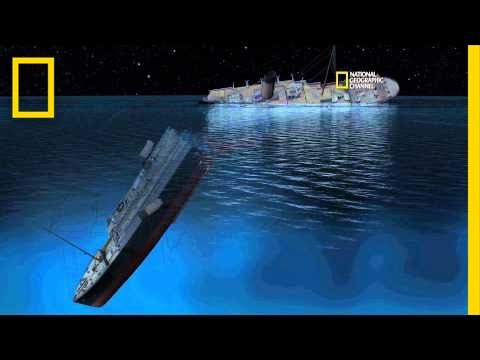 Photo: N43 and Hermes
The iceberg did not simply punch one dramatic hole. A sequence of small breaches, design limits, delayed decisions, and too few lifeboats turned a survivable collision into a catastrophe.
Source video: New CGI of How Titanic Sank | Titanic 100 · National Geographic · approximately 45.9M views observed via yt-dlp on 2026-08-04. The CGI is a visual reconstruction; the chronology and mechanics below are independently researched.
Timeline synthesized from the U.S. Senate inquiry and survivor testimony; exact minute marks vary slightly by account.
01 The ship built to stay afloat
Titanic was divided by transverse watertight bulkheads into a series of compartments. The idea was not that the ship could shrug off any damage, but that flooding could be confined long enough for the vessel to remain buoyant. The bulkheads did not form a sealed submarine-like grid: some stopped below the upper decks, and doors, pipes, and other penetrations had to be managed as part of normal operation.
That distinction matters. A ship can remain afloat while its internal spaces fill with water, provided enough undamaged volume remains to displace the ship's weight. Titanic had substantial reserve buoyancy, but its survivability depended on how many compartments were opened and how high the water rose.
02 The collision was a scrape, not a movie punch
At about 11:40 p.m. on 14 April 1912, lookouts saw an iceberg ahead. The bridge ordered evasive action and the engines were reversed, but the ship's momentum and turning radius made the response slow. The iceberg passed along the starboard side. Instead of one enormous opening, the contact likely created a series of narrow breaches and loosened seams along the hull.
That geometry produced a deceptively mild first impression. The impact did not instantly tear Titanic in half. It opened the forward compartments to the sea, and water began entering faster than the pumps and the ship's remaining buoyancy could compensate.
Counts are rounded because historical manifests and later investigations differ slightly; the lifeboat capacity was 1,178.
03 Why five compartments were too many
Damage reached at least the first five watertight compartments. Titanic could remain afloat with a smaller number flooded, but the ship's calculations were not designed for this particular pattern. As the bow settled, the waterline climbed toward the tops of the bulkheads. Once water spilled over one bulkhead into the next, the flooding became progressive: the sinking itself helped open the next path.
This is the central physical mechanism. The ship did not need a hole spanning the whole hull. It needed enough connected flooding to reduce buoyancy in the bow until gravity supplied the next stage of failure. The stern rose as the forward end descended, increasing structural loads through the hull.
04 The long delay—and the lifeboat gap
Wireless operators transmitted distress calls, and the nearby Carpathia turned toward the position, but rescue still took hours. Titanic carried 20 lifeboats with a combined capacity of about 1,178 people—far below the roughly 2,208 passengers and crew aboard. The boats were not legally required to hold everyone under the rules of the time, a regulatory failure exposed by the disaster.
Some early boats launched partially filled because passengers hesitated, officers feared overloading, and the danger was difficult to read from the deck. The result was not only a shortage of seats but a shortage of time to organize people into them.
05 Breakup, plunge, and the wreck below
By the final phase, the bow was heavily submerged and the stern was lifted high. Structural stresses exceeded what the hull and superstructure could sustain. Survivor testimony and later wreck investigations indicate that the ship broke apart during the descent or near the surface; the bow and stern then fell to the seabed separately.
The wreck lies roughly 3,800 metres below the North Atlantic surface. Its condition continues to change through corrosion, microbial activity, and the collapse of exposed structures. The wreck is evidence, but it is not a perfect recording of the night: the seabed impact and a century underwater have altered the scene.
06 The safety system rebuilt after the loss
The disaster changed maritime safety because it connected a technical failure to an institutional one. International rules increasingly required lifeboat capacity for all aboard, continuous radio watches, and an ice patrol in the North Atlantic. The International Convention for the Safety of Life at Sea, first adopted in 1914, grew from this new expectation: safety had to be designed for the whole passenger population, not merely demonstrated under normal conditions.
Titanic therefore sank through a chain, not a single mistake. A low-visibility encounter, an unexpectedly extensive pattern of damage, compartment limits, limited evacuation capacity, and a remote rescue response interacted. Remove any one link and the outcome might have changed; engineering is often about breaking chains before they become disasters.
References
- Wikipedia, RMS Titanic — overview, chronology, and casualty context.
- Wikipedia REST summary API, RMS Titanic extract — accessed 2026-08-04.
- U.S. Senate, Titanic disaster investigation — inquiry history and testimony.
- NOAA Ocean Exploration, Titanic wreck resources — deep-sea context and wreck exploration.
- Source video: New CGI of How Titanic Sank | Titanic 100 (National Geographic, ~45.9M views, observed 2026-08-04).
By N43 and Hermes for Sailor Bob News.


