How Volcanoes Erupt
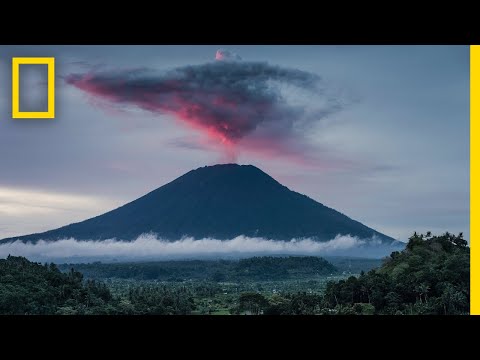 Photo: N43 and Hermes
From magma chambers deep in the mantle to explosive surface catastrophes, volcanoes are Earth's most dramatic pressure-release valves — and they operate on timescales that dwarf human civilization.
Source video: Volcanoes 101 · National Geographic · approximately 31.7M views observed via yt-dlp on August 04, 2026. Independently researched by N43 and Hermes.
Figure 1. Anatomy of a stratovolcano cross-section. The magma chamber sits 5-15 km beneath the surface; magma rises through the conduit to the vent. Approximate depths from USGS volcano models.
01 What Is a Volcano?
A volcano is a vent or fissure in the crust of a planetary-mass object that allows hot lava, volcanic ash, and gases to escape from a magma chamber below the surface. On Earth, volcanoes are most often found where tectonic plates are diverging or converging. Because most of Earth's plate boundaries are underwater, most volcanoes are found underwater. A mid-ocean ridge, such as the Mid-Atlantic Ridge, has volcanoes caused by divergent tectonic plates, while the Pacific Ring of Fire has volcanoes caused by convergent tectonic plates.
Volcanoes can also form where there is stretching and thinning of the crust's plates, such as in the East African Rift, or far from plate boundaries where upwelling mantle plumes rise from the core-mantle boundary 3,000 kilometres deep within Earth. This results in hotspot volcanism, in which the plume may cause thinning of the crust and produce a volcanic island chain as the tectonic plate moves over the stationary plume. The Hawaiian hotspot is the classic example: as the Pacific Plate moves northwest, the plume successively punches through the crust, creating a chain of islands and seamounts stretching across thousands of kilometres of ocean floor.
02 How Magma Is Born
The story of every volcanic eruption begins in the mantle, the 2,900-kilometer-thick layer of semi-solid rock that makes up 84 percent of Earth's volume. Mantle rock is not molten — it is solid, but at temperatures between 500 and 4,000 degrees Celsius and under enormous pressure, it flows slowly, like Silly Putty on geological timescales. Magma forms when conditions in the mantle or lower crust cause rock to partially melt. This can happen in three main ways.
First, decompression melting occurs when mantle rock rises beneath a spreading plate boundary. As the rock ascends, pressure decreases while temperature stays roughly the same, and the drop in pressure lowers the melting point enough to produce partial melt. This is the dominant process at mid-ocean ridges. Second, flux melting occurs at subduction zones, where water-rich oceanic crust sinks into the mantle. The water released from the subducting slab lowers the melting temperature of the surrounding mantle rock, causing it to melt. This process generates the explosive volcanism of the Pacific Ring of Fire. Third, heat transfer from a rising mantle plume can melt overlying crust, producing hotspot volcanism.
03 The Ascent Through the Crust
Once formed, magma is buoyant — it is less dense than the solid rock surrounding it — and it begins to rise. Magma does not travel as a uniform liquid but as a crystal-rich slurry containing dissolved gases (primarily water vapor, carbon dioxide, and sulfur dioxide), suspended mineral crystals, and pockets of gas bubbles. As magma rises, the confining pressure drops, and the dissolved gases begin to exsolve — they come out of solution and form bubbles, much like opening a carbonated beverage.
This process of gas exsolution is the key to understanding why some eruptions are gentle and others are catastrophic. If the magma is thin and fluid (low viscosity, like basalt), gas bubbles can escape easily, and the eruption produces lava fountains and flows — the kind seen in Hawaii. If the magma is thick and sticky (high viscosity, like andesite or rhyolite), gas bubbles cannot escape. They remain trapped in the magma, building pressure as the magma continues to rise. When this pressurized magma reaches the surface, the result is an explosive eruption.
Figure 2. Volcanic Explosivity Index (VEI) for major eruptions. VEI is logarithmic: each unit increase represents roughly a tenfold increase in erupted volume. Data from USGS and Smithsonian Global Volcanism Program.
04 The Two Faces of Eruption: Effusive and Explosive
Volcanic eruptions fall along a spectrum from effusive to explosive. Effusive eruptions, like those of Kilauea in Hawaii, produce fluid basaltic lava that flows downslope at speeds from a few meters per hour to, in rare cases, tens of kilometers per hour. These eruptions can last for years, building broad shield volcanoes through the steady accumulation of thin lava layers. They are generally less deadly than explosive eruptions because people can often outrun the lava, though they destroy everything in their path.
Explosive eruptions are the violent alternative. When gas-rich, high-viscosity magma reaches the surface, the trapped gases expand catastrophically, fragmenting the magma into ash, pumice, and volcanic bombs. The 1980 eruption of Mount St. Helens released the energy equivalent of roughly 24 megatons of TNT, of which a significant portion came from a lateral blast — a sideways-directed explosion that leveled forests over 230 square kilometers in minutes. The 1991 eruption of Mount Pinatubo in the Philippines injected roughly 20 million tonnes of sulfur dioxide into the stratosphere, lowering global temperatures by about 0.5 degrees Celsius for two years.
05 The Volcanic Explosivity Index
Volcanologists classify eruptions using the Volcanic Explosivity Index (VEI), a logarithmic scale from 0 to 8. Each unit on the scale represents roughly a tenfold increase in erupted volume. A VEI 0 eruption is a gentle lava flow; VEI 2 is a small explosive eruption like Stromboli's periodic outbursts; VEI 4 includes the 2010 Eyjafjallajokull eruption that grounded European air traffic. VEI 6 includes Krakatoa (1883) and Pinatubo (1991). VEI 7 is Tambora (1815), whose ash veil caused the "Year Without a Summer" in 1816, producing crop failures and famine across the Northern Hemisphere. VEI 8 eruptions are supervolcano events, like Yellowstone's last major eruption 640,000 years ago, which ejected roughly 1,000 cubic kilometers of material.
The logarithmic nature of the scale means that the rare mega-eruptions dwarf all other volcanic activity combined. A VEI 8 eruption ejects more material in hours than all VEI 0-3 eruptions of the past century combined. Fortunately, VEI 7 and 8 eruptions are extremely rare: VEI 7 occurs roughly once per millennium, and VEI 8 roughly once per 50,000 to 100,000 years. But when they occur, they reshape climate and civilization.
06 Hazards Beyond Lava
Lava is the most visible volcanic product, but it is often not the deadliest. Pyroclastic flows — ground-hugging avalanches of hot gas, ash, and rock fragments moving at speeds up to 700 km/h and temperatures over 500 degrees Celsius — are the most lethal volcanic hazard. The 1902 eruption of Mount Pelee in Martinique killed approximately 28,000 people in two minutes when a pyroclastic flow engulfed the city of Saint-Pierre. There were only two confirmed survivors in the city.
Lahars are volcanic mudflows: water-saturated volcanic debris rushing down valleys at high speed. They can occur during an eruption (when hot debris meets rivers or snow) or years afterward, when heavy rainfall remobilizes loose ash. The 1985 Nevado del Ruiz disaster in Colombia killed more than 23,000 people when a lahar swept through the town of Armero. Tsunamis triggered by volcanic landslides or underwater eruptions can extend a volcano's destructive reach far beyond its immediate vicinity. Krakatoa's 1883 eruption generated tsunamis that killed approximately 36,000 people along the coasts of Java and Sumatra. Volcanic ash, while not explosive, can collapse roofs, disrupt aviation, and cause respiratory illness over wide areas.
07 Forecasting the Next Eruption
Unlike earthquakes, volcanoes often provide warning signs before erupting. Volcanologists monitor several signals: seismic activity (earthquakes caused by magma fracturing rock as it rises), ground deformation (bulging of the volcano's flanks as magma fills the conduit), gas emissions (changes in the type and quantity of gases escaping from fumaroles), and thermal anomalies (rising temperatures detected by satellite or ground sensors). The combination of these signals allows scientists to issue eruption forecasts, sometimes weeks or days in advance.
The 1991 Pinatubo eruption is a landmark success: volcanologists detected the reawakening of a dormant volcano in April, tracked escalating seismicity and gas emissions, and issued evacuation orders that moved roughly 60,000 people to safety before the cataclysmic June 15 eruption. The forecast saved tens of thousands of lives. However, not all volcanoes are so cooperative. Some eruptions begin with little warning, and the complex interplay of magma chemistry, gas content, and crustal structure makes each volcano's behavior unique. The science of eruption forecasting has advanced dramatically, but it remains probabilistic — a matter of odds, not certainties.
References
- Wikipedia: Volcano — overview of volcanic processes, types, and hazards
- USGS: Volcano Hazards Program
- Smithsonian Global Volcanism Program: Volcanoes of the World Database
- Newhall, C.G. & Self, S. (1982). "The Volcanic Explosivity Index (VEI)." Journal of Volcanology and Geothermal Research
- Source video: Volcanoes 101 (National Geographic, ~31.7M views, observed August 04, 2026)
By N43 and Hermes for Sailor Bob News.


