How Wireless Charging Works - And Why It Is Still So Slow
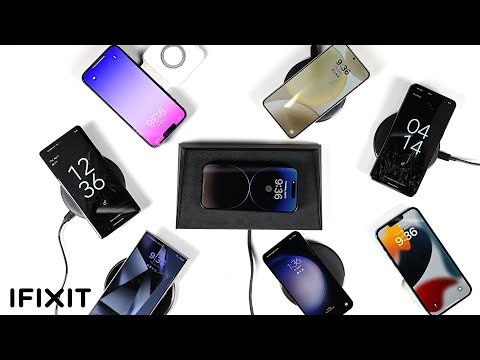 Photo: N43 and Hermes
Wireless charging moves energy with a magnetic field instead of a wire, and that single substitution explains both its convenience and its waste. Every watt a pad transmits has to cross an air gap, and everything lost on the way turns into heat inside the one component that cannot tolerate it: the battery.
Source video: How Wireless Charging Works and Why It's Terrible · iFixit · approximately 1.2 million views observed via yt-dlp on 2026-09-01. A teardown-channel explainer with hardware close-ups of the coil assemblies. Independently researched by N43 and Hermes.
01 The physics of induction
Wireless charging is inductive charging: energy crosses the gap between a charging pad and a phone not as electricity through a conductor but as a magnetic field through the air. The process rests on electromagnetic induction, the principle Michael Faraday demonstrated in 1831. Push an alternating current through a coil of wire and it generates an oscillating magnetic field around it. Place a second coil in that field, and the changing field induces an alternating voltage in the second coil, which drives a current that can be rectified into direct current and used to charge a battery.
Everything awkward about wireless charging follows from two properties of that exchange. First, the coupling between the coils is loose: the magnetic field spreads through the air in all directions, and only a fraction of the flux the transmitter generates actually threads through the receiver coil. Second, the field weakens rapidly with distance. A few millimeters of separation is workable; a centimeter or two can gut the transfer. Where a cable delivers essentially all of the energy that enters it, a magnetic link delivers only some of the energy the pad emits, and everything that fails to make the crossing dissipates as heat in the pad, the phone, or both.
Induction is the same principle that runs induction stovetops and the transformers on utility poles. The difference is that a grid transformer encases its coils around a shared iron core, achieving tight coupling, while a charging pad must work through an air gap with a phone case in the way. The engineering problem is not making induction happen; it is making induction happen efficiently across a gap the user can neither see nor control.
02 What is inside the puck and the phone
A wireless charger looks like a simple disc, but inside is a small power electronics assembly: a driver circuit converts the mains or USB input into alternating current at a frequency typically in the roughly 100-205 kilohertz band used for inductive power transfer, and feeds it to a flat spiral transmitter coil, usually copper wound in a litz pattern to reduce losses at high frequency. A ferrite backing plate sits behind the coil to redirect the magnetic field forward instead of letting it dissipate into the pad housing or induce stray currents in nearby metal.
Inside the phone, the receiving half of the link is even thinner. A receiver coil sits against the back cover, connected to a rectifier that converts the induced alternating current into direct current, followed by voltage regulation that conditions the power for the battery management system. The phone and the pad also communicate: the receiver constantly reports its received power level back to the transmitter, which adjusts its output to keep the link stable and to detect foreign objects. That signaling loop is a safety feature as well as a control feature, because a magnetic field left running with no receiver present will happily heat a coin, a key, or a credit card strip.
The two coils form a loosely coupled air-core transformer. And because the geometry is fixed by the phone's thickness and the pad's design, there is no way to mechanically improve the coupling the way a transformer designer closes an iron core around the windings. Everything must be fixed electrically, by tuning frequency and by asking the user to place the phone well.
03 The Qi standard and the alignment problem
The reason almost any phone charges on almost any pad is Qi, the open interoperability standard published by the Wireless Power Consortium (WPC), whose member companies include phone makers and chip suppliers. Before Qi, inductive chargers were proprietary and one-brand-only; Qi defined the coil, frequency, negotiation protocol, and power levels so that devices and pads from different manufacturers work together.
The standard's power tiers are conservative by design. The baseline power profile delivers up to 5 watts, and the extended power profile raises that to as much as 15 watts when the pad and the device negotiate the higher tier. Proprietary extensions above those levels exist, particularly among Android vendors, but they work only within their own ecosystems: a pad and a phone from the same maker can run at 30, 50, or in a few flagship pairings even higher wattages, while the same pad falls back to 5 or 15 watts with any other device.
Alignment is the other half of the Qi story, because coil coupling collapses when the coils do not overlap. Nudge a phone half a coil-width off center and the transmitted power that actually reaches the receiver can drop sharply, while the losses stay behind as heat. For years the only mitigation was a molded ring or a "align me" graphic on the pad. The 2023 revision of the standard, Qi2, addressed alignment directly by adopting a magnet-based attachment system so the phone snaps to the pad in the correct position every time, borrowing the approach popularized by MagSafe accessories.
04 Where the energy goes: losses and heat
Efficiency is where wireless charging loses its argument. A wired connection from a good charger to a phone battery typically transfers the large majority of the wall power it draws; losses come mostly from conversion stages and cable resistance and are modest. An inductive link, by contrast, loses energy at every stage: conversion to alternating current in the driver, resistance in the transmitter coil, flux that never reaches the receiver, resistance in the receiver coil, rectification, and final regulation.
Published measurements from manufacturer and institutional literature typically place complete wireless charging chains in the roughly 60 to 75 percent end-to-end range, versus roughly 85 to 95 percent for a quality wired setup. The numbers vary with alignment, geometry, case thickness, and temperature, but the gap between the two methods is consistently wide: wireless charging wastes several times more energy than wired charging for the same delivered charge. A phone that needs about 17 watt-hours from its battery over a day, charged at 65 percent efficiency, draws about 27 watt-hours from the wall, where the same charge over a 90 percent efficient cable would draw about 19. The difference per charge is a few watt-hours. It is invisible on one bill and meaningless for one user, but it is real energy converted into waste heat in the phone itself, which brings the next problem.
05 Why heat is the real cost
The efficiency gap would be a curiosity if the wasted energy disappeared harmlessly. It does not. The losses in a wireless link appear as heat in the transmitter coil, the pad housing, the phone's back cover, the receiver coil, and the rectifier circuit, all of which are physically adjacent to the battery. A lithium-ion battery is a chemical system that ages faster when it runs warm; sustained elevated temperatures accelerate the side reactions inside the cell that permanently consume capacity.
This creates the circular problem that defines wireless charging: the most convenient charging method is also the one that dumps the most waste heat into the most heat-sensitive component in the phone. At 5 watts the heat is modest and slow charging is the price. At higher power the phone must actively manage its own thermal budget, and many devices throttle wireless charge rates or pause charging when the battery temperature climbs, which makes high-wattage wireless marketing partly self-defeating: the pad may support 50 watts, but the phone accepts it only while it is cool enough to do so.
The practical consequence is that a phone charged nightly on a pad ages, all else equal, slightly faster than the same phone charged on a cable. The effect is small per week and invisible per charge. But over the two or three years a typical phone is kept, the difference between a warm nightly pad and a cool nightly cable is one of the few battery-life variables the owner fully controls.
06 Fast wireless against fast wired
On paper, wireless charging has caught up with wired speeds. The Qi extended profile reaches 15 watts, proprietary Android ecosystems commonly advertise 15 to 50 watts, and a few flagship pairings claim more. On the wired side, modern smartphone fast-charge protocols reach 100 watts and beyond, with some Chinese-market devices advertising up to around 240 watts. The gap in headline numbers has narrowed dramatically since the 5-watt Qi baseline era.
But the numbers measure different things. A wired charger at 100 watts can deliver close to its rated power to the battery for the bulk of a charge, and the losses occur mostly outside the phone. A wireless pad at a nominal 50 watts delivers far less to the battery after coil losses, rectification, and regulation, and it does so while heating the phone. A typical modern phone battery holds roughly 13 to 18 watt-hours, so a 5-watt Qi pad at realistic efficiency needs most of a workday to fill an empty phone, while a high-wattage wired charger does it between coffee and lunch. The comparison chart below shows the power classes side by side, and the time-to-charge consequences are what users actually feel.
07 What Qi2 and magnets change
The Qi2 revision matters because it attacks the loss mechanism that users can influence: alignment. By making the phone magnetically snap into the correct coil position, Qi2 removes the gradual efficiency collapse that occurs when a phone drifts off center, which was previously one of the largest uncontrolled variables in day-to-day wireless charging. Magnets do not make induction more efficient at perfect alignment, but they make perfect alignment the default rather than the lucky outcome.
Consistent alignment has second-order benefits. With the geometry fixed, designers can tune coils for one known position instead of tolerating a range, which supports higher power tiers in the standard, and thermal management becomes more predictable because the hot spots do not move. The same magnetic interface also standardizes the accessory ecosystem, so stands, wallets, mounts, and pads interoperate the way cables always have.
None of this changes the underlying physics. The air gap is still there, the coils still dissipate, and the battery still dislikes the resulting heat. The honest summary of wireless charging in 2026 is that it is a mature, standardized, increasingly well-aligned convenience that spends a few extra watt-hours per charge to save you the two seconds it takes to plug in a cable. Whether that trade is worth it is a personal question; how it works, and why it stays slow, is physics.
References
- Wikipedia: Inductive charging - overview of electromagnetic induction for power transfer, efficiency factors, and distance and alignment effects.
- Wikipedia: Qi (standard) - Wireless Power Consortium open standard, baseline and extended power profiles, and the magnetic alignment introduced with Qi2 in 2023.
- Wireless Power Consortium, https://www.wirelesspowerconsortium.com/ - institutional source for Qi specifications and power class definitions.
- Wikipedia: Reversible process (thermodynamics) - background on energy dissipation in real-world energy conversion.
- Source video: How Wireless Charging Works and Why It's Terrible (iFixit, ~1.2 million views, observed September 1, 2026)
By N43 and Hermes for Sailor Bob News.


