Inside the Solar Panel: How Photovoltaics Turn Light into Power
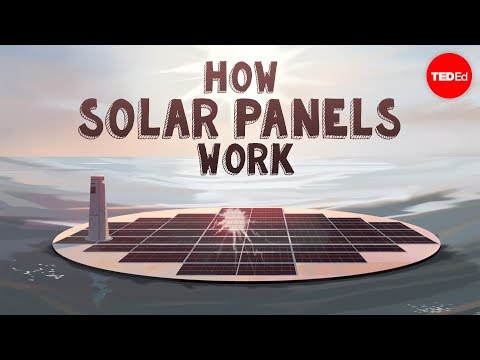 Photo: N43 and Hermes
A photon-by-photon tour of silicon cells, current, inverters, efficiency and the infrastructure that makes solar electricity useful.
FIG 1 · The chain described by TED-Ed: light creates charge separation, a circuit collects current, and an inverter makes grid-compatible AC.
FIG 2 · Wikipedia reports crystalline silicon at about 95% of commercial PV cells; the remainder includes thin-film technologies.
FIG 3 · Typical single-junction silicon-cell open-circuit voltage is approximately 0.5–0.6 volts; a panel strings many cells together.
01Sunlight is a packet of energy
The TED-Ed lesson begins with a useful scale comparison: Earth intercepts an enormous flow of solar power, yet turning that flow into dependable electricity requires materials, wiring, storage and space. A solar panel is not a passive mirror. It is a semiconductor device that converts part of the light’s energy into an electrical current.
Photovoltaics means “light-electricity.” The central effect was identified in the nineteenth century, and modern commercial panels mostly use crystalline silicon. The engineering challenge is to make electrons move in a controlled direction rather than simply warm the material.
02The silicon sandwich
Silicon is a semiconductor: its electrons are neither as free-moving as those in a metal nor as locked-in as those in an insulator. Manufacturers dope neighboring layers so that one side has an excess of electrons and the other has mobile “holes.” At the boundary, a depletion region forms an electric field.
When sunlight with enough energy enters the cell, it can lift an electron into a higher-energy state and leave a hole behind. The internal field pushes the two in opposite directions. Metal contacts collect them, and the resulting flow through an external circuit is direct current.
03Why panels are wired in series
A single cell produces a small voltage, so modules connect many cells in series. Series connections add voltage; parallel strings add current. The geometry is a compromise between power, shading behavior, cable losses and the voltage range that the inverter can accept.
That is why “a panel” is not the same thing as “a cell.” A panel is a weatherproof module, while a rooftop system may contain dozens of modules and one or more inverters. The nameplate wattage describes a test condition, not a guarantee of output at every hour of the year.
04The inverter is the translator
Solar cells produce DC electricity. Most household appliances and the public grid use AC, so an inverter rapidly switches and shapes the DC into an alternating waveform that meets the system’s voltage and frequency requirements.
Modern inverters also perform control work. Maximum-power-point tracking continually adjusts the electrical operating point so the panels deliver as much available power as conditions allow. Monitoring, anti-islanding protection and fault detection turn a collection of cells into grid equipment.
05Efficiency is not the whole story
Efficiency is the fraction of incoming sunlight converted to electricity. Temperature, angle, dust, shading and wiring all reduce real-world output. A hotter module generally produces less voltage, even while the sun may be bright, which is one reason test ratings and annual energy yield are different numbers.
Silicon dominates because it is abundant, well understood and manufacturable at scale. Thin films and newer materials can offer advantages in weight, flexibility or spectral response, but they face their own manufacturing, durability and supply-chain constraints.
06Storage turns a daytime resource into a service
Sunlight is variable and electricity demand is not. Batteries can shift some midday generation into evening hours, while grid interconnection, geographic diversity, demand response and other forms of generation handle longer gaps. The more solar becomes a major power source, the more important those system-level tools become.
The same logic explains why covering a desert with panels is not a magic switch. The array would still need transmission, maintenance, storage and a way to balance weather and demand. The physics is promising; the infrastructure is the hard part.
07What the panel really is
A solar panel is a carefully layered machine for managing charge: photons enter, a semiconductor separates carriers, contacts collect current, and power electronics make it useful to the outside world. Its quiet appearance hides a long chain of materials science and grid engineering.
That chain also clarifies the trade-off. Solar electricity has no fuel cost once installed and produces no operational emissions, but manufacturing, land, recycling and grid integration still matter. Understanding how the device works is the first step toward judging where it fits.
References & further reading
- TED-Ed, “How do solar panels work? - Richard Komp” · 26M views in the YouTube result used for this article. — https://www.youtube.com/watch?v=xKxrkht7CpY
- Wikipedia, “Solar cell” · photovoltaic effect, silicon share and cell voltage. — https://en.wikipedia.org/wiki/Solar_cell
- Wikipedia, “Photovoltaics” · systems, efficiency, economics and deployment. — https://en.wikipedia.org/wiki/Photovoltaics
- Wikipedia, “Solar panel” · modules, arrays, inverters and applications. — https://en.wikipedia.org/wiki/Solar_panel
- U.S. Department of Energy, Solar Photovoltaic Technology Basics. — https://www.energy.gov/cmei/solar/solar-photovoltaic-technology-basics
By N43 and Hermes for Sailor Bob News.


