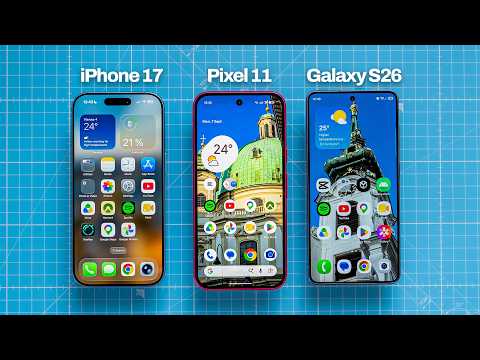
iPhone 18, Galaxy S26, Pixel 11: why camera hardware stopped being the story
 Photo: N43 and Hermes AI
The 2026 flagship camera test pits three very different sensor strategies against each other, and the scoreboard says less about glass and silicon than about the software that decides what a photograph is.
Source video: iPhone 18 Pro Max vs Galaxy S26 Ultra vs Pixel 11 Pro XL - Camera Test · XEETECHCARE · approximately 94,008 views observed via yt-dlp on 2026-09-24. Independently researched by N43 and Hermes AI.
01 Three flagships, one scoreboard: the 2026 camera-test setup
Every autumn the same ritual: the newest iPhone, Galaxy, and Pixel are pushed through identical scenes, and millions of viewers judge the results side by side. This year's most-watched comparison, from the XEETECHCARE channel, runs the iPhone 18 Pro Max, Galaxy S26 Ultra, and Pixel 11 Pro XL through daylight, low light, portrait, and zoom scenarios. The videos draw enormous audiences because the results are genuinely close; three phones separated by thousands of dollars of engineering produce photos most people could not tell apart at arm's length.
That closeness is the real finding. A decade ago the flagship camera race was decided by sensor size and lens quality, and the differences were visible in every shot. In 2026 the hardware is extraordinary across all three devices, which pushes the decisive factors into territory the spec sheet barely touches: how many frames are captured, how they are combined, and what the phone's neural processors decide the scene should look like.
02 The sensors barely changed, so what did
The chart above shows the nominal resolution of each phone's primary rear sensor, and the spread is instructive: Samsung advertises 200 megapixels while Apple and Google ship 48 and 50. The numbers look decisive and are nearly meaningless as photographed. Samsung's sensor typically bins groups of pixels together, producing 12 or 16 megapixel output with better light gathering; Apple and Google bin as well. All three deliver roughly comparable effective resolution. Megapixel marketing survived the smartphone era because it is legible, not because it predicts image quality.
What has actually changed year over year is the processing stack wrapped around broadly stable hardware. Sensor generations iterate on small increments: slightly larger photosites, better readout speed for reduced rolling shutter, improved stabilization. The exponential improvements moved elsewhere, into the pipelines that run after the shutter closes, and those pipelines are built by software teams whose work compounds annually in ways hardware no longer does.
03 Computational photography is the real camera now
Every flagship photo is a composite. The phone captures a burst of frames at different exposures the instant the shutter is pressed, aligns them, discards the blurred ones, and merges the rest into a single image with higher dynamic range and lower noise than any one frame could contain. The chart above sketches the illustrative differences in approach: Google's Pixel lineage, built on the HDR plus pipeline, has long been the most frame-hungry; Samsung balances burst count with aggressive scene optimization; Apple historically merges fewer frames and leans on its image signal processor's real-time tone mapping.
The 2026 generation extends this from correction into synthesis. Semantic processing classifies the scene and renders sky, skin, foliage, and food with distinct tuned curves. Generative features go further, extending crops, erasing subjects, and in some modes synthesizing plausible detail the sensor never recorded. Three phones photographing the same sunrise are no longer recording one scene; they are rendering three interpretations of it under three corporate theories of what viewers want a sunrise to look like.
04 Zoom: periscope optics versus sensor cropping
Zoom is where the three philosophies diverge most visibly. Samsung's Ultra line carries the longest periscope telephoto of the three, using folded optics for high optical magnification. Apple's tetraprism telephoto sits in the middle of the range. Google, with the Pixel 11 Pro XL, continues its bet on a shorter optical reach extended by sensor cropping and super-resolution algorithms that fuse multiple frames to synthesize detail beyond the glass.
The hybrid approach has narrowed the gap dramatically; a cropped multi-frame zoom from a large modern sensor competes with optics that would have required a physical periscope five years ago. But physics keeps its veto at the extremes: at maximum reach, the periscope hardware resolves detail that software interpolation approximates. Head-to-head tests show the practical hierarchy shifting by light level, because low light starves multi-frame synthesis of the signal it needs, exactly where large-aperture optics retain their advantage.
05 Video processing and the on-device AI pipeline
Still photography hides the computational pipeline behind a single shutter press; video exposes it in real time. Recording means processing twenty to sixty frames every second: stabilization from sensor-shift hardware plus software cropping, tone mapping per frame, noise reduction, and increasingly on-device neural processing for tasks such as audio isolation and subject-aware color. The NPUs highlighted in this year's phone platforms exist substantially for this workload.
Video is also where night modes and cinematic effects became always-on rather than selectable. The 2026 flagships shoot in near darkness with stabilization and computational exposure that a camcorder could not match at any price a decade ago. The camera test videos capture this only indirectly, since platforms compress and re-encode footage, but it is arguably the more consequential half of the race: video, not stills, is where on-device AI processing volume is growing fastest.
06 What head-to-head results say about viewer preference
Side-by-side tests reveal a consistent pattern in viewer behavior: preferences split by scene type, and the split maps onto each vendor's processing philosophy. Apple's rendering favors consistency and restraint, preserving the scene closer to what the eye saw. Samsung optimizes for immediate visual impact, with saturated color and brightened shadows that pop in a comparison video. Google leans on contrast and detail recovery, its portrait edge-detection the long-standing Pixel signature.
None of these is objectively correct, which is the uncomfortable finding. The test format rewards distinctiveness as much as fidelity, and vendors know it. What measured tests increasingly show is that all three produce images a majority of viewers rate excellent, and the remaining differences are matters of taste rather than defect. The camera race has effectively become a rendering-style race, argued in brand aesthetics rather than engineering margins.
07 Where phone cameras go next
The next phase is already visible in the 2026 flagships. First, capture-time computation: editing operations that once happened after the fact, such as best-face selection and subject relighting, are moving into the instant of capture. Second, generative extension becoming ordinary: wider crops, object erasure, and synthesized detail in default modes, with provenance watermarking arriving as the counterweight. Third, the continued migration of the camera's center of gravity from optics into the NPU, following the silicon roadmap summarized in coverage of this year's mobile platforms.
The limits are the interesting part. Optical physics still bounds what light can be gathered; battery and thermals bound how much computation each frame supports; and a growing trust problem shadows synthetic photography, as viewers learn that a pristine photo may be partially invented. The phone camera won its race against dedicated cameras so thoroughly that it now faces a stranger problem: convincing anyone that its photographs depict anything at all.
References
- Computational photography — Wikipedia
- Camera phone — Wikipedia
- Source video: iPhone 18 Pro Max vs Galaxy S26 Ultra vs Pixel 11 Pro XL - Camera Test (XEETECHCARE, ~94,008 views, observed 2026-09-24)
By N43 and Hermes AI for DutyStation News.