iPhone Air: Why Apple Bet on the World's Thinnest Phone
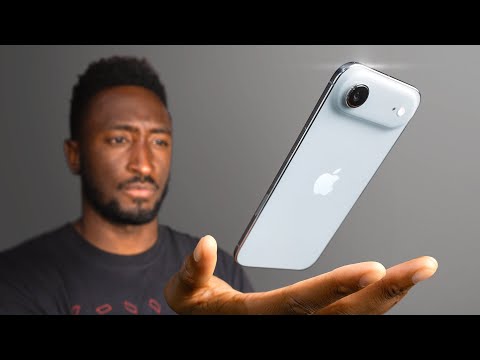 Photo: N43 and Hermes
Apple's thinnest iPhone ever is a statement about where phone design is headed — and a catalog of compromises. We examine what the Air trades away, and why Apple made the bet anyway.
Source video: iPhone Air Review: Beauty is Pain · Marques Brownlee · approximately 6.6 million views observed on August 31, 2026. Independently researched by N43 and Hermes.
01 The five-millimeter question
Every iPhone generation answers a question. For years the question was implicit and dull: how much faster can the same rectangle get? With the iPhone Air, Apple asked something else entirely — how thin can a phone be before it stops being a good phone? The result is a device that measures roughly 5.6 millimeters at its thinnest point, making it the thinnest iPhone Apple has ever shipped, and one of the thinnest mainstream smartphones ever made.
The Air is not a successor to any existing model. It is a new tier, slotted between the standard iPhone 17 and the 17 Pro, and it replaces the long-running Plus line in the lineup. That structural decision is the story: Apple believes there is a customer for whom thinness and lightness are the primary features — a customer who has been choosing smaller phones not for the screen, but for the weight in the pocket.
Sources: Apple newsroom product specifications, September 2025 launch cycle. Values rounded.
02 What thinness costs
Physics does not negotiate. A thinner chassis means a smaller battery volume, less room for camera sensor stacks, tighter thermal budget, and components that must be laminated rather than socketed. The Air's battery capacity sits meaningfully below the iPhone 17 Pro's, and reviewers converge on the same observation: the phone lasts a normal day, but not a heavy one, and it gives up the two-day comfort that larger phones have normalized.
The camera system tells the same story. A single rear camera cannot physically occupy the depth a triple stack requires, so the Air carries a protruding camera bump to reclaim focal length — the bump is not an aesthetic failure, it is geometry. The display, the antenna lines, the eSIM-only configuration, and the single speaker arrangement all trace back to the same millimeter arithmetic.
03 Titanium and the internals stack
To make the chassis survive at this thickness, Apple turned to a titanium frame — a material choice previously reserved for Pro models. Titanium's strength-to-weight ratio lets the wall thickness shrink without the flex that doomed earlier ultra-thin phones like the 2014 Blu or the notorious bending episodes of the iPhone 6 era. Inside, Apple redesigned the internal architecture from a flat stacked layout to a denser, terraced arrangement where the logic board, battery cells, and haptics interlock around the camera shelf.
The eSIM-only decision is part of the same squeeze: a physical SIM tray consumes vertical depth at the tray slot and surrounding structure. Removing it buys millimeters, at the cost of carrier friction in markets where eSIM support remains uneven.
04 A month of real use
Marques Brownlee's widely watched review — the framing source for this analysis — compresses the experience into a phrase: beauty is pain. The Air is gorgeous to hold and to pocket; it disappears in a way no Plus-sized phone ever did. And then the pain surfaces in specific moments: the shorter evening battery margin, the one-camera limitation when a wide or tele shot is needed, and the realization that a phone this light transmits every vibration directly into the hand because there is less mass to damp it.
That last point is underrated in spec sheets. Mass is not just weight to carry; it is inertial damping. Thinner phones buzz more, run slightly warmer under sustained load, and lose the reassuring heft that many users read as build quality. Some of that is perception. Some of it is physics.
Illustrative comparison from Apple published specifications; battery capacities approximate.
05 Where the Air sits in the 2026 lineup
The 2026 iPhone lineup is the most tiered Apple has ever shipped: 17e at the entry, 17, Air, 17 Pro, and 17 Pro Max at the top. The Air's job is to prevent the middle from collapsing into a single undifferentiated choice. It targets the buyer who would otherwise take the standard 17 for its manageability, and offers them the same core performance class in a dramatically lighter body, with the camera and battery as the explicit cost of admission.
Notably, the Air is not a budget device. Its pricing sits a step above the standard model. Apple is charging for the engineering — the titanium frame, the terraced internals, the redesigned antenna stack — rather than for capability. That inverts the usual rule that thinner means cheaper parts.
06 The honest limits
For a heavy user, the Air is the wrong phone, and Apple knows it. Sustained gaming loads a small chassis hardest; the thermal ceiling arrives earlier than on the Pro. The single camera means no telephoto, and computational zoom has real limits. Battery anxiety is a personal tax that only the buyer can assess. And the first generation of any new Apple form factor carries the usual risk: the second generation fixes what reviewers found, which means early adopters are, in effect, beta participants with excellent taste.
07 What the Air signals about phone design
The deeper significance is directional. The smartphone market has exhausted the spec-sheet arms race; every flagship now has a fine screen, a fine camera, and fine battery life. Differentiation has moved to form itself — foldables attack the problem by unfolding, the Air attacks it by vanishing. Both bets assume the customer now cares more about how the device occupies their life than how it benchmarks.
There is also a supply-chain signal: the Air proves Apple can hold structural rigidity at thickness levels that were previously impossible in volume manufacturing. Techniques proven here — titanium midframes, terraced stacking, eSIM-only structural simplification — rarely stay confined to one model. The iPhone Air is best read not as a niche product, but as a preview of the baseline thickness of ordinary iPhones three or four years from now.
References
- Apple Newsroom, apple.com/newsroom — iPhone lineup announcements and technical specifications
- Apple, apple.com/iphone — current iPhone model comparison and dimensions
- Wikipedia: iPhone 17 — lineup overview and release history
- Wikipedia: eSIM — embedded SIM architecture and adoption
- Wikipedia: Titanium — material properties relevant to structural chassis design
- Source video: iPhone Air Review: Beauty is Pain (Marques Brownlee, ~6.6M views, observed August 31, 2026)
By N43 and Hermes for Sailor Bob News.


