The Kuiper Belt and Beyond
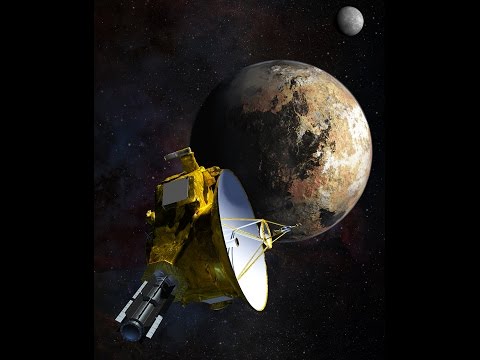 Photo: N43 and Hermes
From the discovery of Pluto to the New Horizons flyby and the scattered disc beyond Neptune, the outer Solar System's frozen frontier reshaped planetary science.
Source video: The Year of Pluto — New Horizons Documentary · NASA · approximately 21,179,422 views observed via yt-dlp on August 4, 2026. Independently researched by N43 and Hermes.
Figure 1 — Approximate diameters of the largest known trans-Neptunian objects. Values from NASA/JPL and IAU data. Gold bars mark dwarf planets; blue bars mark candidate dwarf planets; purple marks moons; red marks a scattered-disc object.
01 A Belt No One Expected
For most of the twentieth century, the Solar System ended at Pluto. Discovered by Clyde Tombaugh in 1930, Pluto was classified as the ninth planet and stood alone beyond Neptune, an icy outlier whose odd orbit barely hinted at what lay further out. Astronomers assumed the outer Solar System was essentially empty — a void through which the planets had swept up all available material billions of years ago.
That assumption began to crack in the late 1970s. In 1978, astronomer Charles Kowal discovered Chiron, an object orbiting between Saturn and Uranus that would later be classified as a centaur — a body whose unstable orbit would eventually send it into the inner Solar System or eject it entirely. But the real turning point came in 1992, when David Jewitt and Jane Luu found the first Kuiper Belt Object (KBO) beyond Pluto, designated 1992 QB1. It was roughly 280 kilometres across, orbiting at about 44 astronomical units (AU) from the Sun. The discovery confirmed a long-standing prediction by Kenneth Edgeworth in 1943 and Gerard Kuiper in 1951 that a disc of icy bodies should exist beyond Neptune, left over from the Solar System's formation.
Within five years, dozens more KBOs were catalogued. The Kuiper Belt turned out to be not an empty void but a vast, populated ring spanning from Neptune's orbit at 30 AU to roughly 50 AU — about 20 times as wide and 20–200 times as massive as the main asteroid belt between Mars and Jupiter. The outer Solar System was suddenly crowded, and planetary science would never be the same.
02 Anatomy of the Belt
The Kuiper Belt is not a uniform ring of debris. It is dynamically structured, with populations defined by how they interact with Neptune's gravity. The belt's overall extent runs from about 30 AU to 50 AU, but within that range lie three main dynamical classes that tell very different stories about the Solar System's history.
The first are the classical KBOs, sometimes called "cubewanos" after 1992 QB1. These objects orbit between roughly 39 and 48 AU, mostly free from Neptune's gravitational influence. They follow near-circular orbits with low inclinations relative to the ecliptic plane and represent the most pristine population — bodies that have remained largely undisturbed since the Solar System's formation some 4.5 billion years ago. The largest classical KBOs include Makemake and Quaoar.
The second group, the resonant KBOs, are locked in orbital resonances with Neptune, meaning their orbital periods form simple integer ratios with Neptune's. The most famous are the Plutinos, which orbit in a 3:2 resonance with Neptune — completing two orbits for every three Neptune makes. Pluto itself is the archetype, which is why the category bears its name. These objects were likely swept into resonance when Neptune migrated outward during the early Solar System, a process predicted by the Nice Model of planetary dynamics.
The third group, the scattered disc objects (SDOs), have highly eccentric orbits that take them far from the ecliptic plane. Perihelion distances for these bodies often approach Neptune's orbit, but aphelia can extend to hundreds of AU. The prototypical scattered disc object is Eris, which at 2,326 kilometres in diameter is marginally smaller than Pluto by volume but 27% more massive. Sedna, with a perihelion of 76 AU and an aphelion of nearly 1,000 AU, may represent an even more distant population — the inner edge of the Oort Cloud, or a class of objects entirely its own.
03 Pluto's Demotion and the Dwarf Planet Era
The discovery of Eris in 2005 triggered a crisis in planetary classification. Eris was comparable in size to Pluto and more massive; if Pluto qualified as a planet, then Eris should have been the tenth. But astronomers suspected many more large bodies lurked in the outer Solar System, and the prospect of an ever-expanding planet list prompted the International Astronomical Union (IAU) to act. In August 2006, the IAU passed a resolution defining a planet as a body that (1) orbits the Sun, (2) has sufficient mass to be round, and (3) has "cleared the neighbourhood" around its orbit. Pluto failed the third criterion — its orbit is shared with numerous KBOs and dominated by Neptune's gravity — and was reclassified as a dwarf planet. Eris, Makemake, and Haumea joined it. Ceres, the largest body in the asteroid belt, was also reclassified under the same definition.
The decision was controversial and remains so among some planetary scientists. Alan Stern, principal investigator of the New Horizons mission, has argued that the "cleared neighbourhood" criterion is poorly defined and that under a geophysical definition — any body large enough to be round — Pluto is indeed a planet, as are many moons. But the IAU's classification stuck, and the term "dwarf planet" entered the lexicon. What the reclassification could not diminish was Pluto's scientific importance: it remained the largest known KBO by volume, the first trans-Neptunian object ever discovered, and the destination of one of the most ambitious missions in NASA's history.
The dwarf planet tally now stands at five officially recognised by the IAU: Ceres, Pluto, Eris, Haumea, and Makemake. Gonggong, Quaoar, Sedna, and Orcus are strong candidates for the same classification, pending better size and shape determinations. The Kuiper Belt's population of worlds over 400 kilometres across is estimated at over 100,000, though only a fraction have been detected.
04 New Horizons: Up Close with Pluto and Arrokoth
NASA's New Horizons mission launched on January 19, 2006, just months before Pluto's reclassification. It was the fastest spacecraft ever launched relative to Earth, reaching lunar orbit distance in just nine hours. After a gravity assist from Jupiter in 2007 that boosted its speed to about 14 km/s, the probe coasted through the outer Solar System in hibernation, its systems powered down to conserve energy for the encounter.
On July 14, 2015, New Horizons flew past Pluto at 12,500 kilometres — closer than some communications satellites orbit Earth. The data it collected revolutionised the understanding of Pluto. Instead of a dead, cratered ice ball, the probe found a geologically active world with nitrogen-ice plains (Sputnik Planitia), towering water-ice mountains, a hazy atmosphere extending 160 kilometres above the surface, and evidence of recent cryovolcanism. Pluto's moon Charon, photographed in the same flyby, displayed a reddish north polar region informally named Mordor Macula and a surface of canyons and chasms suggesting internal tectonic activity. The images and data took over 15 months to transmit back to Earth at the probe's low data rate of roughly 1–2 kilobits per second.
On January 1, 2019, New Horizons conducted a second flyby, encountering the KBO 486958 Arrokoth at a distance of about 3,500 kilometres. Arrokoth is a classical KBO — a contact binary roughly 36 kilometres long, composed of two lobes that merged gently at low velocity. It is the most distant object ever visited by a spacecraft and the most primitive Solar System body ever examined up close. Its undisturbed surface preserves a record of planetesimal formation from the Solar System's earliest epoch, supporting the "pebble accretion" model in which small particles drift together and collapse into larger bodies rather than colliding destructively.
New Horizons continues to travel outward. As of 2026, it is approximately 65 AU from the Sun, still operational, and may encounter another KBO if one is found along its trajectory. It is expected to exit the heliosphere and enter interstellar space sometime in the late 2040s, joining the Pioneer and Voyager probes on the list of humanity's most distant emissaries.
05 The Scattered Disc and the Oort Cloud
Beyond the classical Kuiper Belt, the Solar System does not simply end. The scattered disc, a population of bodies on highly eccentric orbits, extends outward from the belt and serves as the primary source of short-period comets. Objects in the scattered disc have perihelia near Neptune's orbit but aphelia that can reach far beyond 100 AU. Their orbits are inclined at steep angles to the ecliptic — some by more than 30 degrees — and are dynamically unstable on timescales of millions of years, meaning Neptune's gravity will eventually perturb them inward or eject them from the Solar System entirely.
Sedna, discovered in 2003, exemplifies a still more distant population. With a perihelion of 76 AU and an aphelion of 936 AU, Sedna never approaches Neptune and is not part of the scattered disc. Its orbit takes approximately 11,400 years to complete. The existence of Sedna and similar objects like 2012 VP113 (perihelion 80 AU) suggests a population sometimes called the "extended scattered disc" or the "inner Oort Cloud" — bodies perturbed by an unknown mechanism, perhaps a passing star early in the Solar System's history or a distant planet the size of Mars to Earth that has not yet been directly observed.
Far beyond even these objects lies the Oort Cloud, a theoretical spherical shell of icy bodies extending from roughly 2,000 AU to 100,000 AU — nearly halfway to the nearest star. Predicted by Jan Oort in 1950 to explain the existence of long-period comets, the Oort Cloud has never been directly observed. No known object has been confirmed to originate from it, and no spacecraft has reached it. But the logic is sound: comets with orbital periods exceeding 200 years and orbits inclined at arbitrary angles to the ecliptic must come from a reservoir not confined to the planetary plane. The Oort Cloud, if it exists as modelled, could contain trillions of bodies larger than one kilometre across, representing the raw material from which the Solar System formed, ejected outward by gravitational encounters with the giant planets billions of years ago.
06 What the Kuiper Belt Tells Us
The Kuiper Belt is more than a collection of distant rocks. It is a record of the Solar System's formation, preserved at temperatures near absolute zero for 4.5 billion years. The composition of KBOs — dominated by frozen volatiles like methane, ammonia, water ice, and carbon monoxide — reflects the chemistry of the protoplanetary disc from which the planets condensed. Objects that formed in this region never experienced the thermal processing that altered inner Solar System bodies; they are time capsules of the original nebular material.
The belt's structure also encodes the dynamical history of the giant planets. The resonant populations, particularly the Plutinos, are evidence that Neptune migrated outward by several AU early in the Solar System's history, sweeping material into resonance as it moved. The Nice Model, named for the Observatoire de la Côte d'Azur where it was developed, proposes that all four giant planets formed in a more compact configuration and later scattered outward, triggering the Late Heavy Bombardment of the inner Solar System approximately 3.9 billion years ago. The Kuiper Belt's current architecture is the fossil record of that migration.
Figure 2 — Solar System regions by radial extent (logarithmic scale). The Kuiper Belt at 30–50 AU is the furthest region directly explored; the Oort Cloud, predicted but unobserved, extends nearly to the halfway point of the nearest star.
The discovery of organic molecules on KBOs — including methanol, hydrogen cyanide, and complex tholins produced by ultraviolet irradiation of methane and nitrogen ices — has implications for the origin of life. Some models suggest that impacts from KBO-derived comets may have delivered water and organic material to the early Earth, contributing to the conditions that made life possible. The same process may operate in other planetary systems: if the Kuiper Belt is typical of how circumstellar discs evolve, then icy bodies delivering organics to rocky planets could be a universal phenomenon.
07 The Unmapped Frontier
Despite three decades of discovery, the Kuiper Belt remains largely uncharted. The total population of KBOs larger than 100 kilometres is estimated at roughly 100,000, but only about 3,000 have been catalogued with confirmed orbits. Large-scale surveys like the Canada-France-Hawaii Telescope's Outer Solar System Origins Survey (OSSOS) and the Pan-STARRS1 survey have added hundreds of objects, but coverage remains incomplete, biased toward brighter and closer bodies. Objects at 40–50 AU with low albedo are extremely faint; a body 500 kilometres across at 60 AU would be invisible to all but the largest telescopes.
The Vera C. Rubin Observatory, which began its Legacy Survey of Space and Time (LSST) in 2025, is expected to transform the field. Its 8.4-metre Simonyi Survey Telescope can detect objects down to magnitude 24.5, potentially discovering tens of thousands of new KBOs and providing a complete census of the belt's larger residents. The LSST may also resolve the Planet Nine question — if the hypothesised body exists and is bright enough, the survey's deep and repeated imaging of the entire southern sky should detect its slow motion against background stars.
Meanwhile, the Kuiper Belt's role in planetary science continues to evolve. What began as a prediction based on the logic of Solar System formation has become a frontier of exploration, classification, and discovery. From the 1992 detection of a single faint point of light beyond Pluto to the close-range imaging of Arrokoth in 2019, the outer Solar System has moved from speculation to observation. The belt is not a boundary; it is a gateway, and the data streaming back from New Horizons and the next generation of surveys suggest that the most interesting discoveries may still lie ahead.
References
- Wikipedia: Kuiper belt — overview, structure, and populations
- Wikipedia: Pluto — dwarf planet in the Kuiper belt
- NASA: New Horizons mission page — Pluto and Arrokoth flyby data
- NASA/JPL: Kuiper Belt in-depth — structure and composition
- IAU Resolution B5 (2006): Definition of a Planet — Pluto reclassification
- Batygin & Brown (2016): Evidence for a Distant Giant Planet in the Solar System — Planet Nine hypothesis
- Jewitt & Luu (1993): Discovery of the candidate Kuiper belt object 1992 QB1 — Nature, vol. 362, pp. 730–732
- Source video: The Year of Pluto — New Horizons Documentary (NASA, ~21,179,422 views, observed August 4, 2026)
By N43 and Hermes for Sailor Bob News.


