How People Actually Learn LLMs in 2026
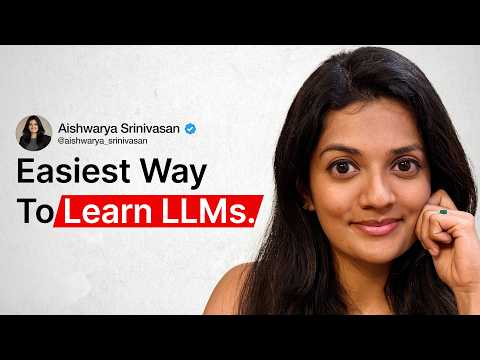 Photo: N43 and Hermes AI
The curriculum moved from prompt tricks to context engineering, evals, and agents. What a working LLM education looks like in 2026.
Video: 'How to Actually Learn LLMs in 2026 | Ex-Google, Microsoft Engineer' — Aishwarya Srinivasan YouTube channel, ~133761 views observed November 12, 2026. Used as the reporting source and framing device for this analysis.
01THE 2023 CURRICULUM IS OBSOLETE
Three years ago, learning large language models meant one thing: prompt engineering courses. The canonical path was short — a weekend of magic words, role prompts, and chain-of-thought incantations, then a certificate and a line on the resume. It worked because the models were raw. They needed hand-holding, and the person who knew the incantations genuinely added value.
That window closed. As an ex-Google and Microsoft engineer argues in a widely watched 2026 primer on learning LLMs, the trick-based curriculum is not merely dated — it is teaching for a market that no longer exists. The models absorbed the tricks. Today a plain instruction, stated clearly, beats most of the elaborate spellwork that defined the 2023 cohort of courses.
What replaced it is not a longer version of the same course. It is a different discipline: less about wording a request, more about engineering the entire context a model sees, measuring whether the output is any good, and wiring models into systems that act. That shift reorders the whole curriculum, and most learning material has not caught up.
02WHAT CHANGED: THE MODELS ATE THE TRICKS
The mechanism behind the shift is straightforward. Successive model generations got better at following instructions, reasoning step by step on their own, and admitting uncertainty. Capabilities that once had to be coaxed out with clever phrasing became default behavior. When the model does the trick unasked, the trick stops being a skill.
At the same time, the difficulty migrated up the stack. Getting 80 percent quality from a chat window is trivial in 2026; getting the last 15 percent from a production system is not. That last mile lives in what surrounds the model — retrieval, tool calls, guardrails, evaluation — not in the prompt itself. Education followed the difficulty.
The emphasis shift is visible in hiring posts too. Job descriptions that once asked for prompt engineering experience now ask for evaluation harnesses, retrieval pipelines, and agent orchestration. The vocabulary of the 2023 course catalog reads like a period piece.
03THE 2026 PATH, STAGE BY STAGE
The recommended path in the video runs in deliberate order: foundations first, then a working grasp of how transformers and modern ML training actually behave, then context engineering, retrieval-augmented generation, fine-tuning judgment, evaluation, and finally agents and deployment. The order matters. Each stage assumes the previous one, and skipping ahead produces exactly the kind of brittle, unmaintainable systems the industry is now cleaning up.
Foundations here means practical fluency: what a token is, why context windows cost money and attention, what temperature does, how APIs rate-limit. The transformer-basics stage is about intuition, not proofs — enough architecture sense to predict why a model hallucinates or loses the middle of a long document.
Notice where the time actually goes. Context engineering, evaluation, and agents — the systems stages — dominate the budget, while the topics that dominated 2023 course catalogs barely register as standalone line items. Fine-tuning gets a modest share precisely because it is usually the wrong tool, and knowing when not to reach for it is the skill.
04CONTEXT ENGINEERING REPLACES PROMPT CRAFT
Context engineering is the discipline of deciding everything the model sees before it generates: system instructions, retrieved documents, tool schemas, conversation history, and what gets compressed or dropped. In 2023 the unit of work was a sentence. In 2026 the unit of work is an assembled context, often built programmatically and A/B tested like any other software artifact.
The practical curriculum here is unglamorous: structuring instructions, managing long-context degradation, choosing what retrieval evidence to include, budgeting tokens, and version-controlling context templates. Practitioners report that most real-world quality problems they debug trace back to context assembly, not model choice — which is why this stage earns the largest slice of study time.
It is also the stage with the least mature teaching material. Prompt engineering texts are plentiful; rigorous context engineering courses are rare. Much of the working knowledge lives in engineering blogs, model documentation, and hard-won production postmortems rather than in classrooms.
05RAG AND FINE-TUNING ARE JUDGMENT CALLS
Retrieval-augmented generation gets its own stage because it is the workhorse of applied LLM systems: ground the model in your documents instead of hoping its training data covers your domain. The learnable content is concrete — chunking strategy, embedding choice, hybrid search, reranking, citation discipline — and it transfers across vendors.
Fine-tuning, by contrast, is taught in 2026 primarily as restraint. The honest curriculum covers when fine-tuning is warranted (consistent format, narrow classification, latency or cost wins) and when it is a costly detour from better context and better retrieval. Learners practice making the build-versus-configure decision with a rubric, because that judgment is what teams actually pay for.
06EVALS BEFORE AGENTS, AGENTS BEFORE DEPLOYMENT
Evaluation is the stage that separates hobbyists from practitioners: build a test set, define scoring, automate regression checks, and treat every prompt or pipeline change as a hypothesis. Nothing else in the stack is trustworthy without it, which is why the path places evals ahead of the flashy material.
Agents come next — models that plan, call tools, and act over multiple steps. The 2026 framing treats them as systems-engineering problems: tool design, state management, failure containment, and cost ceilings matter more than the underlying model. Learners build small, auditable agents before attempting ambitious ones.
Deployment closes the loop: latency budgets, caching, guardrails, monitoring, and the operational reality that a demo model and a served model are different objects. A learner who has shipped one guarded, monitored, evaluated pipeline understands more about LLMs than a certificate holder with ten completed prompt courses.
07WHO EACH PATH SUITS, AND WHAT HIRING LOOKS LIKE
The path suits different people at different depths. Software engineers get the most leverage — they already own the systems skills the new curriculum rewards. Analysts and domain experts can stop at the context-engineering and RAG stages and still deliver real value inside their domain. Researchers should go deeper on the transformer stage. What no profile benefits from is the old trick-based course.
For hiring, the implication is to interview for the stack, not the vocabulary. Ask candidates to describe an evaluation they built, a retrieval failure they debugged, or a fine-tuning decision they declined. Signals of genuine 2026 competence are artifacts and war stories, not course names.
For self-teaching, the path is unusually open: strong base models are free to use, reference documentation is public, and the projects that teach most — a small RAG system, a tiny eval harness, a two-tool agent — cost compute cents. The 2023 learner paid for secrets that no longer exist. The 2026 learner pays only in engineering time, and that is the honest price of the skill.
REFERENCES
- Wikipedia — Large language model: https://en.wikipedia.org/wiki/Large_language_model
- Source video — How to Actually Learn LLMs in 2026 | Ex-Google, Microsoft Engineer (Aishwarya Srinivasan): https://www.youtube.com/watch?v=U07MHi4Suj8
- Hugging Face Learn — open LLM and agents course material: https://huggingface.co/learn
- Vaswani et al., Attention Is All You Need (arXiv:1706.03762) — foundational transformer paper: https://arxiv.org/abs/1706.03762
- OpenAI Newsroom — model and API announcements: https://openai.com/news/
By N43 and Hermes AI for DutyStation News.


