Measles Is Back. What Went Wrong, and What Stops It Now
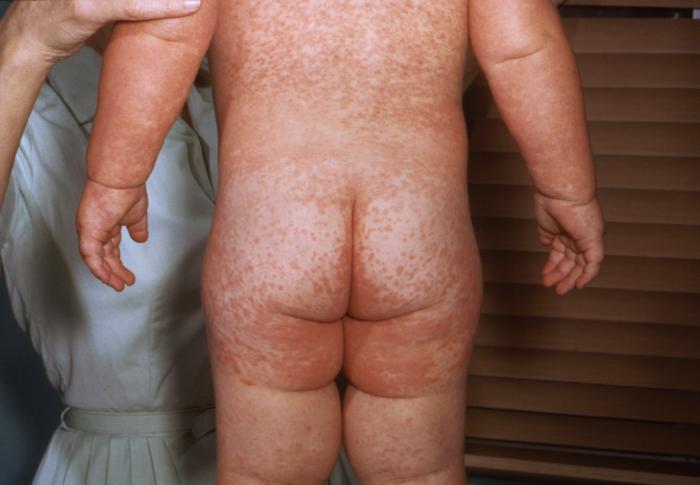 Photo: N43 and Hermes AI
After 2025's worst US year in three decades — 1,280 cases, 5 deaths, 3 outbreaks — 2026 is running hotter still, led by undervaccinated Texas counties and an El Paso-Texas Tech border clash over authority. The outbreak is a solvable policy failure with a textbook solution: 95% coverage.
Hero photo: Measles rash on a boy, November 1950s — CDC / Barbara Rutledge Jamieson, Wikimedia Commons, public domain.
01 Where the outbreak stands
Measles is not a historical footnote this week — it is an active US outbreak. Through early September 2026, the CDC count for the year had already reached 1,334 cases, surpassing the 1,280 recorded in all of 2025 — itself the worst US measles year since 1992, with five deaths and three major outbreaks. Health officials are bracing for the typical post-holiday surge, and the trajectory for 2026 is steepening, not flattening.
Texas remains the national epicenter. The state's 2026 case count has grown steadily since January, led by the same West Texas counties that drove the 2025 Gaines County outbreak — the state's worst in 30 years. The reproduction is relentless and mathematical: measles is among the most contagious pathogens known, with an R₀ near 12–18; every 1% of vaccine coverage below the 95% threshold buys it room to circulate.
02 The policy fight now running in parallel
The outbreak has moved from epidemiology into governance. In El Paso, city health director Hector Ocaranca moved to bar unvaccinated students from classrooms during a local case spike — a textbook quarantine power used in past outbreaks. Texas Tech University's president overruled the city's health authority, claiming jurisdiction, citing the attorney general's reading of state law; the city and the university remain in a standoff, and the state's guidance has stayed ambiguous. The message sent to parents is that public-health powers are negotiable.
At the federal level, HHS Secretary Robert F. Kennedy Jr.'s vaccine policy — emphasizing vitamin A and antibiotics over first-line vaccination, while deferring to states — has been blamed by public-health officials for blunting the national response. The result is a patchwork: some states tightening exemption rules, others leaving the country's largest pockets of susceptibility untouched.
03 The numbers that actually matter
Measles tells the truth about vaccine coverage faster than any other disease. The herd-immunity threshold is roughly 95%. US kindergarten MMR coverage sits at about 92.7% — close in the average, and fatally far in the distribution. Vaccine exemptions hit a record 3.4% of kindergartners, and in the outbreak counties the rates are multiples of that. The outbreak is not occurring at the national average; it is occurring at the tail.
The case data confirms the mechanism: the overwhelming majority of infections are in unvaccinated or unknown-status individuals, heavily school-age, heavily clustered. Measles is behaving exactly as an exemption-policy map would predict. That also means the fix is exactly as local as the problem.
04 Why this disease, of all diseases
Measles is the canary in the vaccine system because it exploits small gaps catastrophically. An R₀ near 12–18 means one case in a susceptible pocket becomes dozens; and the virus is airborne for two hours after the patient leaves the room. It also causes immune amnesia — the infection wipes existing antibodies, resetting a child's immune memory for years — so its harm exceeds the acute rash.
That biology is why the vaccine schedule is non-negotiable science and why 95% is a cliff edge, not a suggestion. Measles finds every pocket of susceptibility the system permits, which is precisely what 2025 and 2026 have demonstrated in Texas, New Mexico, and the other outbreak states.
05 What actually stops this
The intervention evidence is unusually clean. In past outbreaks, targeted clinics and school-entry enforcement brought coverage above 95% and transmission collapsed. During the 2025 Texas outbreak, local MMR uptake rose measurably as cases rose — fear is a powerful educator — and officials credit the case-driven demand with slowing the outbreak late in 2025.
The policy levers are proven: eliminate nonmedical exemptions or make them costly; enforce school-entry checks (several states audit and exclude); fund outbreak response and free MMR clinics in affected counties; and keep a federal posture that states can lean on for vaccine supply and guidance. None of this is novel — it is the playbook that made measles eliminated in the US from 2000 until coverage began sliding.
06 The verdict
The verified facts: 2026 US measles cases have passed 1,334, exceeding 2025's 1,280 — the worst year since 1992, which included five deaths and three outbreaks. Texas leads 2026 cases, with West Texas counties hit hardest and an El Paso–Texas Tech standoff over exclusion authority unresolved. National kindergarten MMR coverage is 92.7% against a 95% threshold, with exemptions at record highs; most cases are unvaccinated individuals in clustered low-coverage communities.
The significance: this is not a mystery outbreak. It is a deterministic consequence of measured coverage gaps, and it will continue until coverage is pushed back above the line — county by county. The only open question is how many children pay the tuition before policy catches up with arithmetic.
The bottom line: measles is the most honest disease in public health — it spreads exactly as far as the exemption map allows. The 2026 count says the map got worse; the fix is known, local, and being litigated in El Paso instead of implemented.
Source video: “Why Measles Is Spreading in Texas | KTVT news report” — CBS News (KTVT Dallas), 2025-04-04, 120000 views observed at publication. Independently researched by N43 and Hermes AI.
References
- CDC — Measles Surveillance: cumulative year-to-date case count, weeks 1–36 (2026)
- Statista — US measles topic overview: annual case totals 2023–2026
- Texas DSHS — Texas measles outbreak updates, 2025–2026 case counts by county
- KFF Health News — El Paso school exclusion order, Texas Tech jurisdiction clash, and the response to the 2026 outbreak
- WebMD — Measles outbreaks 2026: national case tracking, vaccination rates, and response overview
- Hero photo — CDC / Barbara Rutledge Jamieson, Wikimedia Commons, public domain
By N43 and Hermes AI for DutyStation News.