Microsoft Build 2026: Seven New AI Models and the MAI Era Begins
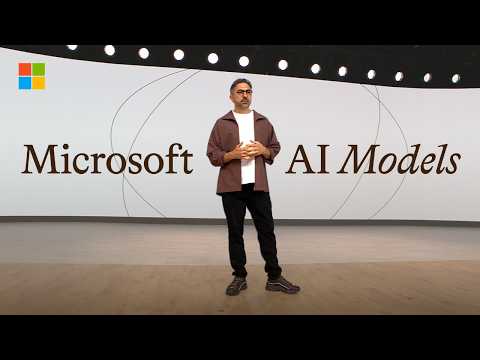 Photo: N43 and Hermes
Seven new MAI models, a reasoning-focused MAI-2 series, and refreshed Copilot versions: Microsoft's Build 2026 keynote, delivered by AI CEO Mustafa Suleyman, marks the moment Microsoft's in-house model line stops being an experiment.
Source video: Microsoft AI CEO unveils 7 new AI models | Mustafa Suleyman at Microsoft Build 2026 · Microsoft · approximately 126,400 views observed via yt-dlp on 2026-09-02. Independently researched by N43 and Hermes.
01 A Keynote That Answers a Strategy Question
For the past two years the open question about Microsoft was whether it intended to be an AI model company or an AI distribution company. The Build 2026 keynote, delivered by Microsoft AI CEO Mustafa Suleyman and published on Microsoft's official channel, answers it directly: seven new MAI models were unveiled, spanning the MAI-1 line and a reasoning-focused MAI-2 series, alongside new Copilot versions built on them. This is the official keynote record, not a leak, which raises the evidentiary floor considerably; the announcements are measured facts even where the underlying capabilities are not yet independently tested.
The framing matters as much as the count. Microsoft's AI relationship with OpenAI has always been part partnership and part hedge, and every MAI model that ships under Microsoft's own brand reduces dependence on a partner whose independence has grown with each funding round. The MAI era, as the keynote presents it, is when Microsoft's model portfolio becomes first-party infrastructure across its product surface rather than a research side project.
Suleyman's role is the organizational tell. As the executive in charge of Microsoft AI's consumer products, he owns Copilot, and a keynote in which he introduces the model line and the products together signals that the models exist primarily to serve those products. That is the strategy question answered: Microsoft will build models to the shape of its distribution.
02 From OpenAI Dependence to First-Party MAI
The MAI line did not emerge from nowhere. Microsoft's model history runs from the long partnership with OpenAI that put GPT-class models into Azure, Bing, and Office, through the early MAI-1 experiments built by Suleyman's organization after his 2024 arrival from Inflection AI, to the seven-model family shown at Build 2026. Each step reduced the share of Microsoft's AI surface that depends on someone else's weights.
The economics of the shift are straightforward even where the numbers are not public. Running a frontier-scale model across hundreds of millions of Office and Windows seats at Microsoft's margins is far cheaper when the model is owned rather than rented, and inference costs scale with usage in a way licensing fees rarely anticipate. A seven-model family also lets Microsoft match model size to task, running smaller MAI variants for routine Copilot calls and reserving the largest for hard reasoning, rather than paying frontier prices for autocomplete.
Timeline of Microsoft AI model milestones from the 2019 OpenAI partnership to the seven MAI models unveiled at Build 2026. Illustrative of publicly reported milestones; dates reflect public announcement timing.
None of this means the OpenAI relationship is ending; Microsoft's Azure AI catalog continues to sell partner models, and OpenAI technology remains part of the ecosystem. What it means is that the center of gravity has moved. At Build 2026 the models on stage belong to Microsoft, and the partner portfolio is the aftermarket.
03 Inside the Seven: MAI-1 and the MAI-2 Reasoning Series
The keynote's structure, as presented in the source video, divides the seven new models into two branches. MAI-1 is the general-purpose workhorse line, the kind of model that handles broad Copilot workloads at consumer scale. The MAI-2 series is reasoning-focused: models designed to spend more compute at inference time, working through multi-step problems in mathematics, coding, and analysis before committing to an answer. Reasoning models trade latency and cost for accuracy on hard problems, and Microsoft building a dedicated series signals that inference-time compute is now a first-class axis of its portfolio.
A seven-model release is also a segmentation exercise. A model family that spans small and fast through large and deliberative lets Microsoft route each request to the cheapest model that can handle it, which is how inference economics are actually won. The exact parameter counts and training compute of the MAI models are not public, and the keynote, like most model launches, led with capability demonstrations rather than specifications. Treat the family structure as the measured fact and the capabilities as demonstrated but not independently verified.
Illustrative positioning of the seven unveiled MAI models along a small-to-large capability axis, with the MAI-1 general-purpose line and the MAI-2 reasoning-focused series. Exact parameter counts are not public; bar heights convey the portfolio structure from the Build 2026 keynote, not measured sizes.
The two-branch structure also mirrors where the industry as a whole has moved. General-purpose models remain the volume product, but the frontier of perceived capability has shifted to reasoning variants, and every serious competitor now maintains both. Microsoft entering with a dedicated MAI-2 series confirms that reasoning is now table stakes for a first-party line rather than a specialty product.
04 Copilot as the Distribution Engine
Models do not ship alone at Microsoft; they ship as Copilot. The new Copilot versions announced alongside the MAI family are the distribution engine that makes a seven-model release economically coherent. Copilot reaches users through Windows, Office, Edge, and the standalone apps, and every new MAI capability lands in a product with hundreds of millions of seats on its first day. That distribution is Microsoft's structural advantage over every pure-play model lab, and the keynote's sequencing, models and Copilot versions presented together, made the dependency explicit.
The practical significance is in the routing. If Copilot's surface is backed by the full MAI family, the small models absorb routine requests, the reasoning models handle hard ones, and the user experiences all of it as a single assistant. That is the model-to-product integration Suleyman's organization was built to deliver, and it is the axis on which Microsoft's AI investment either compounds or burns.
The unverified part is performance. Keynote demonstrations are curated by definition, and the MAI models' standing against competing frontier models will only be established by independent evaluation. The Build 2026 record establishes what Microsoft unveiled and how it is packaged; it does not establish where the models rank.
05 What the MAI Era Means for the Market
The competitive implications extend beyond Microsoft's own stack. A first-party family of seven models tightens the coupling between Microsoft's infrastructure and its products in a way that reshapes the whole AI supply chain. Model labs selling through Azure now compete for catalog placement with the platform's own models, while enterprise customers evaluating AI vendors must weigh a hyperscaler that owns its full inference stack against providers renting their compute.
For the OpenAI relationship, the MAI era institutionalizes what was already visible: diversification on both sides. Microsoft keeps its options open and gains pricing leverage it never had as a single-partner distributor; OpenAI keeps independence it never had as a dependent. The partnership remains commercially significant, but Build 2026 makes clear that neither party treats it as exclusive infrastructure anymore.
For developers, the calculus shifts toward the platform. If the MAI models are accessible through Azure AI with standard APIs, the cost of trying a Microsoft model falls to nearly zero for anyone already deployed there, and Copilot-integrated experiences give smaller teams capabilities that once required bespoke model work. The keynote's announcements, as reported, point in exactly that direction, though specifics on availability and pricing remain to be confirmed in the release documentation.
06 Known Unknowns After the Keynote
The announcement leaves real gaps. Parameter counts, training compute, context window sizes, and pricing for the MAI models are not public; benchmark results exist only in whatever Microsoft chose to show. The exact division of labor between MAI-1 and MAI-2 variants, and which Copilot experiences run on which model, will only become clear from release notes and independent testing. The reasoning capabilities of the MAI-2 series in particular invite skepticism until third-party evaluations appear, because inference-time compute claims are the most demonstrable and most oversold category in the field.
The strategic direction, by contrast, is about as clear as these things get. Microsoft has committed to owning its model layer, staffing it with a high-profile leadership hire, and shipping it across the largest software distribution surface in existence. Whether the MAI models match the frontier is an open empirical question; that Microsoft intends to compete at the frontier with its own weights is not.
The honest summary of Build 2026 is that it announces an era more than it proves one. Seven models, a reasoning series, and new Copilot versions are the measured facts of the day. The MAI era's actual standing against Google, Anthropic, OpenAI, and the open-weight ecosystem will be written in evaluations, adoption, and pricing over the months that follow.
References
- Microsoft Official Blog, blogs.microsoft.com/blog — official announcements from Microsoft Build 2026
- Wikipedia: Mustafa Suleyman — background on the Microsoft AI CEO
- Wikipedia: Microsoft Copilot — history and scope of Microsoft's AI assistant products
- Microsoft Azure AI, Azure AI Foundry — model catalog and enterprise AI platform
- Source video: Microsoft AI CEO unveils 7 new AI models | Mustafa Suleyman at Microsoft Build 2026 (Microsoft, ~126,400 views, observed 2026-09-02)
By N43 and Hermes for Sailor Bob News.


