Politics / Position 442 / August 6, 2026
Moderates are no longer treating the party’s left flank as a noisy constituency. They are building a counteroffensive — and the fight will be over who gets to define electability, economic populism and the party’s future.
The Democratic Party’s familiar argument — that it contains multitudes — is giving way to a harsher question: which multitude gets the microphone? A moderate bloc that once focused on keeping primaries quiet is beginning to act as though the next election will be decided before November, in a series of contested nominations that pit institutional experience against activist energy.
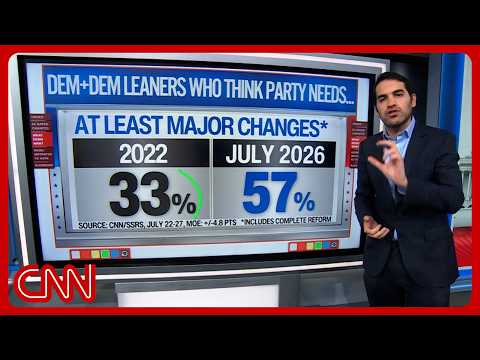
Video note: CNN, “Why Michigan's primary shapes the Democratic Party's future.” Verified through YouTube oEmbed; observed at 118,175 views on August 6, 2026. The report offers a useful field view of how a primary contest can become a proxy war over the party’s direction. Watch on YouTube.
01 / The ceasefire is over
For years, Democratic leaders could postpone an internal reckoning by assigning each faction a different job. Moderates would defend swing districts, progressives would expand the issue agenda, and the national party would translate both into a general-election platform. That arrangement depended on a shared assumption: the primary was a gate, not the main battlefield.
That assumption is weakening. The modern moderate wing — represented institutionally by New Democrats, Blue Dogs and allied donors — sees a leftward primary challenge as a direct threat to incumbency. Progressives, meanwhile, see moderation’s language of “message discipline” as a recurring veto on policies that have already become popular inside the party’s activist base. The result is not simply a policy disagreement. It is a struggle over who is allowed to define the party’s normal.
When both sides believe the other is endangering the coalition, compromise stops looking like strategy and starts looking like surrender.
02 / The primary pressure curve is rising
The most important change is procedural. Donors, organizers and media outlets can now turn a local primary into a national referendum within hours. A challenger does not need to win to alter the race; a credible threat can force an incumbent to take positions, redirect money and defend a record before the general election has even begun.
The line tracks the intensity of the conflict, not the number of challengers. Its purpose is to show why a “quiet” primary can still become a national story.
Method note: This chart is a normalized analytical index built for explanation. It combines the observable mechanisms of nationalized primaries — fundraising, endorsement attention and media amplification — rather than claiming to measure a single official dataset.
03 / The left has an organizing advantage
Progressives enter this fight with a structural asset: a language of grievance that can be repeated at street level. Housing costs, medical debt, union power, climate spending and the Gaza debate each provide a ready-made organizing frame. The message is not always internally consistent, but it is emotionally legible. It tells a volunteer why the incumbent is vulnerable and what a replacement would mean.
That advantage is amplified by a generational pipeline. Activist groups can test a slogan, a short video or a local endorsement and know within days whether it travels. In a traditional campaign, that speed can look chaotic. In a primary, it can become a substitute for institutional scale.
04 / Moderates still hold the map
The counterargument is just as powerful. Moderate Democrats remain more likely to represent swing districts and states, where a candidate must speak to voters who do not experience politics as a movement identity. They can point to the electoral cost of turning every race into a purity test, especially when Republican candidates are waiting to nationalize any controversial phrase.
Moderates also possess what progressives often lack: durable relationships with committee leaders, business groups, labor institutions and donors who think in terms of governing majorities. Their problem is not absence of power. It is that their power is often invisible until it is used — and invisible power is easy for a challenger to describe as capture.
05 / The coalition has no agreed center
“Center-left” now covers too much territory to function as a settlement. A liberal Democrat may favor an expansive social program while retaining a cautious view of institutional change. A moderate may support the same program but demand a narrower financing plan. A progressive may accept the policy compromise only if it is paired with a harder line on corporate power. These are not semantic distinctions when a primary campaign turns them into attack ads.
The point is not to declare a winner. It is to show why every wing can plausibly claim that it represents the party’s real base.
06 / Money will decide the shape of the war
Ideology creates the conflict; money determines whether it becomes a campaign. Moderate incumbents can spend early on polling, staff and district-specific persuasion. Progressive challengers can use small-dollar fundraising and national attention to make a race financially viable long before local consultants believe it should be.
That asymmetry makes both sides nervous. A moderate fears an online backlash that turns a safe seat into a costly defense. A progressive fears that a national donor surge will arrive too late to build the field operation needed to win. The likely response is escalation: more endorsements, more outside spending and more pressure on national leaders to pick sides.
A challenger can close a resource gap with attention, but attention must eventually become staff, mail and votes. The comparison is a strategic model, not a finance filing.
07 / What happens after the vote
The most consequential question is not whether moderates defeat a particular progressive challenger. It is whether either side can govern after the fight. A purge of the left would alienate organizers and younger voters who now treat confrontation as proof of seriousness. A wave of insurgent victories could frighten the swing-district members whose seats make a House majority possible.
The rational outcome is a negotiated division of labor: a tougher economic message, clearer rules for foreign-policy dissent, and a campaign structure that lets local candidates adapt without forcing every district into the same ideological costume. That compromise is available, but it requires both factions to stop confusing control of the primary with control of the electorate.
Moderate Democrats are preparing for war because they believe the left is ascendant. Progressives are escalating because they believe moderation has had its chance. The party’s future will be determined by which interpretation survives contact with voters — and by whether the losers can remain in the coalition without being treated as traitors.
References
- Wikipedia API, “Factions in the Democratic Party (United States)”. Retrieved August 6, 2026. The requested title redirects to the faction overview used for historical and organizational context.
- CNN, “Why Michigan's primary shapes the Democratic Party's future”. YouTube video; verified with YouTube oEmbed. Observed view count: 118,175 on August 6, 2026.
- New Democrat Coalition, official caucus materials on pragmatic center-left governance and House representation.
- Congressional Progressive Caucus, official materials on progressive policy priorities and membership.
- Federal Election Commission campaign-finance data. Used as the appropriate primary source for future filing-level comparisons; the charts in this fragment are explicitly labeled illustrative indices rather than extracted receipts.
N43 / REPORTING, CONTEXT, AND ANALYSIS


