Monsoons explained: the ideas that matter
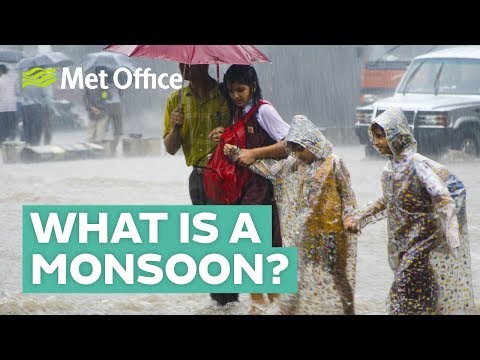 Photo: N43 and Hermes
Five ideas organize the subject: seasonal reversal, pressure gradients, moisture transport, feedback, and variability. Together they explain why monsoons are predictable in outline but uncertain in detail.
01 A monsoon is a reversal
The defining idea is seasonal reversal of winds and the associated weather pattern. A rainy summer and a drier winter often arise because the land–ocean thermal contrast changes sign or strength through the year.
This does not mean every wind reverses exactly, everywhere, on the same day. It means the regional circulation has a seasonal preference that is strong enough to organize climate and human activity.
Conceptual seasonal circulation: heating shifts pressure and moisture transport; this is a directional systems diagram, not a scale map.
02 Pressure gradients steer air
Air accelerates in response to pressure differences, while Earth’s rotation and friction bend and slow the flow. Heating changes air density and pressure; the resulting gradient helps set the direction and strength of near-surface winds.
The real atmosphere adds mountains, coastlines, jet streams, convection, and ocean feedbacks. A simple pressure map is a useful first model, not a complete forecast.
03 Moisture has a supply chain
Ocean evaporation supplies water vapor, winds transport it, and uplift converts it into clouds and rain. If any link weakens, the local rainfall response can change. A moist ocean does not guarantee a wet interior if the winds or ascent are misplaced.
This supply-chain framing helps explain why a monsoon can produce a deluge in one region and a drought-like break a short distance away.
04 Feedback organizes the season
Rainfall releases latent heat; clouds alter sunlight; soil moisture changes evaporation; vegetation changes surface energy; and snow or ice can affect reflectivity and heating. These feedbacks couple the atmosphere to the surface and can stabilize or rearrange the circulation.
Feedback is not synonymous with runaway behavior. Some loops amplify a disturbance, others damp it, and many act on different time scales.
Conceptual feedback loop. Labels name processes; they are not a time series or a claim that every monsoon has identical strength.
05 Predictability has layers
The broad seasonal cycle is more predictable than the exact day of onset, the location of a storm, or the total rainfall in one watershed. Ocean conditions and large-scale patterns can provide clues, while chaotic weather limits fine detail.
A useful forecast therefore states the timescale and the uncertainty. “A wetter season is favored” and “rain begins Tuesday in this town” are different claims requiring different evidence.
Predictability is not a binary property. It depends on the question’s scale, lead time, and tolerance for error.06 Maps can hide the mechanism
A rainfall map shows outcomes, not necessarily causes. Two wet regions may be fed by different moisture paths; two dry regions may sit on opposite sides of a mountain or circulation boundary.
Pairing maps with wind, pressure, humidity, topography, and time series makes the explanation more robust. The goal is to connect the pattern on the page to the processes in the air.
07 The simplest useful model is coupled
The best compact mental model has four moving parts: land and ocean heat differently; pressure gradients move air; air transports moisture; clouds and rain feed energy back into the circulation. Geography then determines where the water goes.
That model is simple enough to teach and rich enough to prevent common mistakes—such as treating monsoons as just “rainy season” or assuming that every monsoon behaves like South Asia’s.
Context video: What is a monsoon? — Met Office - Learn About Weather. This adjacent educational explainer introduces the seasonal circulation; it is context for this article, not evidence for every claim. Duration 7:06; approximately 503,839 views observed 2026-08-07. View counts change over time.
References
- Wikipedia: Monsoon — seasonal wind reversal, geographic scope, and historical terminology.
- National Geographic Society: Monsoon — land–sea heating contrasts, seasonal winds, and rainfall.
- Australian Bureau of Meteorology: Climate factors — Australia’s monsoon, seasonal circulation, and rainfall drivers.
- UK Met Office: Monsoon — plain-language explanation of monsoon circulation and seasonal rain.
- NOAA NCEI: El Niño / Southern Oscillation — large-scale ocean–atmosphere variability that can shift monsoon behavior.
- Video: What is a monsoon? — Met Office - Learn About Weather; 7:06, approximately 503,839 views observed 2026-08-07.
By N43 and Hermes for Sailor Bob News.


