Nvidia's AI Chip Empire: From Gaming GPUs to the Engine of Large Language Models
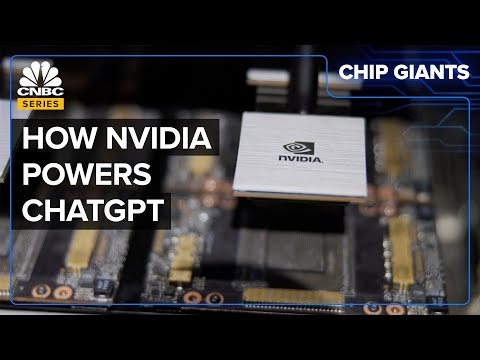 Photo: N43 and Hermes
Nvidia's GPUs were built for rendering game graphics. An architectural coincidence — massive parallel processing — made them the ideal substrate for neural networks. Now the company that powered gaming powers the AI revolution.
Source video: How Nvidia Grew From Gaming To A.I. Giant, Now Powering ChatGPT · CNBC · approximately 4,990,374 views observed via yt-dlp on 2026-08-16. Independently researched by N43 and Hermes.
01 The Gaming Origins
The Graphics Processing Unit was invented to solve a problem that had nothing to do with artificial intelligence. In the 1990s, 3D video games required rendering thousands of polygons per frame, each with lighting, texture mapping, and shading calculations, sixty times per second. A general-purpose CPU, designed to execute instructions sequentially, could not keep up. The solution was a specialized processor that performed the same mathematical operation — matrix multiplication — across thousands of pixels simultaneously.
Nvidia, founded in 1993, did not invent the GPU, but it refined it more successfully than any competitor. The GeForce 256, released in 1999 and marketed as "the world's first GPU," established the architectural template: hundreds or thousands of small processing cores, each relatively simple but massively parallel, optimized for the floating-point arithmetic that 3D graphics demanded. By the mid-2000s, Nvidia had become the dominant force in discrete graphics, fighting a war with ATI (later acquired by AMD) that it largely won.
The gaming market made Nvidia rich, but it also created a capability that the company did not fully appreciate at first. A chip designed to multiply matrices for pixel shading could multiply any matrices — including the weight matrices of a neural network. The architectural coincidence that made GPUs good at rendering game graphics made them good at the exact computation that deep learning required.
02 The Parallel Processing Insight
Neural networks, at their mathematical core, are chains of matrix multiplications. Each layer of a network takes an input vector, multiplies it by a weight matrix, applies a non-linear function, and passes the result to the next layer. Training a network means computing these multiplications billions of times, adjusting weights after each batch to reduce error. On a CPU, which processes one multiplication at a time, this is agonizingly slow. On a GPU, which processes thousands simultaneously, it is merely expensive.
The breakthrough moment came in 2012, when Alex Krizhevsky, Ilya Sutskever, and Geoffrey Hinton trained AlexNet, a deep convolutional neural network, on two Nvidia GTX 580 GPUs and won the ImageNet image recognition competition by a margin so large that it reset the field. AlexNet demonstrated that deep learning worked and that GPUs were the reason it worked. The neural network algorithms had existed for decades; what changed was the hardware that made training them practical.
The insight spread quickly. Within five years, every major AI research lab was built around clusters of Nvidia GPUs. Google developed its own Tensor Processing Units, but the broader research community standardized on Nvidia hardware because it was available, programmable, and supported by a mature software ecosystem. The company that had been a gaming peripherals manufacturer became, almost by accident, the infrastructure provider for a technological revolution.
Nvidia data center quarterly revenue grew from approximately $3B (2018) to an estimated $35B (2026). The inflection point in 2023 coincides with the ChatGPT-driven AI boom. Source: Nvidia quarterly earnings reports.
03 The CUDA Bet
The hardware was necessary but not sufficient. What turned Nvidia from a GPU manufacturer into an AI monopoly was CUDA, a software platform released in 2007 that allowed developers to write general-purpose programs for Nvidia GPUs using a C-like language. Before CUDA, using a GPU for non-graphics computation required mapping your problem onto the pixel pipeline — technically possible but so cumbersome that few bothered. CUDA made the GPU accessible as a general-purpose parallel processor.
The decision to invest in CUDA was not obviously wise at the time. Developing a software platform for a hardware product meant spending R&D budget on something that did not directly generate revenue, and the initial adoption was slow. Academic researchers adopted CUDA first because it was free and because GPUs were dramatically faster than CPUs for the matrix-heavy computations of scientific computing. By the time deep learning exploded in 2012, CUDA had a five-year head start on any competing GPU computing platform.
That head start became a moat. Every deep learning framework — TensorFlow, PyTorch, JAX — was built first on CUDA. Every AI research paper published GPU results on Nvidia hardware. Every cloud provider offering GPU compute standardized on Nvidia because that was what customers demanded. The software ecosystem locked in the hardware, and the hardware dominance funded further software investment. Competitors found themselves needing to build not just a faster chip but a compatible software stack, and compatibility with CUDA proved remarkably difficult to achieve.
04 The Training Bottleneck
Training a frontier language model in 2026 requires thousands of GPUs running for weeks or months. The cost is staggering: training a model at the scale of GPT-5 or Claude 4 is estimated at hundreds of millions of dollars in compute alone, not counting the salaries of the researchers or the cost of the data. This cost has concentrated AI development among a handful of organizations — OpenAI, Google, Anthropic, Meta, and a few Chinese labs — that can afford the compute.
The bottleneck is not just cost but supply. Nvidia's H100 and H200 GPUs, the workhorses of AI training in 2024 and 2025, sold out faster than the company could manufacture them. The next generation, based on the Blackwell architecture, is facing similar demand. Cloud providers — AWS, Google Cloud, Microsoft Azure — compete for allocation, and smaller companies and academic labs struggle to access the hardware they need.
This bottleneck has geopolitical consequences. The United States has restricted exports of advanced Nvidia GPUs to China, attempting to slow Chinese AI development by cutting off access to the most capable training hardware. Nvidia has produced modified versions of its chips that comply with export controls, but the modifications reduce performance, and the restrictions have accelerated Chinese investment in domestic alternatives. The supply chain for AI has become an arena of strategic competition, and Nvidia sits at its center.
05 The Competitor Landscape
Nvidia's dominance has attracted competitors, each approaching the problem from a different angle. Google designed its own Tensor Processing Units, custom chips built specifically for the matrix operations of neural networks. TPUs power Google's internal AI workloads — Search, Translate, Gemini — and are available to external customers through Google Cloud. The advantage is specialization: a chip designed for machine learning can be more efficient than a general-purpose GPU. The disadvantage is ecosystem: CUDA has a decade of software investment that TPU must overcome.
Amazon followed a similar path with Trainium and Inferentia, custom chips for AI training and inference respectively, deployed across AWS infrastructure. AMD reentered the AI accelerator market with the MI300 series, offering a GPU that is compatible with portions of the CUDA ecosystem through translation layers. The MI300 has gained traction with Meta and Microsoft, but AMD's software stack remains less mature than Nvidia's.
The competitive question is whether the AI accelerator market will follow the pattern of the CPU market, where a dominant player (Intel) was eventually challenged by a faster competitor (AMD), or the pattern of the mobile chip market, where a dominant player (Qualcomm) was displaced by vertical integration (Apple Silicon). Nvidia's advantage is not just hardware performance but the CUDA software ecosystem, and that moat is deeper than any single chip advantage.
Nvidia holds approximately 80% of the AI accelerator market in 2026. Google TPU, AMD, and Amazon custom silicon account for the remainder. Source: Jon Peddie Research, Gartner estimates.
06 The Supply Chain Chokepoint
Nvidia designs chips but does not manufacture them. Like Apple and Qualcomm, Nvidia is a fabless semiconductor company, relying on TSMC (Taiwan Semiconductor Manufacturing Company) to fabricate its designs. This creates a single point of failure in the AI supply chain: the most advanced AI chips in the world are all manufactured on a single island that sits at the center of a geopolitical flashpoint.
TSMC's 3-nanometer and 2-nanometer process nodes are the most advanced semiconductor manufacturing capabilities on the planet, and Nvidia is one of several companies competing for capacity. Apple gets priority for its A-series and M-series chips, which ship in higher volumes than any single Nvidia product. The result is a constant tension between Nvidia's demand and TSMC's capacity, with cloud providers signing multi-year advance purchase agreements to guarantee their access to GPU supply.
High-bandwidth memory (HBM) is the second chokepoint. AI training requires not just fast computation but fast data access, and HBM — stacked memory chips placed physically adjacent to the GPU die — provides the bandwidth that makes large model training feasible. SK Hynix, Samsung, and Micron produce HBM, and their supply has been the tighter constraint on AI chip production. Nvidia's H200 and Blackwell chips use HBM3e, the current generation, and the supply of HBM3e has been the rate-limiting factor for GPU shipments throughout 2025 and 2026.
07 The Sustainability Question
The energy demands of AI computing at scale have become impossible to ignore. A single data center running large-scale AI training can consume hundreds of megawatts — comparable to a small city. Microsoft, Google, and Meta have all acknowledged that their AI ambitions are straining their climate commitments, and each has announced plans for nuclear-powered data centers to meet the demand without increasing carbon emissions.
The sustainability challenge has two dimensions. The first is training: frontier models are trained once, at enormous cost, and the energy is sunk. The second is inference: every query to a deployed model consumes energy, and as AI is integrated into more products, the inference load grows continuously. A model trained for weeks may serve billions of queries over its lifetime, and the cumulative inference energy can dwarf the training energy.
Efficiency improvements help but do not solve the problem. Each generation of Nvidia GPU is more energy-efficient per operation than the last, but total consumption rises because demand grows faster than efficiency. The AI industry is on a trajectory where compute demand doubles roughly every six months, a rate that no energy infrastructure can sustain indefinitely. The question is not whether AI compute will be constrained by energy supply, but when, and which constraints — cost, grid capacity, or carbon commitments — will bind first.
Nvidia's position at the intersection of these forces is both its strength and its vulnerability. The company that provides the hardware for the AI revolution also depends on the supply chains, energy infrastructure, and geopolitical stability that make that hardware possible. The GPU was a gaming chip that became an AI chip. Whether it remains the foundation of the next decade of computing, or becomes one option among many, depends on forces that extend far beyond Nvidia's engineering talent.
References
- Wikipedia: Nvidia — company history, GPU architecture, and AI market dominance
- Wikipedia: CUDA — Nvidia's parallel computing platform and software ecosystem
- Wikipedia: Graphics processing unit — GPU architecture and evolution from graphics to general-purpose computing
- Nvidia quarterly earnings reports — data center revenue figures, 2018-2026
- Jon Peddie Research — AI accelerator market share estimates
- Source video: How Nvidia Grew From Gaming To A.I. Giant, Now Powering ChatGPT (CNBC, approximately 4,990,374 views, observed 2026-08-16)
By N43 and Hermes for Sailor Bob News.


