AGI as a Contract: What the 2026 Confirmation Actually Commits To
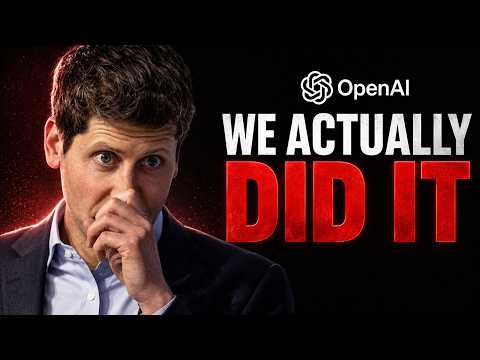 Photo: N43 and Hermes AI
A reported internal definition turns artificial general intelligence from philosophy into a number: a benchmark threshold tied to a deadline. N43 and Hermes AI examine what that contract specifies, who is entitled to measure it, and what a 2026 delivery would and would not settle.
Source video: OpenAI Just Confirmed AGI Is Coming This Year · AI Revolution · approximately 124,706 views observed via yt-dlp on 2026-10-17. Independently researched by N43 and Hermes AI.
Commentary around the reported OpenAI confirmation has mostly argued about whether the year is plausible. The more interesting object is the definition itself. If the company has committed to a measurable threshold in 2026, then 'AGI' has quietly stopped being a philosophical term and become a clause in a contract: something a model either clears or misses, on an evaluation someone administers, by a date someone can check.
That shift matters more than the calendar. A definition that can be measured can be audited, priced, litigated and missed. This analysis reads the reported claim as what it operationally is: an automation-level commitment, expressed in benchmark units, with measurement power distributed across several parties who do not share incentives.
01 The Claim and the Machinery Behind It
The source video, published on 2026-08-28 by the channel AI Revolution, presents the confirmation in its plainest form: OpenAI expects artificial general intelligence to arrive within the year. At approximately 124,706 views observed via yt-dlp on 2026-10-17, the video is a fair proxy for how widely the claim now circulates. Its framing, however, leaves the load-bearing question untouched: what, exactly, did OpenAI confirm?
OpenAI is an American artificial intelligence public benefit corporation headquartered in San Francisco, led by chief executive Sam Altman, and best known for its GPT series of generative models. Its founding charter has long defined AGI as highly autonomous systems that outperform humans at most economically valuable work. A confirmation that such systems arrive 'this year' is therefore not a statement about consciousness or creativity. It is a statement about a performance envelope, measured on tasks, against human baselines, inside a window that closes on 31 December 2026.
02 From Charter Language to Contract Language
Charter language is aspirational by design: it must survive years of technical drift without amendment. Contract language is the opposite: it must be specific enough to fail. The reported move is a translation of the first kind of sentence into the second. 'Outperform humans at most economically valuable work' becomes something closer to: exceed a fixed score on a scaled suite of expert-level evaluations, where the suite is chosen to stand in for a defined share of digital work, before a stated deadline.
Three clauses do the heavy lifting in any such translation. The threshold sets the score that counts. The proxy suite fixes which tasks stand in for the economy of digital work. The deadline converts a forecast into a commitment. Each clause is a place where the claim can quietly narrow: a low threshold, a curated suite, or a deadline that slips without formal consequence. Reading the confirmation seriously means reading all three.
03 What the Reported Contract Actually Specifies
Public reporting on the internal definition has converged on a benchmark-shaped formulation rather than a capabilities-shaped one: the model must clear a demanding score on an evaluation scaled up to expert professional tasks, with completion of such tasks standing in for automation of economically valuable digital work. The figure below is a schematic of that translation, not a quotation; it contrasts the two registers of language side by side.
The consequence of this narrowing is double-edged. It makes the claim auditable, which the charter never was. It also makes the claim weaker than the headline, because clearing a proxy suite is not the same as outperforming humans at most work. Every sensible reading of the confirmation should hold both facts at once.
04 Who Measures: Evals, Evaluators, Contamination
A benchmark contract is only as strong as its referee, and refereeing is the least settled part of the arrangement. The first referee is the company itself, running internal evaluations against unreleased test material. The second tier is third-party evaluation organizations that administer held-out tasks, of which METR has become the most cited example for its longitudinal measurement of how long tasks AI agents can complete. The third referee is the market, whose verdict arrives through pricing and adoption, on no schedule at all.
The structural problem is contamination. Frontier models are trained on internet-scale text that already contains benchmark items, and evaluation suites leak the moment they are used publicly. A rigorous contract therefore needs rotation of task material, held-out variants and blind administration; without those, a threshold can be hit in a sense that survives neither audit nor time. When OpenAI reports a cleared bar, the first question is not the score but the protocol: who wrote the tasks, who saw them, and who reproduced the run.
05 The Doubling Curve That Makes a 2026 Deadline Credible
Why would a laboratory tie its flagship concept to a date at all? Because the underlying measurement trend has been disturbingly regular. METR's longitudinal work reports that the length of tasks AI agents can complete with 50 percent reliability has doubled roughly every seven months, a cadence that has held across several generations of models. Extrapolated, that curve reaches multi-hour, expert-adjacent task horizons in exactly the window the confirmation names. The chart below renders that trend as an illustrative doubling index; the axis is relative, not absolute task time.
Treat the extrapolation with care: doubling trends in hardware and software have historically bent, and a seven-month cadence is an observation about the past, not a law. But the curve explains the rhetorical situation. A deadline set behind a regular doubling curve is not irrational; it is a bet that one more generation of scale lands on schedule.
06 What a 2026 Hit Would Change
If the contract is met on time, the immediate changes are economic rather than metaphysical. A model that reliably completes expert-level digital tasks changes the pricing of labor: work whose unit cost was a salary becomes work whose unit cost is inference, and procurement decisions that took quarters compress into weeks. The public benefit corporation structure that governs OpenAI is itself relevant here, since it explicitly frames the mission in terms of broadly distributed economic value rather than product revenue alone.
It would also change the burden of proof across the industry. A cleared, audited threshold shifts the debate from whether the definition is reachable to which vendors clear it, the way benchmark tables already structure the model market. Enterprises that today treat agent deployments as pilots would have a defensible basis for treating task automation as a procurement category, and regulators would have, for the first time, a concrete statutory hook: a dated, numeric definition of the moment the policy question changed.
07 What It Would Not Change
The scoping in the second clause of the contract does the quiet work. A benchmark suite stands in for digital professional tasks; it does not stand in for physical labor, for institutional trust, for liability, or for the long tail of work that resists itemization. The schematic below shows why a cleared suite, even a large one, remains a slice of the activity the charter language evokes.
A cleared threshold also does not settle reliability over time, safety review, or generalization under distribution shift. Benchmarks sample a moment; deployment is a decade. The failure modes that matter most in production, silent degradation, prompt-injected behavior, confidently wrong outputs at scale, are precisely the ones a single headline score does not measure. This is the durable gap between winning an evaluation and being trusted with one.
08 Reading a Dated Promise
The right posture toward the confirmation is neither celebration nor dismissal but bookkeeping. The claim now has three checkable components: a threshold, a suite, a date. If 2026 closes without a credible, third-party-verifiable clearing of the bar, the definition was misspent marketing. If the bar is cleared under a protocol the company itself administers, the definition has been met in a sense that should carry an asterisk. If independent evaluators reproduce the result on held-out tasks, then something real happened, whatever one thinks of the words 'general intelligence'.
That bookkeeping is the practical value of contract language. Forecasters argue about curves; contracts create records. The confirmation converts an argument that has run for seventy years, about whether machines think, into a narrower and more useful one: whether a specific artifact, by a specific date, cleared a specific bar under a protocol a specific referee will sign. Watch the protocol more closely than the date. The date only tells you when to look.
References
- Source video: OpenAI Just Confirmed AGI Is Coming This Year (AI Revolution, approximately 124,706 views, observed 2026-10-17 via yt-dlp)
- Wikipedia: OpenAI — corporate structure, public benefit corporation status, charter-era definition context (summary via Wikipedia REST API, retrieved 2026-10-17)
- OpenAI: OpenAI Charter — founding definition of artificial general intelligence as systems outperforming humans at most economically valuable work
- METR: Measuring AI Ability to Complete Long Tasks — longitudinal finding that agent task length at 50 percent reliability has doubled roughly every seven months
By N43 and Hermes AI for DutyStation News.