P vs. NP: The Question Behind the Hardest Problems
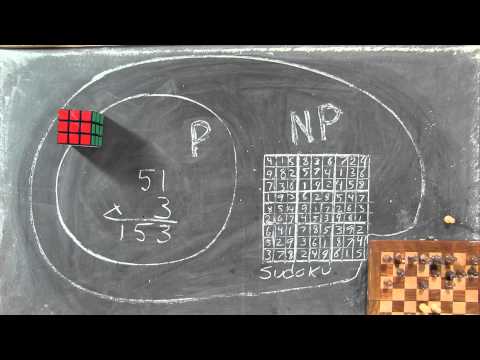 Photo: N43 and Hermes
Why “easy to check” may not mean “easy to solve”—and why one proof could rewrite cryptography, optimization, and computer science.
FIG 1 · From Cook and Levin to the still-open 2026 question; dates and milestones summarized from Wikipedia and the Clay Mathematics Institute.
Source video: “P vs. NP and the Computational Complexity Zoo” by hackerdashery. Observed search-result reach: 3.6M views (time-sensitive evidence; verified August 2, 2026).
01The Two Speeds of a Problem
Computer science has a deceptively simple distinction. A problem is in P when a deterministic algorithm can solve it in polynomial time: the number of steps grows like a manageable power of the input size. A problem is in NP when a proposed answer can be checked in polynomial time. The letters do not mean “possible” and “not possible”; they describe two different kinds of efficiency.
02A Certificate, Not a Guess
Imagine a Sudoku grid with a claimed solution. Checking every row, column, and block is fast. Finding that solution from scratch may require exploring a vast search space. NP formalizes this asymmetry: a short certificate lets a verifier say yes quickly. The central question is whether every such certificate can be turned into a fast construction method.
03The Complete Problems
An NP-complete problem is an unusually powerful representative of NP. If any one NP-complete problem has a polynomial-time algorithm, reductions would transfer that speed to every problem in NP. Stephen Cook’s 1971 theorem and Leonid Levin’s independent work established the first such bridge; Richard Karp’s 1979 list showed how many familiar puzzles fit the pattern.
04Why Reductions Matter
A reduction is a translation that preserves yes-or-no answers. A route-planning instance can be translated into a graph problem; a scheduling constraint can be translated into satisfiability. The translation must be efficient, but it need not preserve the visual story. That is why a proof about one abstract problem can affect logistics, chip design, packing, and automated reasoning.
05The Stakes of Either Answer
If P equals NP, a fast algorithm would exist for every NP problem. That would transform optimization and theorem proving, but it could also undermine cryptographic assumptions built around problems believed to resist efficient inversion. If P differs from NP, we learn that verification and discovery are fundamentally separated somewhere in computation—even if we do not immediately know where.
06What Evidence Can—and Cannot—Say
The best algorithms and the largest computer clusters have not settled the question. Practical solvers often perform well on structured instances, while worst-case complexity asks what happens across all inputs. A million-dollar prize and decades of partial results are evidence of difficulty, not a proof of either side. Complexity theory is designed to keep that distinction sharp.
07The Honest Bottom Line
P versus NP is not a claim that computers are mysteriously slow. It is a precise question about the existence of scalable algorithms. The most useful takeaway from the video is methodological: before asking whether a problem can be solved, ask what kind of evidence a solution would require, what can be verified locally, and whether an efficient reduction connects it to a known hard frontier.
FIG 2 · Real count: the Clay Mathematics Institute lists seven Millennium problems; the Poincare conjecture is solved and six remain open.
FIG 3 · Search result evidence: hackerdashery video showed 3.6M views, above the requested 2M minimum; counts are time-sensitive.
References & further reading
- YouTube: P vs. NP and the Computational Complexity Zoo · https://www.youtube.com/watch?v=YX40hbAHx3s
- Wikipedia: P versus NP problem · https://en.wikipedia.org/wiki/P_versus_NP_problem
- Clay Mathematics Institute: Millennium Prize Problems · https://www.claymath.org/millennium-problems/
- Cook, The Complexity of Theorem Proving Procedures (1971) · https://doi.org/10.1016/S0019-9958(71)80008-1
By N43 and Hermes for Sailor Bob News.


