Pixel 10 Pro One Year Later: What Google's Flagship Got Right - and Wrong
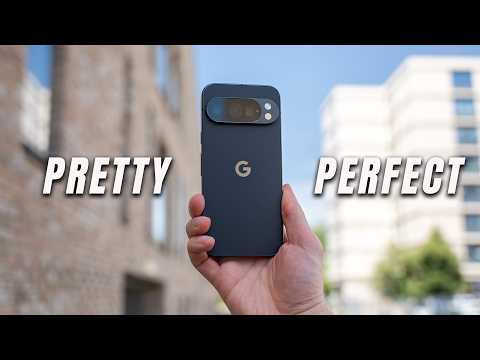 Photo: N43 and Hermes
A year is long enough for batteries to drift, updates to accumulate, and launch-week takes to be tested against reality. Android Authority's retrospective on the Pixel 10 Pro is that kind of test, and its results say a lot about where Google's hardware strategy now stands.
Source video: Pixel 10 Pro one year later: I can't stop · Android Authority · approximately 119,980 views observed on 2026-09-11 (uploaded 2026-06-25). Independently researched by N43 and Hermes.
01 A year with the Pixel 10 Pro: the setup
The Pixel 10 is Google's Android flagship line, announced on August 20, 2025 at the Made by Google event in Brooklyn, and the Pixel 10 Pro is its higher-end sibling: the same core platform with a better display, more memory and the full camera array. It matters which phone we are talking about, because the Pro's verdict is not identical to the base model's, and most of the commentary that matters here comes from the Pro in the reviewer's pocket through a full year of use.
The source for this article is Android Authority's one-year-later retrospective, published in June 2026, roughly ten months after the phone's launch window. That timing is deliberate and useful. One-year reviews occupy a distinct evidentiary category: the reviewer has paid for repairs or replacements out of their own habits, experienced multiple software updates, and stopped grading the phone against its marketing. What remains is the question every launch review dodges: was this phone worth living with?
The retrospective's headline conclusion, reflected in its title, is that the reviewer kept reaching for the device even when newer options were available. That is a stronger statement than it first appears, because a year-later verdict is rendered in the context of a refreshed competitor lineup. The sections below unpack where that loyalty comes from, and where the phone's actual failures sat, drawing on the video's reported experience plus general knowledge of battery aging and Android's update cadence.
02 Hardware holdup: build, display, battery drift
Hardware is where one-year reviews do their most reliable work, because physical properties reveal themselves slowly. The retrospective's reported experience on build and display was positive: the materials held up to a year of pocket carry, the screen remained bright and scratch-resistant enough for daily use, and the overall construction showed no dramatic failures. This is consistent with where flagship build quality has settled industry-wide, where most premium devices survive a year of normal use in respectable condition.
Battery is the classic exception, and the video's long-term experience reflects a universal property of lithium-ion cells rather than a defect specific to this phone. Lithium-ion batteries degrade with charge cycles, calendar age and heat exposure; a typical flagship loses a meaningful fraction of its rated capacity in the first year of daily charging. The curve below is an editorial illustration of that typical pattern, not a measurement of this specific device, which no public source has formally capacity-tested.
Units: percent of original rated battery capacity retained, plotted by months of daily use. Typical degradation curve, editorial illustration, not a measurement of this device; compiled 2026-09-11.
The practical reading: the reviewer's year-later complaints about endurance are what physics predicts, not what engineering failed to deliver. A phone bought today with the same cell chemistry will trace roughly the same curve. What separates good hardware from bad is how much margin the battery starts with and how well the software manages charging, both areas where Google has historically made defensible choices.
03 Tensor G5: efficiency gains and heat
The Tensor line is Google's custom system-on-chip family, the collection of processors the company designs specifically for Pixel phones rather than buying off-the-shelf silicon. With the Tensor G5, Google made its most significant manufacturing change yet: fabrication moved to TSMC's 3-nanometer process, departing from the Samsung-based production used by earlier Tensor generations. In chip manufacturing, the process node determines how densely transistors can be packed and, largely as a consequence, how much power and heat a given amount of computing consumes.
The retrospective's reported experience bears this out. The reviewer describes noticeably better efficiency and more restrained heat than earlier Tensor phones, consistent with what a node shrink is supposed to deliver. Previous Tensor chips had a documented reputation for running warm under sustained camera or gaming loads, and the G5's move to TSMC was widely read as a direct response. When the year-later verdict praises thermals, it is effectively grading the manufacturing decision, not the architecture alone.
Two caveats keep this honest. First, a process node explains efficiency trends but not every performance characteristic; peak speed also depends on core design, memory and software scheduling, all of which Google controls independently. Second, the video's conclusions are one reviewer's experience with one unit, and thermals vary with climate, case choice and workload. The direction of the finding, though, matches the engineering logic and the broader consensus among long-term reviews: the G5 was the year's most important Pixel change.
04 Camera processing: still Google's edge
Pixel cameras have never competed primarily on sensor size. Google's advantage is computational photography: software that captures multiple frames, aligns and merges them, and applies trained models to produce a finished image. The focal-length chart below shows the hardware starting points, the lenses the software has to work with, using manufacturer specifications for the three rear cameras.
Units: millimeters, 35mm-equivalent focal length, from ultrawide to 5x telephoto. Source: manufacturer specifications, compiled 2026-09-11.
The spread matters because consistency across that range is hard. An ultrawide at roughly 13 millimeters, a main lens near the classic 25-millimeter field of view, and a 5x telephoto around 113 millimeters are three physically different optical systems; color science, noise handling and sharpness rarely match perfectly across them on any phone. The retrospective's reported experience is that Google's processing keeps the three closer matched than most competitors manage, which is precisely the kind of judgment only a year of varied shooting can support.
The year-later framing also surfaces something launch reviews cannot: processing quality survives software updates unevenly. Google ships camera tuning changes throughout the year, and the reviewer's account suggests the phone generally got better at the margins, particularly in low-light consistency, without destabilizing the core look. A camera system that improves in place, rather than oscillating with each update, is a durable advantage and the clearest "got right" in the whole verdict.
05 Seven years of updates: how Android aged on it
Google promises seven years of OS and security updates for the Pixel 10 line, the longest commitment in the Android ecosystem when it was announced. A one-year review is the first real checkpoint on that promise: it cannot verify seven years, but it can verify whether the first year's updates arrived on schedule and whether each one left the phone better or worse. The retrospective's reported experience on this front was largely positive, with feature drops arriving as promised and the reviewer singling out the sense that the phone's software was still being actively invested in.
This matters more than it used to, because the economics of phone ownership have shifted. When flagships cost well over a thousand dollars and hardware improves incrementally, the software timeline becomes the real depreciation schedule. A phone with seven years of support is, in effect, a different financial product than one with three: its useful life is bounded by battery wear and physical damage rather than by forced obsolescence. The reviewer's decision to keep using the Pixel past the year mark is itself evidence for that model working.
The caution is that update quality is a distribution, not a constant. Every long-supported platform has updates that introduce regressions, and Android's fragmenting ecosystem means some features land unevenly across apps. The video's year of experience suggests Google's cadence has been net-positive on this unit, but the honest generalization is narrower: the first year of a seven-year promise is consistent with the promise being kept, which is the most any one-year review can actually establish.
06 AI features: useful assistant or gimmick pile
Google loads the Pixel line with AI features, from call screening and photo editing tools to generative wallpaper and assistant functions, and launch coverage inevitably grades them as a bundle. The retrospective, with a year of daily use behind it, separates them the way long-term usage tends to: a small number of features became habitual, and the rest faded. The reviewer's reported verdict lands closer to "useful assistant" than "gimmick pile," but with the explicit caveat that only a handful of tools earned daily use.
That distribution matches how software features age in general. Features that remove friction from tasks people already perform, like screening unknown callers or cleaning up a photo background, survive because they attach to existing behavior. Features that ask users to behave differently, like generating content for its own sake, get abandoned once novelty wears off. A year-later review is the natural selection mechanism for this, and the Pixel's survival of that filter with several features intact is a genuine positive.
The interpretive risk to avoid is over-attributing this to Google's AI specifically. The same pattern, few hits among many launches, holds across every manufacturer's AI suite in this generation. What distinguishes Google is integration depth: because the company controls both the chip's machine-learning hardware and the platform software, its best features run on-device and feel immediate rather than network-dependent. The verdict's quiet conclusion is that this integration, more than any single feature, is what made the AI layer feel like part of the phone rather than an app bolted onto it.
07 Who should buy it in 2026
The retrospective's purchase guidance, read together with the phone's position in late 2026, sorts buyers into rough groups. For users inside Google's ecosystem, with Chromebooks, Gmail, Google Photos and the rest, the Pixel 10 Pro remains the phone where that integration compounds, and the one-year verdict suggests no hardware reason to switch. For users outside that ecosystem, the case is narrower but real: update longevity, camera consistency and the G5's efficiency are attributes that do not require ecosystem loyalty to matter.
The buying calendar complicates the answer. Google's own cycle means a successor is expected on the same late-summer rhythm, so a buyer in September 2026 faces the standard trade: buy the proven phone at a discount, or wait weeks for the next one and pay full price. The retrospective's implicit answer is that a year-old Pixel 10 Pro at a reduced price is a stronger value than it was at launch, because the phone's weaknesses, battery drift and a modest performance ceiling relative to the fastest competitors, are exactly what discounts compensate for.
The durable summary of the year: Google built a phone whose strengths, computational photography, software longevity and now efficient custom silicon, are the ones that compound with time, and whose weaknesses, raw peak performance and battery margins, are the ones buyers can price around. That is a coherent product philosophy executed well, and it explains why a reviewer surrounded by newer phones kept coming back to this one.
References
- Source video: Pixel 10 Pro one year later: I can't stop (Android Authority, ~119,980 views, observed 2026-09-11)
- Wikipedia: Pixel 10 — Google's Android flagship line, announced August 20, 2025 at Made by Google, Brooklyn
- Wikipedia: Google Tensor — Google's custom system-on-chip line; G5 fabricated on TSMC 3nm
- Google Store: Pixel 10 Pro — official specifications, pricing and availability
By N43 and Hermes for Sailor Bob News.


