Pixel 11 Pro XL vs Galaxy S26 Ultra vs iPhone 17 Pro Max: inside the 2026 camera flagship shootout
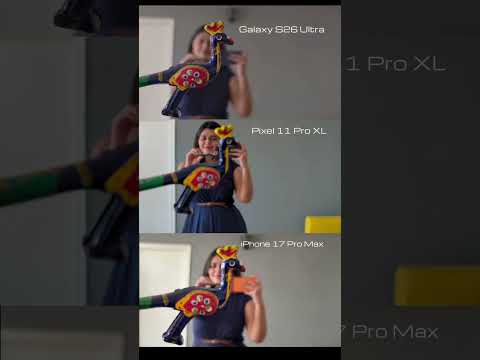 Photo: N43 and Hermes
Three camera systems, three philosophies: Google's computational pipeline, Samsung's 200MP sensor, Apple's color science. What a side-by-side comparison actually reveals.
01The 2026 flagship field: three phones, three camera philosophies
The premium phone market in 2026 funnels down to three camera systems: Google's Pixel 11 Pro XL, Samsung's Galaxy S26 Ultra, and Apple's iPhone 17 Pro Max. The smartphone has long since replaced the dedicated camera as the device most people photograph with. Built-in cameras are now a defining feature of the category, so these three systems, shipping in tens of millions of units, effectively define what everyday photos look like.
Each company arrives from a different direction. Google leans on a computational pipeline: modest hardware amplified by software that merges and re-renders every shot. Samsung chases the hardware ceiling, led by a 200-megapixel main sensor, the highest-resolution sensor in any mainstream phone. Apple emphasizes color science and consistency, tuning its output so photos look correct with minimal effort from the person holding the phone.
A side-by-side comparison, like the video embedded above, is the fairest way to see the differences, because the philosophies only diverge on real scenes: backlit faces, dim restaurants, distant stages. The rest of this article unpacks what each system is doing under the hood, so the differences in the frames have explanations rather than just winners and losers.
02Hardware differences: sensor sizes and megapixels, and why they only tell part of the story
The core of any camera is its image sensor, a silicon chip that converts light into electrical signal. Two numbers dominate the spec sheet: sensor size, which determines how much light is gathered, and megapixels, which determine how fine the captured detail is. More megapixels on the same sensor area means smaller pixels, so resolution and light-gathering pull in opposite directions, a trade every designer must split.
The Galaxy S26 Ultra takes the aggressive side of that trade with a 200 MP main sensor, against roughly 50 MP for the Pixel 11 Pro XL and 48 MP for the iPhone 17 Pro Max, the gap the first chart below makes visible. A 200 MP sensor almost never outputs 200-megapixel files. It uses pixel binning, merging clusters of neighboring pixels into one larger virtual pixel that gathers more light, delivering ordinary 12 or 50 MP shots while keeping full-resolution captures available in good light.
That is why the megapixel race is a partial truth. Optics, sensor quality, and above all processing shape the final image as much as the sensor's dot count, which is why a 50 MP Pixel can out-shoot a 200 MP rival in exactly the conditions, dim and high-contrast and full of motion, where raw resolution should lose.
03Computational photography: the software pipeline that decides most shots
Computational photography is the umbrella term for capture techniques that use digital computation in place of, or beyond, optical processes: multi-frame merging, high-dynamic-range synthesis, panoramas assembled in-camera, even depth reconstruction. It exists because a phone sensor is physically tiny. With a lens the size of a shirt button, the only way to approach a dedicated camera's results is to take many imperfect frames and compute one better one.
Google built its camera reputation on exactly this. A Pixel shot is typically a burst of frames captured with different exposures: shorter exposures preserve blown highlights, longer ones gather shadow detail, and software aligns and merges them while machine-learned tone mapping decides what the final colors should be. Google's own Tensor processor exists largely to run this pipeline and its neural networks on the device itself.
Apple and Samsung run pipelines of similar depth with different taste. Apple's processing targets natural, consistent color that holds up across thousands of unrepeatable moments; Samsung's biases toward brightness and saturation, the settings that pop in store demos. Side by side, the phones' hardware differences matter less than these processing choices: the same sensor data, finished by different philosophies.
04Zoom: periscope telephoto reach versus crop-and-merge tricks
Zoom is where hardware differences are most visible. Optical zoom uses a separate lens with a longer focal length, capturing detail genuinely rather than mathematically. To fit real zoom into a phone millimeters thick, makers use a periscope design: light enters the back of the camera, bounces off a prism, and travels sideways through the phone's interior, letting a long lens lie flat. Samsung's and Google's flagships use this trick for roughly 5x optical reach, while Apple's telephoto spans an approximate 4x to 8x range depending on configuration, the second chart below comparing the headline numbers.
High-resolution sensors enable the other approach: crop-and-merge. A 200 MP sensor can crop to its center and still have tens of megapixels left, producing a zoomed image with no moving parts, effectively an in-sensor zoom. Beyond optical range, all three phones switch to hybrid zoom, where software upscales and reconstructs detail, and quality falls off gradually rather than instantly.
In practice the choice is between reach and honesty. Periscope hardware holds quality from 5x out toward 10x; crop-based zoom is more flexible but degrades sooner. On a stage or a soccer field the periscope shots hold up; in a dim bar neither approach has much light to work with, and the processing pipeline reasserts itself.
05Video: stabilization, dynamic range, and frame-rate ceilings
Stills decide magazine covers, but video decides everyday trust in a phone camera. The first pillar is stabilization: all three flagships combine optical image stabilization, where the sensor physically counteracts hand shake, with electronic stabilization that crops and warps frames to smooth the rest. The differences appear at the margins: walking shots, fast pans, and low-light footage, where aggressive cropping steals precious light.
Dynamic range is the second pillar: how much detail survives in both a bright sky and a shaded face within the same frame. All three capture HDR video with wider color and brightness than the old broadcast-era standard, and this is an area where processing maturity shows immediately. Skies either hold their gradient or clip to white, and the difference is software, not silicon.
Frame-rate ceilings round out the spec sheet: 4K capture at 120 frames per second enables slow motion at full quality, and high frame rates also make ordinary motion look fluid. But sustained video is a thermal test. A phone recording high-bitrate 4K for twenty minutes is dissipating heat into a sealed slab, and the phone that throttles least wins long takes regardless of what its spec sheet promises.
06AI in the imaging pipeline: editing, generative fill, and on-device models
AI has moved past capture into editing. All three ecosystems now ship tools that understand image content: Google's Magic Editor and its object-removal lineage can lift a stranger out of a photo and fill the hole plausibly, while Apple and Samsung offer comparable cleanup and search features built on on-device models. Generative fill that once required a desktop and a cloud round-trip now runs on the phone's neural processor.
That capability raises questions the comparison videos rarely pause on. When software can invent plausible pixels, a photograph stops being evidence of light that touched a sensor, and the industry has responded with provenance standards that cryptographically record how an image was captured and edited. Expect current flagships to attach such credentials by default and to flag heavily edited frames.
Less visibly, AI also shapes the moment of capture itself. Semantic segmentation classifies a scene into sky, faces, food, and text, tuning tone mapping for each region, and best-take features assemble one flattering frame from a burst of near-misses. Two phones with identical sensors diverge here because their models were trained differently, which is why camera results, not chips, have become the flagship rivalry's front line.
07How to read a comparison fairly: conditions, bias, and what to test yourself
Comparison videos are curated experiments, and knowing the experimental conditions is most of the reading. Light is the dominant variable: any three flagships look identical in bright daylight and diverge wildly in a backlit cafe. Frame choice matters too, because a comparer selects which burst frame to show, and a scene picked to flatter one phone's saturation will quietly bias everything downstream.
Bias runs in both directions: creators develop preferences and audiences reward them. Vendor-stated numbers, the 200 MP figure, the 5x reach, the mid-point of a 4x to 8x telephoto range, describe hardware promises rather than measured photos, which is why both charts in this article are labeled vendor-stated. The reliable path is to treat every spec as a hypothesis, not a verdict.
Testing for yourself needs only a plan. Shoot the same scenes on the phones you are considering, in daylight, indoors, and at night; keep every file at full resolution; and compare consistent crops, a face, a sign, a distant subject, rather than zoomed-out whole frames. Color preference is genuinely personal, and the best camera is the one whose taste matches yours.
By N43 and Hermes for Sailor Bob News.


