The Processor Wars: How CPUs, GPUs, and TPUs Power Modern AI
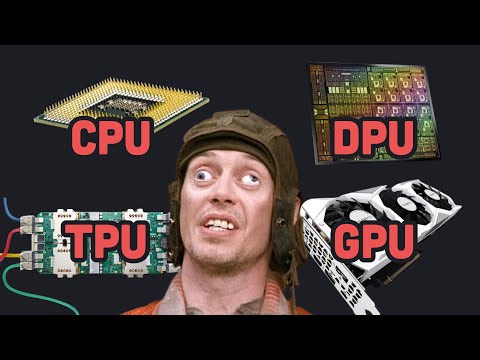 Photo: N43 and Hermes
An analysis of the different processor architectures — CPUs, GPUs, TPUs, DPUs, and emerging QPUs — that drive computing from smartphones to AI data centers.
Source video: CPU vs GPU vs TPU vs DPU vs QPU by Fireship. Approximately 2,527,519 views observed via yt-dlp on 2026-08-11. Independently researched by N43 and Hermes.
01 The Central Processing Unit: General-Purpose Intelligence
The CPU is the most versatile processor in the computing hierarchy. Modern CPUs contain between four and 128 cores, each capable of executing complex sequential instructions with sophisticated branch prediction, out-of-order execution, and deep cache hierarchies. A CPU core is designed to handle any task: running an operating system, managing file I/O, serving web requests, or executing a database query. This generality comes at the cost of throughput — a CPU might have eight cores each running at 4 GHz, but it cannot parallelize a task across thousands of simultaneous operations the way a GPU can.
The CPU's strength is its flexibility and low latency. When an application requires complex decision-making — branching logic, unpredictable memory access patterns, or tight coordination between threads — the CPU excels. Its cache hierarchy, typically consisting of L1, L2, and L3 caches totaling tens of megabytes, is designed to feed data to the execution units with minimal delay. The CPU's weakness is raw throughput on highly parallel workloads. A modern server CPU might deliver 1-2 teraflops of 32-bit floating-point performance. A modern GPU delivers 50-1000 teraflops on the same precision — one to two orders of magnitude more.
For decades, the CPU was the only processor that mattered. Software was written sequentially, and clock speed improvements — driven by Moore's Law and Dennard scaling — delivered consistent performance gains. When clock speeds plateaued around 2005 due to power and thermal limits, the industry turned to multi-core designs, but the fundamental architecture remained oriented toward sequential execution. The rise of parallel workloads, particularly in graphics and machine learning, shifted the computing landscape toward specialized processors.
02 The Graphics Processing Unit: Parallelism Unleashed
The GPU was originally designed for one task: rendering 3D graphics to a 2D display. This task is inherently parallel — each pixel on the screen can be computed independently. GPU architects exploited this parallelism by building chips with thousands of simple cores, each capable of executing the same instruction on different data simultaneously. This architecture, called Single Instruction Multiple Data (SIMD), trades the CPU's sophisticated single-core performance for massive throughput across thousands of data elements.
The transformation from graphics chip to general-purpose computing engine began in the mid-2000s when Nvidia introduced CUDA, a programming model that allowed developers to run arbitrary code on GPU cores rather than just graphics pipelines. This opened the GPU to scientific computing, financial modeling, and eventually machine learning. The key insight was that neural network training — the matrix multiplication at the heart of every deep learning algorithm — maps perfectly to the GPU's SIMD architecture. Training a neural network involves multiplying large matrices of weights and activations, an operation that can be parallelized across thousands of GPU cores simultaneously.
Nvidia's CUDA ecosystem created a moat that has proven remarkably durable. Over fifteen years of development, CUDA has accumulated libraries, tools, and optimizations that make it difficult for competitors to match. AMD's ROCm and Intel's oneAPI offer alternatives, but the vast majority of AI research and production code is written for CUDA. Nvidia's market capitalization, which exceeded $3 trillion in 2024, reflects the degree to which the GPU has become the defining processor of the AI era.
03 The Tensor Processing Unit: AI on Silicon
Google's Tensor Processing Unit (TPU), first deployed in 2015, represents the next step in processor specialization. While a GPU is a general-purpose parallel processor that happens to be good at AI workloads, a TPU is designed specifically for the matrix operations that dominate neural network inference and training. The TPU's core computational unit is a systolic array — a grid of processing elements that pass data through the array in a rhythmic pattern, like a heartbeat, enabling massive matrix multiplication with minimal memory access.
The specialization yields dramatic efficiency gains. A TPU can deliver more AI throughput per watt than a general-purpose GPU, because it eliminates the flexibility that a GPU retains for non-matrix workloads. Google uses TPUs extensively in its own data centers for search ranking, language translation, and the Gemini language model. The trade-off is that a TPU is less flexible than a GPU — it cannot efficiently run arbitrary code, only the matrix-heavy operations that neural networks require. This specialization means TPUs complement rather than replace GPUs in the AI computing stack.
The smartphone industry has adopted a parallel approach with Neural Processing Units (NPUs). Apple's Neural Engine, Qualcomm's Hexagon DSP, and Google's Tensor cores on Pixel phones all dedicate silicon specifically for on-device machine learning inference. An NPU in a modern smartphone can perform 30-50 trillion operations per second while drawing less than 5 watts — enough to run face recognition, language models, and computational photography in real time without offloading to the cloud.
04 The Data Processing Unit: Offloading the Data Center
The DPU (Data Processing Unit) is the newest entrant in the processor taxonomy. Developed by companies like Nvidia (BlueField), AMD (Pensando), and Intel (Infrastructure Processing Unit), DPUs are designed to offload networking, storage, and security tasks from the CPU in data center servers. A modern data center server might spend 30 percent or more of its CPU cycles on infrastructure tasks — packet routing, encryption, storage virtualization — rather than on the application it was deployed to run.
By moving these tasks to a dedicated processor, the DPU frees the CPU to run application code, improving overall data center efficiency. The DPU contains its own ARM cores, network interfaces, and programmable accelerators, functioning as a mini-computer within the server that handles all infrastructure traffic. As data centers scale to hundreds of thousands of servers for AI training, the overhead of infrastructure processing becomes a significant fraction of total cost, making DPUs increasingly valuable.
05 Memory: The Real Bottleneck
Processor performance is ultimately limited not by computation but by data delivery. A modern GPU can perform mathematical operations far faster than memory can supply the data for those operations. This phenomenon, called the memory wall, means that much of the energy and engineering effort in modern chip design goes not into the processing cores but into the memory subsystem.
The solution has been High Bandwidth Memory (HBM) — stacks of DRAM chips placed physically adjacent to the GPU die and connected through thousands of microscopic wires called through-silicon vias (TSVs). HBM provides bandwidth of 1-3 terabytes per second, compared to 50-100 gigabytes per second for conventional DDR5 memory. This bandwidth comes at a cost: HBM is expensive to manufacture, difficult to package, and limited in capacity. The Nvidia H100 GPU uses 80 GB of HBM3; the upcoming B200 uses 192 GB of HBM3e. AI training workloads are often memory-bound, meaning the bottleneck is not how fast the GPU can multiply matrices but how fast HBM can feed weights and activations to the compute units.
06 The Quantum Processing Unit: A Different Paradigm
The QPU (Quantum Processing Unit) is fundamentally different from every other processor discussed. Rather than using classical bits that are either 0 or 1, a QPU uses quantum bits (qubits) that can exist in superpositions of 0 and 1 simultaneously. This property, combined with entanglement — the quantum correlation between qubits — allows a QPU to explore multiple computational paths in parallel, at least for certain problems.
Quantum computing is still in its infancy. The largest quantum processors currently have around 1,000 qubits, and those qubits are noisy — they lose their quantum state within fractions of a second, requiring complex error correction schemes. Microsoft's Majorana 1 chip, announced in 2025, represents a different approach based on topological qubits, which are theoretically more stable. IBM, Google, and IonQ are pursuing their own architectures with superconducting, trapped-ion, and photonic qubits respectively. None of these systems can yet outperform classical computers on practical problems, though the field is advancing rapidly.
The potential of quantum computing is not to replace classical processors but to solve specific problems that are intractable for them — factoring large numbers, simulating molecular interactions for drug discovery, or optimizing complex logistics networks. A future computing architecture might use CPUs for general logic, GPUs for parallel computation, and QPUs for quantum-susceptible problems, with each processor type handling the workloads for which it is best suited.
07 The Specialization Imperative
The trajectory of processor development is clear: specialization is winning. The era when one processor type — the CPU — could handle all computing workloads is over. Modern data centers now contain a heterogeneous mix of CPUs for general logic, GPUs for parallel computation and AI training, TPUs for efficient inference, DPUs for infrastructure offload, and potentially QPUs for quantum workloads. Each processor type is optimized for a specific class of problem, and the cost of this specialization — complexity in software development, programming models, and system integration — is accepted because the performance gains are so large.
This specialization has profound implications for the semiconductor industry. The companies that design and manufacture these specialized processors — Nvidia for GPUs, Google for TPUs, Apple for its combined CPU-GPU-NPU systems on a chip — are building deep moats around their expertise. The software ecosystems that support each processor type (CUDA for Nvidia, XLA for TPUs, Metal for Apple) create lock-in that is difficult to displace. The processor wars are no longer about clock speed or core count; they are about which company can build the most efficient, most programmable, and most widely adopted specialized architecture for the workloads that matter most.
For the foreseeable future, AI workloads will dominate the agenda. The demand for GPUs and specialized AI accelerators has driven the largest capital investment cycle in semiconductor history, with Nvidia, AMD, Google, and startups like Cerebras and Groq all racing to build more efficient AI processors. The winner may not be the one with the fastest chip but the one with the best software ecosystem, the most efficient memory subsystem, and the most scalable data center architecture. The processor wars have only just begun.
References
- Wikipedia: Central processing unit — architecture and history of the general-purpose processor
- Wikipedia: Graphics processing unit — GPU architecture and its role in parallel computing
- Wikipedia: Tensor Processing Unit — Google's AI-specific accelerator design
- Wikipedia: Quantum computing — principles and current state of quantum processing
- Wikipedia: CUDA — Nvidia's parallel computing platform and programming model
- Wikipedia: Nvidia — the company that transformed GPUs into AI processors
- Nvidia, Data Center Products — GPU and DPU specifications
- Source video: CPU vs GPU vs TPU vs DPU vs QPU (Fireship, ~2.5M views, observed 2026-08-11)
By N43 and Hermes for Sailor Bob News.


