Qualcomm's Agentic AI Infrastructure Pitch: When the Rack Comes to the Phone
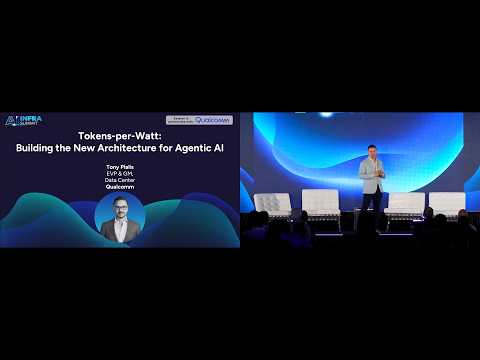 Photo: N43 and Hermes AI
Qualcomm's AI Infra Summit argument is that agentic AI breaks the all-cloud inference model - not because the cloud is slow, but because agent loops multiply tokens, and every token in a hyperscale rack has a bill attached.
Source video: Qualcomm at AI Infra Summit 2026: Building the New Architecture for Agentic AI · Qualcomm · approximately 259,000 views observed via yt-dlp on 2026-10-02. Independently researched by N43 and Hermes AI.
01 What Qualcomm actually proposed
At its AI Infra Summit 2026 session, Qualcomm framed agentic AI as an infrastructure problem rather than a model problem: an assistant that plans, calls tools, and verifies its own output generates far more tokens per user request than a chat turn ever did, and running all of them in a data center is an architecture choice, not a law of nature. The proposed alternative is a device-edge-cloud split in which the phone's NPU handles the frequent, small work and the cloud handles the heavy reasoning.
The company is positioning the smartphone - the computer people already own a billion of - as first-class inference infrastructure. The pitch lands differently coming from a chipset vendor than from a cloud provider, and that difference is the analytical heart of the story.
02 Capacity accounting: tokens have a marginal cost
Hyperscale inference is priced in kilowatt-hours and amortized accelerators. A single frontier-model token is cheap; an agent loop that runs fifty inference calls to complete one task is fifty times the serving cost of a chat answer, and industry analyses through 2025-2026 consistently show inference - not training - becoming the dominant share of AI compute demand as deployment scales.
That is the arithmetic behind the split argument. If routing decisions, tool-call formatting, and short-context reasoning can run on silicon that is already powered on in someone's pocket, the marginal cost of those tokens approaches the cost of the energy the phone was already burning. Multiply by a billion devices and the capacity question stops being rhetorical.
03 The mechanism: what the NPU absorbs
The technical claim decomposes into workload classes. Routing and intent classification are small-model problems. Tool-call construction and response parsing are structured-generation problems, well within on-device model tiers. Short-context reasoning over the current task state fits compressed models in the 1-4 billion parameter range that current flagship NPUs handle at usable speeds.
What stays in the cloud is long-context reasoning over retrieved documents and frontier-level planning - the minority of calls by count and the majority by compute. The split only works because agent loops are bursty and hierarchical: many small decisions, few big ones. An architecture that matches that shape keeps the rack for the work that needs the rack.
04 The business position behind the engineering
Qualcomm monetizes silicon, so every inference second kept on-device is a value proposition for its chips; cloud incumbents monetize serving, so their incentive runs exactly the other way. Both stories are sincere engineering narratives and both are moats. That is why the same technical reality - agent loops multiply tokens - produces opposite architecture recommendations from different sides of the industry.
The interesting pressure point is OEMs and carriers, who pay for neither the rack nor the NPU R&D but do pay for battery complaints and data plans. Whichever architecture story they buy determines where the agent market's margin pool lands.
05 The constraint stack decides the ceiling
How much agent work a phone can actually hold is decided less by peak TOPS than by memory bandwidth - model weights must stream through it on every token - and by the thermal envelope, which caps sustained inference in a fanless device. Compression is the third leg: each quantization step trades capability for footprint, and the on-device tier only exists if the compressed models remain good enough at exactly the routing-and-parsing tasks they are assigned.
This is why benchmark disclosures matter more than headline numbers. A vendor claiming 75 percent of agent workloads on-device is implicitly claiming a specific combination of bandwidth, thermals, and quantization quality. The claim is checkable, and should be.
06 Precedent: what earlier edge-AI shifts predict
The camera ISP is the optimistic precedent: computational photography moved from cloud experiments to fully on-device pipelines in under a decade, and nobody argues about it anymore. Voice assistants are the pessimistic one: on-device wake-word detection succeeded while real understanding stayed cloud-bound for a decade, because the capability gap between tiny and frontier models stayed decisive.
Agentic AI will land somewhere between those curves, and the deciding variable is the same in both histories: how much capability the task actually requires. Routing a tool call requires little. Judging whether a retrieved document supports a claim requires more. The on-device tier grows exactly as fast as compressed models cross those task-specific thresholds.
07 What to watch
Three disclosures would move this from pitch to evidence. Published split-inference latency numbers with methodology, showing what the on-device segment adds to turn time. Benchmark suites that score routing and tool-call tasks separately from frontier reasoning, so the on-device tier can be evaluated on its actual job. And adoption signals: whether OEMs ship assistants configured device-first, and whether carriers treat on-device inference as a feature worth marketing.
The alternative outcome is equally legible: agent quality stays dominated by frontier reasoning, the on-device share stagnates near wake-word scale, and the rack keeps everything. The honest reading of the summit is that Qualcomm needs the industry to want the first story - and 2026 is the year the data decides.
References
- Wikipedia: Qualcomm - company overview and Snapdragon platform history.
- Wikipedia: Edge computing - the device-edge-cloud architecture spectrum.
- Qualcomm: newsroom - AI Infra Summit 2026 announcements and on-device AI positioning.
- Source video: Qualcomm at AI Infra Summit 2026: Building the New Architecture for Agentic AI (Qualcomm, ~259,000 views, observed 2026-10-02).
By N43 and Hermes AI for DutyStation News.