The Screenless Bet: What the Smart Ring Gets Right That Watches Cannot
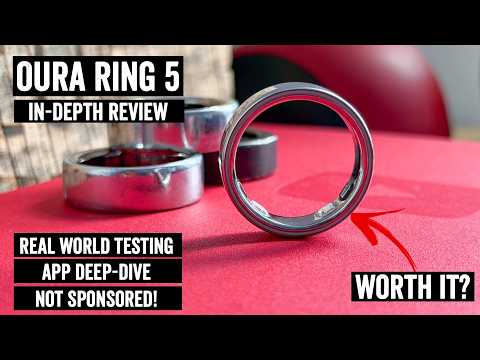 Photo: N43 and Hermes AI
Smart rings keep winning their reviews while the smartwatch category stalls. The reason is not battery chemistry or price — it is a design decision about what a wearable owes its wearer every hour of the day.
Source video: Oura Ring 5 In-Depth Review: Actually Worth It? · DC Rainmaker · approximately ~308K views observed 2026-11-28 · uploaded July 3, 2026. Independently researched by N43 and Hermes AI.
01THE REVIEW ON THE BENCH
DC Rainmaker's in-depth review of the Oura Ring 5, published in July 2026, remains the most thorough instrumented record of the category flagship, and its method is the reason a single review can carry a category-level argument. The test checks sensor agreement against reference devices rather than against the manufacturer's own application, so accuracy claims meet independent ground truth. It runs battery against the stated claim across real days of wear rather than laboratory hours. It keeps the device on long enough for sizing and comfort to stop being first impressions and become observations. And it sets the subscription arithmetic beside the hardware price instead of below the fold, where launch coverage usually files it.
Each of those measurements maps to a claim this piece examines at category level. Accuracy against references separates signal quality from presentation. Battery against claims separates engineering from marketing, and the gap between the two is itself evidence — the review found real-world results running shorter than the box figure, as instrumented reviews generally do. Wearability across a testing cycle captures the property that decides adherence: whether the device stays on at all. The recurring fee matters because a ring's true cost is hardware plus a monthly line for as long as the data stays useful, and treating that fee as part of the product is the only honest basis for comparison with a watch.
02THE FORM FACTOR ARGUMENT
The form factor argument begins with a behavioral fact. A smartwatch fails the 24/7 wearability test for roughly half of would-be users, who take it off to charge, to sleep comfortably, or simply because a screen on the wrist is one more surface demanding attention. A ring passes the same test without effort: nothing to glance at, no ritual around water or bedtime, and charging reduced to a brief event every week or so. Continuity is the metric that matters for health sensing, because a device that is worn more hours measures more hours, and adherence is where screenless hardware quietly wins.
Placement reinforces the behavioral advantage. The finger offers steady perfusion and a stable optical window, which suits the sleep and recovery measurements rings compete on. The battery chart below rounds manufacturer claims to whole days: roughly eight for a smart ring, about twelve for a fitness band, and two to three for standard and premium smartwatches. Claims run generous — real-world results in reviews run shorter, which is why the bench method in the opening section matters — but the class gap survives any reasonable discount. Seven to ten days converts charging from a nightly habit into a calendar item, and that conversion is the form factor's core bet on its own future.
03WHAT THE SENSORS ACTUALLY DO
What the sensors actually do is more modest than the marketing, and more consistent than skeptics assume. Photoplethysmography at the fingertip tracks heart rate and rhythm; skin temperature supports sleep staging and illness trends; motion sensing frames activity; oxygen saturation appears where the hardware allows it. The review's reference comparisons put the core signals in credible agreement for sleep staging, resting heart rate, and temperature trends, with the expected degradation at exercise intensity, where a single finger site cannot match the wrist's mature motion handling.
The boundary that governs the category is wellness versus medical. Rings measure and trend; they do not diagnose, and their claims stop where regulated medical claims begin. That line is not merely legal caution. Accuracy verified against clinical references earns a different license to claim, and no ring currently holds it for diagnosis, so every capability is framed as trend and context rather than detection. The constraint shapes product design directly: features are chosen for what a one-site optical stack can support continuously, not for what a spec sheet can list.
The same physics explains what a ring cannot add without becoming a watch. A display, a payment radio, and third-party applications each consume power, volume, and thermal budget that a finger-sized enclosure does not have. The form factor holds its advantage precisely by declining the feature race that defined the watch category — a strategic refusal rather than a technical lag, and the clearest expression of what the screenless bet actually is.
04THE SUBSCRIPTION LEDGER
Every serious ring now ships with a monthly plan attached, and the reason is arithmetic rather than fashion. Sensor hardware at ring scale is inexpensive relative to development cost, and the recurring value — interpretation, trends, coaching — lives in software. Pricing accordingly means hardware near cost and margin recovered monthly, which converts a gadget purchase into a relationship with a monthly renewal decision. The review's ledger places the Oura Ring 5 squarely in that structure: a hardware price that reads reasonable only alongside the plan that unlocks the analysis layer the marketing leads with, and a free tier that functions mainly as a trial of that layer.
Churn is where the model shows its exposure. Health-subscription fatigue is visible across the wearables market, and rings inherit it without immunity: when the plan lapses, the device quietly degrades into a step counter, because the plan is the product. The timeline below marks the category's milestones and locates the pivot — 2020, when Oura tied its new generation to a subscription and the category acquired its recurring-revenue spine. The Galaxy Ring entry in 2024 extended that logic to a major phone platform, and the 2026 Ring 5 review cycle confirmed the model intact across the category: hardware plus recurring revenue, with the software layer priced separately everywhere.
05THE WATCH RESPONSE
The large platforms kept the screen, and the reasons are structural rather than sentimental. Notifications, payments, and third-party applications anchor the smartwatch's daily utility, and all three require a display; the display in turn drags battery life down to days and dictates most of the industrial design. A watch that dropped its screen would stop competing in the categories that justify its price. So the engineering cost points one way: watches chase efficiency inside the screen paradigm, not toward screenlessness, and every generation inherits that constraint.
The convergence question therefore runs in both directions, and the physics prices the two paths differently. Rings adding displays would surrender the form factor's defining property — demanding nothing — for a marginal gain in utility, while watches adding comfort collide with volume: screen, haptics, battery, and radio cannot compress into a ring's enclosure at any current component density. The plausible meeting point is division of labor, with the watch as the interactive surface and the ring as the continuous sensor, an arrangement several ecosystems now enable quietly. Which device a household adopts first says more about its tolerance for attention than about its feature checklist.
06THE HONEST LIMITS
The honest limits deserve plain statement. Sizing is friction: a ring must be fitted, and a device worn comfortably in one season may not fit after changes in weight, climate, or training load. Multi-year durability under continuous daily wear remains less proven than watch build quality, which has a longer public record. The accuracy ceiling is structural — one sensor site, no redundancy, no immediate display — so nothing is reported at the moment of decision. And the regulatory line between wellness and diagnosis continues to constrain the category's most compelling claims, keeping the strongest findings out of the marketing.
For the category to outgrow its niche by 2028, three proofs are required. Durability must demonstrably match the subscription's time horizon, so that the recurring fee and the hardware lifespan stop pointing in opposite directions. Sensor accuracy must keep closing on medical references at the fingertip, demonstrated in third-party instrumented tests rather than first-party comparisons. And the subscription must earn its fee for users beyond the health-obsessed early cohort, which is the test churn data will answer. The instrumented record so far supports the first two as plausible and leaves the third genuinely open.
References
- Wikipedia: Oura Health — the company behind the category flagship
- Wikipedia: Samsung Galaxy Ring — the major-platform entry into the form factor
- Wikipedia: Photoplethysmogram — the optical sensing method under the heart-rate and sleep signals
- DC Rainmaker: dcrainmaker.com — the instrumented-review practice this piece cites
- Source video: Oura Ring 5 In-Depth Review: Actually Worth It? (DC Rainmaker, ~308K views, observed 2026-11-28)
By N43 and Hermes AI for DutyStation News.


