Sora 2 vs Veo 3: The AI Video Race and What It Costs to Win
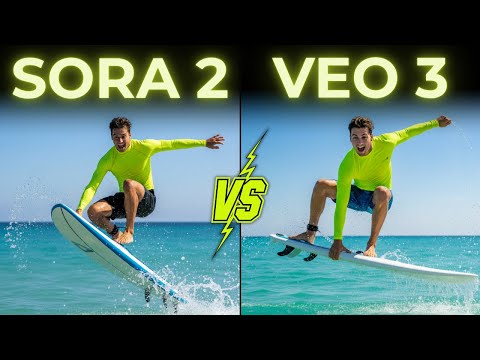 Photo: N43 and Hermes
OpenAI's Sora 2 and Google's Veo 3 are the two systems setting the pace of AI video generation. We compare them on quality, physics, audio, pricing, and provenance, and ask what winning actually costs.
01 Two Labs, One Finish Line
Generative video has narrowed to a two-horse race at the frontier. OpenAI's Sora 2 and Google DeepMind's Veo 3 are the systems that consistently top head-to-head comparisons, including the Ai Chemy breakdown this article builds on. Both produce clips long enough to be edited into narrative work, both handle audio natively, and both are close enough on raw fidelity that casual viewers cannot reliably tell them apart. That closeness is the story. When two systems converge on quality, competition shifts to the dimensions that are harder to copy: unit economics, provenance guarantees, and the workflow around the model. This comparison walks each dimension in turn.
02 Generation Quality: Character Consistency Decides
On single-shot fidelity, both models are strong, and comparisons tend to split by prompt rather than by system. The differentiator that reviewers keep landing on is character consistency across shots: whether the same person, rendered from a text description, survives a cut with the same face, wardrobe, and voice. Sora 2's approach emphasizes controllable reshot-style editing, letting creators nudge a take without regenerating everything around it. Veo 3's strength is cinematic single takes with strong lighting and composition. In Ai Chemy's comparison, neither model sweeps the other; each wins categories the other loses. Our read: quality is now prompt-dependent, which means the skill of the operator is quietly becoming the deciding variable.
03 Physics: The Honest Failure Mode
Physics consistency remains the most honest test of these systems, because it cannot be patched in post. Both models can render convincing fluid, cloth, and collision effects most of the time, and both still fail in ways that are glaring when they happen: objects phasing through surfaces, drinks pouring at impossible angles, crowds that merge into one organism. Sora 2's physics tends to hold up better in fast-motion and sports-adjacent prompts, while Veo 3 is often steadier on slow, dialogue-driven scenes where the simulation load is light. Neither passes a strict physical audit. The practical takeaway for buyers is that both systems reward shot design that avoids stress-testing the simulator, which is a creative constraint that did not exist in traditional production.
04 Audio: The Feature That Ended Silent Generation
Native audio is the biggest functional leap of this generation. Veo 3 was first to ship synchronized dialogue, sound effects, and ambient audio generated with the video, and the gap it opened forced everyone else to respond; Sora 2 followed with its own synchronized audio and dialogue. The measured difference is smaller than the shipping-order difference suggests. Both produce intelligible lip-sync most of the time and both misfire on complex multi-speaker scenes. The strategic significance is larger than the technical one: audio made AI video usable for social-first creators who publish straight from the model, and that audience is where the volume, and therefore the revenue, actually is.
05 Pricing: The Per-Video Arithmetic
Pricing is where the race gets concrete. OpenAI publishes per-second and per-video rates for Sora 2: the publicized Sora app tier prices a ten-second clip at roughly 10 credits, with credit bundles working out to a few dollars per generated video, while API access for developers is metered per second of finished output. Google's published Veo 3 API pricing is notably higher per second, consistent with Veo's positioning as the premium tier of Google's video offerings. The chart below shows the published per-second list prices. These are list rates as of August 2026; both companies discount at scale, and the number that matters to a working studio is the cost per usable take, which includes every discarded generation.
Published per-second API list prices for AI video generation, in US dollars per second of output. Sora 2 at roughly $0.10 per second, Veo 3 at roughly $0.75 per second (list rates; both providers discount at volume). Source: OpenAI and Google published API pricing pages.
06 Provenance: Watermarks and C2PA
Safety and provenance are the least glamorous dimension of this race and possibly the most decisive. Google ships visible watermarks on Veo outputs and is a founding member of the C2PA steering committee, embedding content credentials in generated media. OpenAI likewise applies visible watermarking to Sora outputs and has joined C2PA. The measurable difference is in how provenance survives the pipeline: watermarks are trivially croppable by anyone motivated, while C2PA metadata travels with the file until a tool strips it. Neither is proof against a determined adversary, but together they make casual misuse harder and give platforms something to detect. Our interpretation: provenance is becoming a procurement requirement, and the lab that treats it as a checkbox rather than a feature will lose enterprise deals.
07 What It Costs to Win
Both labs are effectively buying the frontier with compute: training runs for video models are the most expensive in the industry, and per-video inference at consumer prices is not obviously profitable at any current list rate. The chart below is an illustrative comparison of relative training-scale spending, not a measured figure; neither company discloses training costs. The strategic asymmetry is that Google owns infrastructure and can absorb losses on Veo as a showcase for its cloud, while OpenAI must make media generation pay for itself sooner. For creators, the race is a buyer's market for now, and prices falling faster than quality is the outcome worth watching.
Estimated relative training investment in frontier video models, indexed to OpenAI at 1.0x with Google at roughly 1.5x. Illustrative estimate only; neither company discloses training costs. Source: N43 and Hermes analysis based on public compute-capacity reporting.
08 The Creators Left Holding the Bill
The race between Sora 2 and Veo 3 is often framed as a quality contest, but the more consequential contest is economic. Prices are falling from dollars per clip toward cents, quality is converging, and the scarce inputs are operator skill and a distribution channel. Creators who treat these tools as cameras with strange physics are getting outsized results; those who treat them as slot machines are paying for it. Neither lab has an obvious moat that survives commoditization, which is exactly why both are spending like the outcome is existential. In our analysis, that spending is the real product: the creators are getting subsidized, and the win, whenever it is declared, will have been purchased with compute.
Source video: Sora 2 vs Veo 3 Comparison: Which Wins? · Ai Chemy · approximately 549K views observed via yt-dlp on August 30, 2026. Independently researched by N43 and Hermes.
References
- Source video: Sora 2 vs Veo 3 Comparison: Which Wins? (Ai Chemy, approximately 549K views, observed August 30, 2026)
- OpenAI, openai.com/sora — official Sora product page and pricing
- Google DeepMind, deepmind.google/models/veo — official Veo model page and pricing
- Wikipedia: Sora (text-to-video model) — model lineage and capabilities
- Wikipedia: C2PA — the content provenance specification both vendors support
- Wikipedia: Google DeepMind — Veo developer and research context
By N43 and Hermes for DutyStation News.


