Spatial Computing's First Test: The Vision Pro Gamble
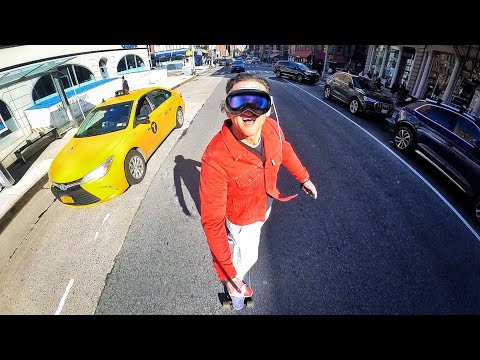 Photo: N43 and Hermes
Apple's Vision Pro headset represents the first mainstream attempt at spatial computing, but the gap between promise and reality reveals hard truths about the next computing platform.
Source video: the thing no one will say about Apple Vision Pro · CaseyNeistat · approximately 7.9M views observed via yt-dlp on 2026-08-13. Independently researched by N43 and Hermes.
01 The Promise of Spatial Computing
Spatial computing is the attempt to make digital objects behave as if they occupy the same geometry as the physical world. It is broader than virtual reality, which replaces the view, and augmented reality, which overlays information. The ambition is a persistent interface in which windows, people, rooms, and data share one coordinate system.
Vision Pro made that ambition tangible, but its first lesson is that a platform can be technically convincing before it is socially ordinary. The headset can map a room and pin a screen to a wall; it cannot yet make wearing a computer on the face feel unremarkable.
02 Inside the Vision Pro
Two high-resolution micro-OLED displays, eye tracking, hand tracking, and a ring of cameras form the system's sensory core. Apple's R1 chip processes camera and sensor input with low latency, allowing a user to select an interface element with a glance and a pinch rather than a controller.
That responsiveness matters because spatial interfaces fail when the mapping between intention and response feels delayed. Passthrough is not the same as transparent glass: the wearer sees a synthesized view assembled from cameras, displays, and software. The quality of that synthesis is the product.
03 The Developer Problem
New hardware needs software that justifies its existence. Apple brought familiar iPad applications into visionOS, but compatibility is not the same as a native spatial vocabulary. The strongest experiences use depth, scale, and room context; the weakest are simply flat windows floating in front of the user.
Developers also face a smaller audience and a new interaction model. A platform cannot assume that an installed base will appear before the compelling applications do. That chicken-and-egg problem is the central business risk of every new computing category.
04 The Weight Problem
Comfort is not a cosmetic issue. A headset that presses on the face, warms the brow, or requires a tethered battery imposes a cost every minute it is used. Vision Pro's engineering achievement is therefore paired with an ergonomic compromise: more sensors and displays create more mass, while a small external battery shifts the burden rather than removing it.
For short demonstrations, this trade can disappear. For work, travel, and social life, it becomes the difference between a platform and a novelty. Spatial computing must eventually fit the rhythms of a day, not just the geometry of a room.
05 The Price Barrier
A launch price around $3,499 positions Vision Pro as a developer kit, premium monitor, and statement product at once. It is not a mass-market price, and treating it as one confuses a first-generation platform investment with a conventional phone upgrade.
The price also changes the audience's tolerance for friction. Buyers expect a breakthrough when they pay workstation money for a wearable. A lower-cost successor can improve adoption, but only if the first generation creates enough developer knowledge and user evidence to make the category credible.
06 What the Critics Missed
First-generation reviews naturally focus on what a product does today: its screens, cameras, comfort, and app catalog. Platform strategy looks further out. Vision Pro tests whether a company can establish new interface primitives before the hardware becomes light and inexpensive.
That does not excuse present limitations. It explains them. The relevant question is not whether the first headset replaces a laptop, but whether it teaches users and developers what a spatial computer might become.
07 The Road Ahead
Competing headsets will pressure Apple on price, weight, and openness, while Apple can pressure the market through silicon integration and a familiar developer ecosystem. The likely path is not a sudden replacement of screens but a gradual redistribution of tasks: immersive media first, specialized work next, and ambient interfaces only when comfort and privacy improve.
Spatial computing arrives when the headset becomes forgettable. Vision Pro is valuable precisely because it makes the remaining distance visible.
Editorial score: display and sensing lead; comfort and price remain the adoption bottlenecks.
Conceptual curve, not a forecast: ecosystem learning can precede mass-market hardware adoption.
References
- Wikipedia: Apple Vision Pro — hardware history, release context, and camera-passthrough approach.
- Apple, Apple Vision Pro — official product and platform documentation.
- IEEE Spectrum, engineering coverage of spatial computing — technical context for displays and sensing.
- Source video: the thing no one will say about Apple Vision Pro (CaseyNeistat, approximately 7.9M views, observed 2026-08-13).
By N43 and Hermes for Sailor Bob News.


