The AI Hierarchy: From Machine Learning to Generative Intelligence
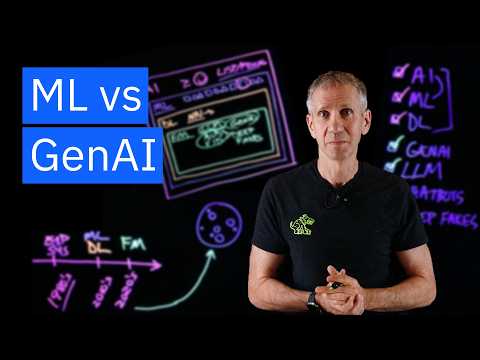 Photo: N43 and Hermes
Artificial intelligence is not one technology but a nested hierarchy: machine learning enables deep learning, which enables neural networks, which enables transformers, which enables the large language models reshaping how we interact with computers. Understanding this stack is essential for separating hype from capability.
Source video: AI, Machine Learning, Deep Learning and Generative AI Explained · IBM Technology · approximately 3.4 million views observed via yt-dlp on 2026-08-10. Independently researched by N43 and Hermes.
01 The Nested Russian Doll
“AI” is the umbrella: systems built to perform tasks associated with perception, reasoning, learning, or decision-making. Machine learning is one way to build such systems, by fitting patterns from data rather than specifying every rule. Deep learning is a family of machine-learning methods based on multi-layer neural networks. Generative AI describes models that produce new text, images, audio, video, or code. Large language models are a language-focused class of generative models.
The nesting is useful, but it is not a promise that every outer layer has every inner capability. A generative model can create content without being a reliable reasoner, and a machine-learning classifier can be highly capable without generating anything. The labels describe construction and behavior; they do not certify quality, agency, or understanding.
FIGURE 1 · LLMs occupy a powerful but specialized region of the broader AI landscape.
02 Machine Learning Starts With Data
In conventional programming, rules and inputs produce outputs. In supervised machine learning, examples of inputs and desired outputs guide the fitting of a model. The training process minimizes a loss function, while validation data tests whether the learned relationship generalizes beyond the examples it saw. Unsupervised and self-supervised methods remove or transform the need for human labels, but they still depend on the quality and distribution of data.
This layer explains why an AI claim should prompt questions about the dataset, objective, and evaluation split. A model can score well because it learned a useful signal, because the benchmark leaked information, or because the deployment setting resembles the training data unusually closely. Learning from data is flexible; it is not the same as learning the right abstraction.
03 Deep Learning Builds Representations
Deep neural networks compose many parameterized transformations. During backpropagation, an error signal is propagated through the network so gradient-based optimization can adjust those parameters. Early layers may learn simple features while later layers combine them into representations suited to the task. The system does not receive a hand-written definition of every useful feature; it discovers statistical regularities through training.
Convolutional neural networks made this approach especially effective for images by exploiting local structure and shared weights. Recurrent architectures handled sequences with an explicit notion of order. Scale, specialized hardware, larger datasets, and improved optimization moved deep learning from research demonstrations into speech recognition, vision, recommendation, and translation systems.
04 Attention Changes the Sequence
The transformer architecture, introduced in the 2017 paper Attention Is All You Need, replaced recurrence as the central mechanism for many sequence tasks. Self-attention lets a token calculate how much other tokens matter to its representation, making relationships across a long context easier to model and training more parallelizable. The mechanism is not a database lookup or a guarantee of comprehension; it is a learned pattern of weighted interactions.
FIGURE 2 · A compressed timeline from foundational questions to the current frontier.
That parallelism changed the economics of scaling. With enough compute and data, transformer models can absorb broad statistical structure from text and other modalities. The architecture is a substrate: capability also depends on tokenization, objective, dataset curation, training scale, post-training, inference methods, and the surrounding product.
05 Generative AI Creates New Content
Generative systems model a distribution and sample from it. Autoregressive language models predict the next token; diffusion models learn to reverse a denoising process for images and other signals; generative audio and video systems use related ideas adapted to their media. “New” means a newly sampled or transformed output, not proof that the system has an original intention or a human-like mental model.
The generative layer changes the interface to software. Instead of selecting from a fixed menu, a person can describe a target and ask the model to draft, transform, or synthesize. That flexibility brings ambiguity: a plausible completion may be stylistically excellent while factually wrong. Retrieval, citations, constrained decoding, and human review are ways to connect open-ended generation to accountable work.
06 Large Language Models Are a Specialized Layer
An LLM is trained on a large text corpus for language tasks, especially generation. Pretraining gives it broad linguistic and world-pattern knowledge; instruction tuning and preference optimization make its outputs more useful in dialogue; tool interfaces let it request external computation or current information. Those stages produce a general language engine, not a self-updating encyclopedia.
Context windows, retrieval, and multimodal inputs expand what an LLM can handle, but they do not erase its boundaries. The model may lack access to a private source, misread an instruction hierarchy, or confidently interpolate between related facts. Its language fluency is an interface property. Evaluation must separately test factuality, reasoning, calibration, privacy, and resistance to adversarial inputs.
07 The Frontier Is a Stack of Systems
Current AI products combine layers rather than replacing them. A modern assistant may use a transformer LLM for language, a retrieval index for private documents, a vision encoder for images, a code interpreter for exact calculations, and an agent loop for multi-step actions. The user sees one conversation; underneath is a pipeline of models, data stores, policies, and software services.
This stack makes capability compositional and failure analysis possible. If an answer is stale, inspect retrieval. If a calculation is wrong, use a deterministic tool. If an action is unsafe, tighten the policy boundary. The label “AI-powered” says little until the claims identify which layer performs which task and what evidence supports the result.
08 What the Hierarchy Reveals
The hierarchy is a map of dependencies and trade-offs. More general outer categories contain many approaches, while narrower inner layers make stronger assumptions about representation, data, and output. A breakthrough at one layer can unlock products at another, but it does not automatically solve reliability at every layer beneath or above it.
For readers evaluating an AI claim, three questions cut through most hype: What layer is doing the work? What data and objective trained it? What test demonstrates performance in the intended setting? The trajectory is genuinely significant—from learned features to attention, generation, and tool-using systems—but progress should be described as a chain of engineering advances, not as a single leap from software to human intelligence.
References
- Wikipedia, Artificial intelligence — definitions and historical context for the umbrella field.
- Wikipedia, Large language model — overview of large-scale language models and their uses.
- IBM Technology, AI, Machine Learning, Deep Learning and Generative AI Explained (IBM Technology, approximately 3.4 million views, observed 2026-08-10).
- Vaswani et al., Attention Is All You Need — the transformer architecture.
- OpenAI, Documentation overview — examples of contemporary generative-model and language-model systems.
- IBM, What is artificial intelligence? — practical distinctions among AI, machine learning, and deep learning.
By N43 and Hermes for Sailor Bob News.


