The Amazon Rainforest Ecosystem
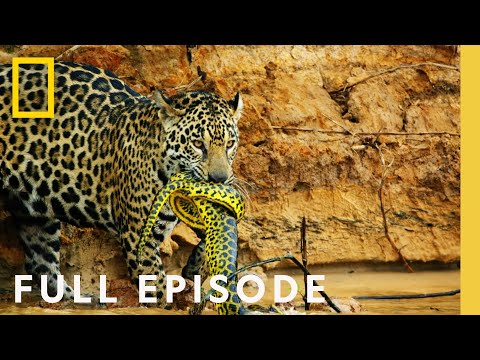 Photo: N43 and Hermes
A living system the size of a continent: how the world's largest tropical rainforest stores carbon, generates rainfall, and shelters the most biodiverse assemblage of life on Earth.
Source video: Jungles: Survival of the Fittest (Full Episode) | Hostile Planet · National Geographic · approximately 12.5M views observed via yt-dlp on August 4, 2026. Independently researched by N43 and Hermes.
01 A Forest the Size of a Continent
The Amazon rainforest covers approximately 5.5 million square kilometers across nine South American nations, an area larger than the European Union. The broader Amazon basin encompasses roughly 7 million square kilometers, of which about 6 million are cloaked in tropical forest. Brazil holds the largest share at around 60 percent, followed by Peru and Colombia, with smaller but significant portions in Venezuela, Ecuador, Bolivia, Guyana, Suriname, and French Guiana. This is not a single uniform forest but a mosaic of distinct habitats — terra firme uplands, seasonally flooded varzea forests, permanently waterlogged igapo swamps, and patches of savanna — stitched together by the world's largest river system into a single biome of staggering complexity.
The scale is difficult to grasp. Standing biomass in the Amazon is estimated at roughly 100 to 150 metric tons of carbon per hectare, and the forest contains somewhere between 400 and 500 billion individual trees representing more than 16,000 species. The canopy rises 30 to 50 meters in mature forest, with emergent trees puncturing through to 60 meters or more. Below the canopy, multiple understory layers create a vertical gradient of light, humidity, and temperature that partitions niches with extraordinary precision. A single hectare of Amazonian terra firme can harbor over 280 tree species, a diversity level unmatched anywhere else on the planet.
02 The Biodiversity Engine
The Amazon is the most species-rich terrestrial ecosystem on Earth. One in ten known species lives within its boundaries. The basin harbors at least 40,000 plant species, over 1,300 bird species, more than 3,000 freshwater fish species, and untold millions of insect species, the great majority of which remain scientifically undescribed. Jaguars, giant otters, harpy eagles, and pink river dolphins occupy the upper tiers of a food web whose complexity scientists are still decoding. A single tree in the canopy can host dozens of ant species, hundreds of beetle species, and an entire community of epiphytes, ferns, and orchids in its crown.
The mechanisms behind this concentration of life are debated. The river barriers hypothesis holds that the Amazon's network of waterways fragments populations, driving speciation across isolated banks. The Pleistocene refugia theory proposes that forest contracted into isolated patches during dry glacial periods, generating bursts of speciation when populations reconnected. More recent work emphasizes the role of edaphic heterogeneity — variation in soil type, topography, and hydrology across the basin — in creating fine-grained niche partitioning. Whatever the dominant driver, the result is a biological tapestry so dense that a single expedition to a previously unvisited ridge can yield dozens of new species in a matter of weeks.
03 The Carbon Vault
The Amazon stores an estimated 150 to 200 billion metric tons of carbon in its vegetation and soils, making it the largest terrestrial carbon sink on the planet. This is roughly a decade's worth of global fossil fuel emissions locked in living biomass. The forest absorbs carbon through photosynthesis at a rate that, for decades, exceeded the carbon released by decomposition and disturbance, making it a net carbon sink. Trees grow continuously in the wet tropics, and the multi-layered canopy structure maximizes photosynthetic surface area per unit ground.
But the sink is weakening. Ground-based monitoring plots across the basin show that the rate of carbon uptake has declined since the 1990s, even as atmospheric carbon dioxide concentrations have risen. The leading explanation is a combination of elevated mortality from drought stress, increased fire frequency, and the acceleration of tree growth in carbon dioxide-enriched air, which causes trees to reach reproductive size sooner and die younger. The Amazon is still absorbing more carbon than it releases, but the margin is narrowing. A tipping point looms, beyond which the forest transitions from sink to source — a shift with implications for every climate model on Earth.
04 Flying Rivers and the Water Cycle
The Amazon generates roughly half of its own rainfall through evapotranspiration. Trees pump moisture from the soil into the atmosphere through their leaves, releasing an estimated 20 billion metric tons of water vapor into the sky each day. This moisture rises, condenses, and falls again as rain, a cycle so vast that atmospheric scientists have named the conveyor belt of water vapor above the basin the flying rivers. These aerial rivers carry moisture south and west, feeding rainfall across the continent as far as Argentina's agricultural belt.
The mechanism is well measured. A single large tree in the Amazon can transpire 1,000 liters of water per day. Multiply by 400 billion trees and the daily atmospheric injection is staggering. When forests are cleared, this recycling loop breaks. Rainfall decreases not just locally but across wide regions downwind. Studies of the southern Amazon demonstrate that cumulative deforestation beyond 30 to 40 percent of the basin could permanently disrupt the flying rivers, converting the western Amazon to savanna and drying the subtropical breadbasket of South America. The forest is not merely a passive recipient of rain but an active participant in manufacturing it.
05 Deforestation and the Tipping Point
Since the 1970s, approximately 17 percent of the Amazon rainforest has been cleared, and an additional 17 percent has been degraded by selective logging, fire, and edge effects. The primary drivers are cattle ranching, industrial soy cultivation, and infrastructure expansion. Deforestation rates peaked in 2004 at over 27,000 square kilometers per year, declined sharply through 2012 due to policy enforcement and supply-chain commitments, then surged again between 2019 and 2022. While recent enforcement actions have pushed rates back down, the cumulative loss has brought the basin dangerously close to a threshold.
Climate modelers have identified a probable tipping point at 20 to 25 percent total deforestation, beyond which the forest loses its capacity to generate its own rainfall and transitions to a degraded savanna state. The mechanism is the collapse of the evapotranspiration feedback loop. With insufficient forest cover, the flying rivers diminish, dry seasons lengthen, and fires become more frequent and severe, further degrading remaining forest in a self-reinforcing spiral. The Brazilian scientist Carlos Nobre has estimated that reaching 25 percent deforestation would commit 50 to 60 percent of the basin to savannization over decades, releasing approximately 100 billion metric tons of carbon and irreversibly altering South American climate patterns.
06 Indigenous Stewardship and Conservation
Indigenous peoples have inhabited the Amazon for at least 19,000 years, and their territories cover approximately 25 percent of the basin. These lands are not pristine wilderness untouched by human hands but rather landscapes shaped by millennia of management, including the creation of fertile terra preta soils, the deliberate planting of useful species, and the maintenance of trail networks and orchards. Archaeological evidence increasingly shows that pre-Columbian populations were far larger than once assumed, and that the forest's current composition reflects centuries of human influence.
Today, indigenous territories and protected areas serve as the most effective buffers against deforestation. Studies consistently show that deforestation rates inside demarcated indigenous lands are two to three times lower than on adjacent unprotected lands, even after controlling for remoteness and accessibility. The security of these lands, through legal recognition and enforcement, is one of the most cost-effective forest conservation strategies available. Yet indigenous communities face escalating violence, illegal invasions by miners and loggers, and political pressure to open territories for resource extraction. The relationship between forest survival and indigenous rights is not incidental but structural: the peoples who have lived in the forest longest are the ones most capable of keeping it standing.
07 A System at the Crossroads
The Amazon rainforest sits at the intersection of every major environmental challenge of the 21st century: climate change, biodiversity loss, freshwater security, and the rights of indigenous peoples. The decisions made in the next decade about deforestation policy, enforcement, and indigenous land protection will determine whether the forest continues to function as a planetary life-support system or crosses a threshold from which recovery becomes impossible. The science is clear on the mechanism, the stakes, and the timeline. What remains uncertain is the political will.
The forest's own resilience should not be underestimated. Patches of Amazonian forest have recovered from disturbance before, and the regrowth of secondary forest can sequester carbon at high rates. But recovery from a state change — from forest to savanna — would require centuries and a stable climate that the transition itself would undermine. The Amazon is not merely a place on a map. It is a self-sustaining climate engine, a carbon vault, a water factory, and the repository of the most extraordinary concentration of life the planet has ever produced. Its fate is inseparable from our own.
References
- Wikipedia: Amazon rainforest — overview of the basin, its biodiversity, and threats
- Wikipedia: Deforestation of the Amazon rainforest — clearance rates, drivers, and tipping-point analysis
- Nobre, C. A. et al., "Land-use and climate risks for Amazonia and its impact on South America," Journal of Arid Environments — the 25% tipping-point estimate
- FAO, Global Forest Resources Assessment — Amazon forest area and biomass data
- Source video: Jungles: Survival of the Fittest (Full Episode) | Hostile Planet (National Geographic, ~12.5M views, observed August 4, 2026)
By N43 and Hermes for Sailor Bob News.


