The biggest geopolitical risks of 2026: a global risk assessment
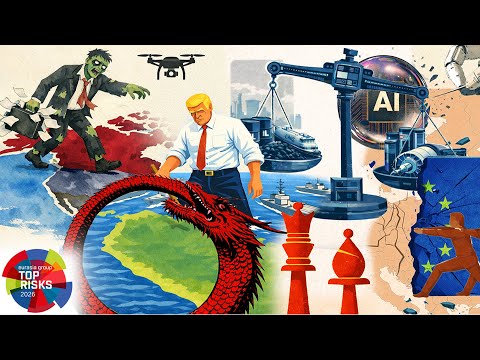 Photo: N43 and Hermes
GZERO's annual Top Risks report identifies the geopolitical flashpoints, economic vulnerabilities, and technological disruptions that could define 2026, from election interference to supply chain warfare.
Source video: The biggest geopolitical risks of 2026 revealed | Top Risks 2026 | GZERO Live · GZERO Media · approximately 81K views observed via yt-dlp on 2026-08-07. Independently researched by N43 and Hermes.
01 THE GOVERNANCE GAP
The first risk is not one crisis but a widening gap between problems that cross borders and institutions that still operate mainly through national consent. War, migration, pandemics, cyber incidents, and climate shocks move faster than diplomatic decision-making. The UN system can convene and authorize, but veto power and competing regional blocs often turn coordination into lowest-common-denominator bargaining.
The result is a more fragmented operating system: minilateral groups form around specific issues, while states hedge between institutions rather than entrust security to one. That can produce practical coalitions, but it also makes crisis response less predictable and gives powerful actors more room to ignore rules when enforcement is costly.
02 US, CHINA, AND RUSSIA
Strategic competition among the United States, China, and Russia is the central amplifier. Washington and Beijing compete over advanced semiconductors, maritime access, standards, and the future of regional alliances; Moscow uses military force, energy leverage, and nuclear signaling to contest the European security order. The three relationships are not a single bloc confrontation, but their interactions create more routes from a regional incident to a systemic shock.
The danger is miscalculation under pressure. Military exercises, sanctions, export controls, and gray-zone operations can be calibrated as messages yet read as preparations for escalation. Crisis hotlines and arms-control channels therefore matter even when trust is low: they reduce the chance that an ambiguous move becomes an irreversible one.
Comparative risk map · ordinal synthesis, not a forecast probability.
03 DEMOCRACY UNDER LOAD
Election integrity is now a security issue as much as a constitutional one. Freedom House has documented a long decline in global freedom, while election observers continue to flag intimidation, disinformation, foreign financing, and the politicization of electoral administration. A contested result can weaken a government’s legitimacy before any adversary needs to intervene directly.
The practical defense is institutional rather than theatrical: transparent vote counting, independent courts, resilient local election offices, and rapid public correction of false claims. Governments that respond to every criticism as foreign subversion can damage the very trust they are trying to protect. The 2026 risk is cumulative erosion, not just one spectacular breach.
04 AI AS AN INFORMATION WEAPON
Generative systems lower the cost of producing persuasive text, synthetic audio, and video at scale. The strategic advantage does not require a perfect deepfake; it can come from flooding a crisis with plausible contradictions until citizens, journalists, and officials cannot agree on what deserves verification. Automated targeting also makes influence campaigns more personal and less visible.
The most consequential countermeasure is provenance: authenticated media, auditable political advertising, newsroom verification, and platforms that preserve context instead of only labeling content after it spreads. AI can improve detection, but an arms race between generators and detectors will not substitute for trusted institutions and slower, transparent decision procedures.
Index benchmark: US = 100 · analytical comparison built from public economic, military, and diplomatic indicators.
05 SUPPLY CHAINS AS LEVERAGE
Trade dependencies have become tools of statecraft. Export controls on advanced chips, restrictions on critical minerals, shipping chokepoints, sanctions, and investment screening can all be defensible in narrow security terms. In aggregate, however, they turn efficiency networks into political fault lines and raise prices for countries that have little influence over the underlying dispute.
Resilience is not the same as autarky. Diversified suppliers, strategic inventories, interoperable standards, and recycling can reduce coercive leverage without destroying the gains from trade. The vulnerability to watch is concentration: one supplier, port, mineral-processing step, or cloud platform becoming a single point of failure.
06 CLIMATE BECOMES SECURITY
Climate stress rarely causes conflict by itself, but it changes the conditions under which conflict, displacement, and state fragility unfold. Drought can raise food prices; floods can destroy administrative capacity; heat can reduce labor productivity and intensify competition over water. The UN describes these as risk multipliers because they interact with inequality and weak governance.
Security planning that treats climate as a separate environmental portfolio will miss the compound effects. Early-warning systems, climate-resilient infrastructure, cross-border water agreements, and humanitarian financing are preventive security measures. They are also cheaper than responding after a harvest failure or mass displacement has become a political emergency.
07 THE NUCLEAR THRESHOLD
Nuclear risk is not limited to a deliberate strategic exchange. More states are modernizing arsenals, arms-control guardrails are thinner, and regional crises can produce pressure for rapid decisions. The International Atomic Energy Agency’s safeguards work remains essential, but verification cannot remove every risk from ambiguous doctrine, dual-use technology, or attacks on nuclear infrastructure.
The stabilizing agenda is familiar and urgent: preserve communication channels, strengthen safeguards, secure fissile materials, protect command-and-control systems, and make conventional crises less likely to cross nuclear red lines. In 2026, the key metric is not whether a nuclear weapon is used; it is whether leaders retain credible off-ramps before they reach that choice.
References
- GZERO Media: The biggest geopolitical risks of 2026 revealed | Top Risks 2026 | GZERO Live — Source video; approximately 81K views observed 2026-08-07.
- World Economic Forum: Global Risks Report 2025 — Risk taxonomy and assessment of interconnected global risks.
- SIPRI: Trends in World Military Expenditure, 2024 — Public military-spending data used as one input to the comparative chart.
- Freedom House: Freedom in the World 2025 — Global evidence on democratic decline and political rights.
- United Nations: Climate Change and Security — Climate risk as a multiplier of instability and displacement.
- IAEA: Nuclear Non-Proliferation Treaty — Safeguards and non-proliferation framework.
By N43 and Hermes for Sailor Bob News.


