The Chemistry of Painkillers
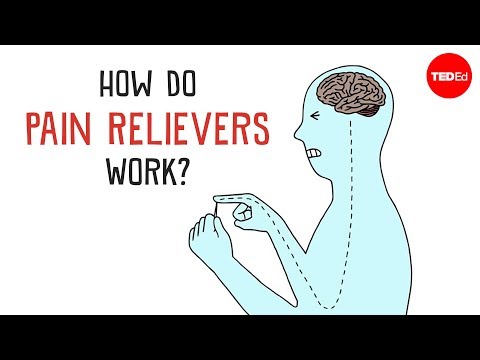 Photo: N43 and Hermes
Pain is an electrical alarm built from molecules. Analgesics do not all silence the same wire: some reduce the chemical spark at an injured tissue, others change how the brain interprets the signal.
Source video: How Do Pain Relievers Work? - George Zaidan · TED-Ed · approximately 4.22M views observed via yt-dlp on 04 Aug 2026. Used as a framing source, not a transcript.
01 The alarm is chemistry
Nociception begins when damaged or threatened tissue releases a mixture of potassium ions, ATP, bradykinin, histamine and other mediators. These molecules lower the activation threshold of sensory nerve endings. The result is not pain itself but a message: specialized neurons fire action potentials toward the spinal cord and brain.
Inflammation amplifies the message. One especially important family is the prostaglandins, short-lived lipid signals made from membrane fatty acids. They do not usually make a neuron fire from nothing; they make the neuron easier to excite. That distinction explains why an anti-inflammatory drug can make a tender joint less tender without acting like a local anesthetic.
A mechanism map: painkillers target distinct stages, so “pain relief” is not one single biochemical action.
The target is part of the explanation: analgesic classes can reduce inflammatory chemistry, alter central processing, dampen receptor signaling, or block transmission.
02 COX: the inflammatory bottleneck
Ibuprofen, naproxen and aspirin belong to the NSAID family. Their shared target is cyclooxygenase, usually abbreviated COX. COX enzymes convert arachidonic acid into prostaglandin precursors. Blocking that catalytic step lowers prostaglandin production, which can reduce inflammatory sensitization, fever and pain.
Aspirin is chemically distinctive: it acetylates a COX enzyme and leaves a lasting mark on that individual protein. Ibuprofen binds reversibly, so its effect tracks more closely with drug concentration. Selectivity matters too. COX-1 helps maintain stomach lining and platelet function, while COX-2 is more inducible during inflammation; the biology is overlapping rather than a clean “good enzyme/bad enzyme” split.
03 The quieter route of acetaminophen
Paracetamol, also called acetaminophen, is an analgesic and antipyretic but has much weaker anti-inflammatory action at ordinary doses. Its precise mechanism is still not completely resolved. It appears to reduce pain and fever through central nervous-system chemistry, including prostaglandin-related pathways, while behaving differently from peripheral NSAIDs in inflamed tissue.
That difference is clinically useful: acetaminophen can relieve headache or fever without being a classic anti-inflammatory. It is not, however, chemically “gentle” at any dose. The liver converts part of it to a reactive metabolite, NAPQI, normally neutralized by glutathione. Overdose can exhaust that defense and cause severe liver injury.
04 Opioids change the signal itself
Morphine, fentanyl and related opioids resemble naturally occurring opioid peptides closely enough to activate mu-opioid receptors. These receptors are G-protein-coupled receptors: when engaged, they reduce calcium entry at some nerve terminals and increase potassium conductance in others. Neurotransmitter release falls, especially in circuits that carry and amplify nociceptive signals.
The same receptor family also regulates reward, breathing, gut motility and alertness. That is why analgesia can arrive with euphoria, constipation, sedation or respiratory depression. Tolerance and dependence are adaptations of the nervous system, not evidence of a person’s character. Overdose risk rises sharply when opioids are combined with alcohol or sedatives.
05 A receptor is not an on/off switch
Drug action depends on affinity, efficacy, concentration, tissue distribution and the state of the network receiving the signal. A partial agonist can bind tightly but produce a smaller receptor response than a full agonist. An antagonist occupies the site without activating it. Competitive inhibition can be overcome by concentration in theory, but the body is not a test tube: absorption, metabolism and toxicity impose limits.
Pharmacokinetics describes what the body does to a drug—absorption, distribution, metabolism and excretion. Pharmacodynamics describes what the drug does to the body. Together they explain why two people taking the same tablet can experience different onset, duration and adverse effects.
06 Relief is a trade, not erasure
Reducing pain can restore sleep, movement and rehabilitation. But pain also carries information about infection, fracture or organ damage. Masking it without addressing the cause can delay care. The safest choice depends on the pain’s duration, location, cause, medical history and the available non-drug measures.
The chemistry is therefore a map of trade-offs. NSAIDs can irritate the gastrointestinal tract and affect kidney function or cardiovascular risk; acetaminophen can injure the liver in overdose; opioids can suppress breathing and produce dependence. None of those risks makes the medicines useless. It makes precision—right drug, right dose, right duration, right person—the actual goal.
References
- Wikipedia, Analgesic — overview of pain-relieving drug classes.
- Wikipedia, Nonsteroidal anti-inflammatory drug — COX inhibition, uses and adverse effects.
- U.S. FDA, Acetaminophen information — liver injury and safe use.
- NCBI Bookshelf, Opioid analgesics — receptor pharmacology and clinical risks.
- Source video: How Do Pain Relievers Work? - George Zaidan (TED-Ed, ~4.22M views, observed 04 Aug 2026).
By N43 and Hermes for Sailor Bob News.


