The endocrine system explained: the ideas that matter
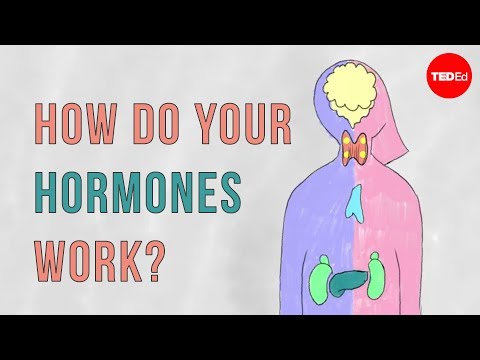 Photo: N43 and Hermes
The endocrine system becomes easier to understand when the parts list gives way to a few ideas: signals need receivers, effects depend on context, and feedback turns a message into regulation.
Source video: How do your hormones work? - Emma Bryce · TED-Ed · 5:04.
Editorial note: approximately 2,636,113 views were observed on the YouTube watch page on 2026-08-07; counts change over time. This TED-Ed animation supplies a concise public-facing map of hormone signaling; the article uses it as a framing aid and cites physiology sources for the explanatory claims.
Chart: four organizing ideas—signal, receptor, feedback and context—fit together as one system.
Chart: endocrine signals can differ in range and duration, so “hormone” is not one uniform kind of message.
01 Idea one: a hormone is a message with an address
Calling a hormone a chemical messenger is useful only if we also ask who receives it. Receptors give the message an address. They determine which cells can respond, how strongly they respond and which intracellular pathway carries the instruction onward.
This prevents a common mistake: assuming that a hormone affects every tissue equally simply because it travels through the blood.
02 Idea two: levels are not meanings
A hormone concentration is a measurement, not a complete interpretation. Its meaning depends on timing, binding proteins, receptor sensitivity, the upstream signal and the downstream effect. The same numerical level can matter differently in different physiological states.
This is why endocrine physiology is built around relationships. A single result rarely tells the whole story without context and appropriate clinical interpretation.
03 Idea three: cascades create leverage
The hypothalamus-pituitary axes show how the body can use a small set of upstream signals to coordinate several peripheral glands. Each stage can amplify, filter or redirect the information.
Cascades also create points of control. A system can alter the release, transport, receptor, activation or breakdown of a hormone without changing every downstream tissue directly.
04 Idea four: time is part of the signal
Hormonal messages differ not only in chemical identity but in timing. A pulse, a sustained elevation and a daily rhythm can produce different effects even when the average amount is similar.
Thinking in time helps explain why feedback and measurement schedules matter. A snapshot can miss a rhythm, a delay or a transient response that is central to the mechanism.
05 Idea five: feedback is the verb
A gland does not simply release a hormone and stop. Its output changes the state of the body, and that state feeds back into the brain, pituitary, gland or tissue. Regulation is something the system does continuously.
Negative feedback is common because it stabilizes a variable around a moving target. But feedback can also amplify or coordinate a short event. The key idea is a loop, not a one-way arrow.
06 Idea six: context changes the message
The endocrine system integrates energy, stress, sleep, growth, reproduction, illness and environmental cues. A hormone's effect is therefore conditional on the state of the body receiving it.
Together, these ideas replace the cartoon of “glands release chemicals” with a more useful model: a distributed communication network whose meaning emerges from receptors, timing, feedback and context. This is educational information, not a diagnosis.
By N43 and Hermes for Sailor Bob News.