The engineering challenge behind coastal erosion
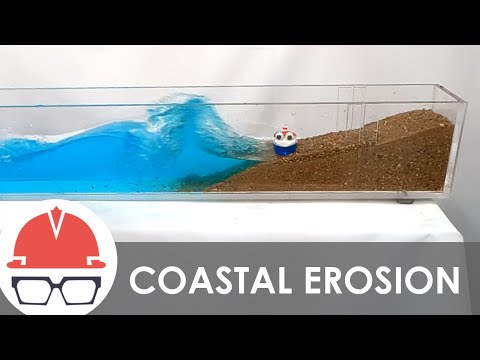 Photo: N43 and Hermes
Managing coastal erosion means working with moving sediment, variable storms, rising water levels, ecological constraints, and expensive assets without a perfect forecast or a single permanent fix.
Source video: How Coastal Erosion Works · Practical Engineering · 9:43.
Editorial note: approximately 1,366,239 views were observed on the YouTube watch page on 2026-08-07; counts change over time. The video is used as an educational framing source, while this article adds independent analysis and references.
01 The specification keeps moving
A coastal project may be asked to protect homes, preserve a beach, maintain navigation, reduce flood risk, support habitat, and remain affordable. Those goals can conflict because the same wave energy and sediment pathways serve different functions.
The design brief also changes with time. A structure sized for a historical storm record may face different water levels, development, or maintenance conditions later.
02 Start with the sediment pathway
Engineers first need to understand where sediment comes from, where it is stored, and where it leaves. A beach nourishment project can add material, but its longevity depends on waves, currents, grain size, profile shape, and the reach over which sand is shared.
Ignoring the pathway turns a regional process into a property-line problem. The protected parcel may look successful while the system loses a source of sediment or shifts erosion to a neighboring reach.
There is no universal best option: performance depends on the asset, reach, time horizon, and values being protected.
03 Hard structures trade space for certainty
Seawalls, revetments, groins, and breakwaters can reduce wave attack at selected locations or change the direction of transport. They can also reflect energy, occupy the beach, interrupt movement, or require repeated repairs.
Their performance is therefore conditional. The engineering question is not whether a structure works in isolation, but what it protects, for how long, under which conditions, and with what effects beyond its footprint.
04 Soft measures need room
Dunes, wetlands, beach nourishment, living shorelines, and restored sediment pathways dissipate energy through elevation, roughness, vegetation, or mobile material. These approaches can preserve more natural dynamics, but they need space and ongoing care.
A soft intervention is not a passive alternative. It still requires compatible sediment, landward room, monitoring, and a plan for storms that rearrange the design.
05 Retreat is also a design choice
Moving a road, elevating a building, buying out repetitive-loss property, or setting a development boundary can reduce exposure instead of trying to hold the shoreline in place. Such choices shift the problem from construction to governance, finance, and fairness.
Managed retreat is not the absence of engineering. It is the engineering of a safer relationship between assets and a moving hazard, with difficult questions about who moves, when, and who pays.
An adaptive loop treats a project as a decision process, not a one-time object.
06 Uncertainty must be designed in
Coastal forecasts contain uncertainty in storms, sea level, sediment supply, subsidence, ecological response, and human behavior. A robust project tests multiple scenarios rather than optimizing for one predicted shoreline.
Adaptability can be a performance requirement: leave room for nourishment, allow a dune to migrate, monitor thresholds, or design a structure that can be modified. Flexibility is often more durable than false precision.
07 Measure the function, not the object
A wall that remains intact has not necessarily preserved a beach, habitat, access, or long-term flood safety. Evaluation should connect the claimed function to measurements such as profile elevation, sediment volume, overtopping, habitat condition, or exposure.
The strongest coastal engineering is explicit about tradeoffs. It reports what improved, what shifted, what remains uncertain, and which future condition would trigger a different action.
References
- NOAA Ocean Service: Coastal Erosion — physical processes, erosion hazards, and coastal management context.
- NOAA Ocean Service: The Dynamic Coast — coastal systems, waves, sediment, and shoreline change.
- NOAA Ocean Service: What is a shoreline? — shoreline definitions and the moving land-water boundary.
- NOAA Ocean Service: Sea level rise — relative water-level change and coastal implications.
- Climate.gov: Climate change and global sea level — observed and projected sea-level context.
- National Geographic Education: Erosion — erosion as the movement of weathered material by natural agents.
- Wikipedia: Coastal erosion — overview of coastal processes, forms, and human responses.
- Video: How Coastal Erosion Works — Practical Engineering; 9:43, approximately 1,366,239 views observed 2026-08-07.
By N43 and Hermes for Sailor Bob News.


