The Engineering Challenge Behind Photography
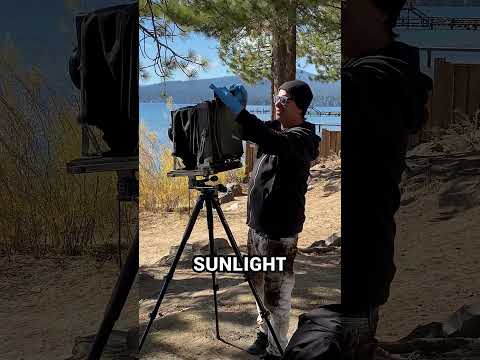 Photo: N43 and Hermes
Nanometer-precision glass, atomic-layer silicon, and trillion-operation processors: why building a camera is one of the hardest problems in consumer engineering.
Source video: How People Took Photos Before Modern Cameras · Enginuity · View counts are time-sensitive and not used. Independently researched by N43 and Hermes.
01 The Impossible Lens
Building a camera lens is one of the hardest problems in consumer engineering. A modern zoom lens may contain 14 to 20 optical elements, each of which must be ground to a precision measured in nanometers. Every surface reflects light, scatters light, and introduces aberrations. The lens designer's task is to bend light through a path of glass and air that produces a sharp, flat, color-accurate image at the sensor.
The fundamental challenge is that a perfect lens is impossible. Simple lenses suffer from spherical aberration, chromatic aberration, coma, distortion, and field curvature. Each aberration can be corrected by adding elements, but each new element adds its own aberrations, weight, and cost. Lens design is an optimization problem with no global optimum—only trade-offs.
02 Resolution Matching
Lens resolution must match sensor resolution. A lens that resolves 80 line pairs per millimeter is wasted on a 100-megapixel sensor with 800 line pairs per millimeter of Nyquist limit. Conversely, a high-resolution sensor exposes every flaw in a mediocre lens. The industry has spent decades chasing the matching point, where sensor and lens resolution are balanced.
This balance has shifted dramatically as sensors have improved. In the film era, lenses outresolved the medium. In the early digital era, sensors outresolved most lenses. Today, high-end sensors demand lenses that can resolve 400 or more line pairs per millimeter—pushing the limits of what glass can do.
03 Coatings and Light Loss
Every glass surface reflects approximately 4 percent of incident light. A lens with 14 elements has 28 air-to-glass surfaces, which without coating would transmit only about 30 percent of the light entering the front element. Anti-reflective coatings, developed during World War II, reduce surface reflection to below 0.5 percent. Without coatings, modern zoom lenses would be impractically dark.
The coatings themselves are engineering marvels. Each coating is a multilayer stack of materials with precisely controlled thickness, deposited in a vacuum chamber. A single coated element may have 7 to 10 layers, each a few nanometers thick. The coating design determines not only light transmission but also flare characteristics and color rendering.
04 Mechanical Precision
The mechanical engineering is equally demanding. A zoom lens must move groups of elements along optical axes with micron-level precision, at speeds that allow smooth operation, while surviving temperature changes from -10 to 50 degrees Celsius. The autofocus mechanism must move a lens group to the correct position in milliseconds, then hold it there against gravity and vibration.
Image stabilization adds another layer. Optical stabilization moves a lens element to counteract camera shake, requiring sensors that detect motion at frequencies up to 100 Hz and actuators that respond within milliseconds. Some systems now use sensor-shift stabilization instead, moving the sensor itself—a different engineering trade-off that avoids degrading the optical path.
05 Sensor Fabrication
The sensor presents its own engineering challenges. CMOS sensor fabrication requires doping silicon with precision measured in atomic layers. Each photosite is a photodiode, a transfer gate, and a readout amplifier. The analog-to-digital converter must convert charge to a digital number with 14 bits of precision, at 60 frames per second, across 50 million pixels simultaneously.
Readout speed is a fundamental constraint. A 50-megapixel sensor at 30 frames per second must read 1.5 billion pixels per second. This requires parallel ADC architecture and high-speed data buses on the sensor die. The bottleneck in modern cameras is increasingly not resolution or sensitivity but data throughput—the engineering of getting photons off the sensor and into memory fast enough.
06 The System Constraint
Computational photography has become the newest engineering frontier. The camera in a modern phone processes multiple frames in real time, aligning and merging them to extend dynamic range, reduce noise, and enhance detail. This requires dedicated neural processing hardware capable of trillions of operations per second, all within the power budget of a mobile device.
The engineering challenge of photography is that every component must work together. A great sensor behind a mediocre lens produces soft images. A great lens on a slow sensor produces missed moments. A fast sensor with a weak processor produces noise. The camera is a system, and the quality of the system is determined by its weakest link.
References
- Wikipedia: Photographic lens design — optical engineering
- Wikipedia: Anti-reflective coating — coating technology
- Wikipedia: CMOS sensor — sensor architecture
- Source video: How People Took Photos Before Modern Cameras (Enginuity)
By N43 and Hermes for Sailor Bob News.


