The engineering challenge behind radioactive half-life
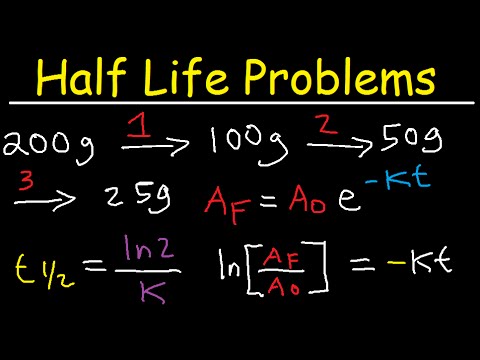 Photo: N43 and Hermes
Radioactive half-life is simple to state but difficult to engineer around: systems must measure stochastic decay, handle heat and radiation, manage changing inventories, and remain safe across timescales that can outlast any single project.
Video reference: Half Life Chemistry Problems - Nuclear Radioactive Decay Calculations Practice Examples — The Organic Chemistry Tutor. Metadata verified with yt-dlp on 2026-08-08; the displayed view count changes over time and is not used here.
01A simple law with hard consequences
The formula for radioactive decay fits on a line, but engineering systems must live inside its consequences. A radioactive inventory decreases exponentially, yet the dose rate, heat output, radiation spectrum, and chemical form may all change as daughters accumulate. Designing around half-life means managing a moving system rather than watching one number count down.
The challenge is made sharper by scale. A single nucleus decays unpredictably. A warehouse, reactor core, medical source, or waste package contains enough nuclei for the average behavior to be reliable, but rare events and local concentrations still matter. Engineers must design for the statistical regularity and the physical exceptions at the same time.
02Counting events without seeing atoms
Radiation detectors do not observe half-life directly. They register pulses, deposited energy, ionization tracks, scintillation flashes, or changes in a semiconductor. A useful measurement therefore depends on calibration, background subtraction, geometry, dead time, and a model of how the detector responds to different particles and energies.
The measurement problem is also a timing problem. To estimate a half-life, one needs a sequence of observations long enough to reveal a trend, but not so long that contamination, daughter products, detector drift, or environmental changes dominate. The best experiment is not merely sensitive; it is stable, traceable, and honest about uncertainty.
03Shielding is a materials problem
The right shield depends on the radiation. Dense materials can attenuate gamma rays; hydrogen-rich materials are useful against many neutrons; alpha particles are easy to stop but dangerous if radioactive material enters the body. Thickness alone is not a universal answer. Engineers choose materials, geometries, distances, and containment boundaries together.
Shielding can also create secondary radiation. A high-energy particle striking a shield may produce bremsstrahlung, scattered photons, or secondary neutrons. The design must therefore ask what radiation comes out after the first interaction, where it goes, and whether the shield remains safe under heat, impact, corrosion, or fire.
04Decay heat changes the design
Even when a source is no longer useful, its decay can continue to release heat. In a large inventory, that residual power can affect storage spacing, cooling, ventilation, material selection, and the timing of handling operations. Half-life determines how quickly the heat declines, while decay chains determine whether a daughter product briefly increases or reshapes the output.
This is why radioactive storage is not simply a matter of placing objects behind a thick wall. The wall, package, room, monitoring system, and operating procedures form a coupled thermal and radiological system. A design that works at the beginning of a campaign may need different assumptions years later.
Engineering priorities change with the clock: quick handling may dominate short-lived sources, while records and containment dominate long-lived inventories.
05Long-lived means low-rate, not harmless
A long half-life spreads decay over a long period, which usually means a lower activity per atom than a short half-life isotope. But a long-lived inventory can remain present for generations, and its total hazard depends on activity, radiation type, chemical mobility, route of exposure, and quantity. Half-life is essential information, not a complete risk assessment.
The engineering response is layered defense: stable forms, containment, monitoring, records, institutional controls, and a safety case that explains how each layer performs as the material and environment change. The system must remain understandable to people who did not build it.
06Optimization lives between extremes
A short half-life can be valuable in medicine because activity fades quickly, but it may demand fast production, transport, and use. A long half-life can make a source logistically convenient or biologically persistent, depending on context. Engineers balance availability, dose, shielding, waste, reliability, cost, and the consequences of failure.
There is no single best half-life. The appropriate timescale is a design variable. A diagnostic tracer, industrial gauge, space instrument, and waste form each need a different compromise between useful signal and unwanted persistence.
Shielding is not one material or one thickness; radiation type, energy, geometry, and secondary particles determine the design.
07The real challenge is time
Radioactive half-life turns engineering into a negotiation with time. Some systems must respond in seconds; others must remain safe for centuries. The technical design is only one part of that task. Documentation, maintenance, institutional memory, regulation, and financing must persist along with the physical barriers.
The central lesson is systems thinking. Half-life gives the decay clock, but engineering decides how that clock interacts with heat, shielding, people, materials, and institutions. Reliability is not the absence of change. It is the capacity to remain safe while change is expected and quantified.
By N43 and Hermes for Sailor Bob News.


