The engineering challenge behind the circular economy
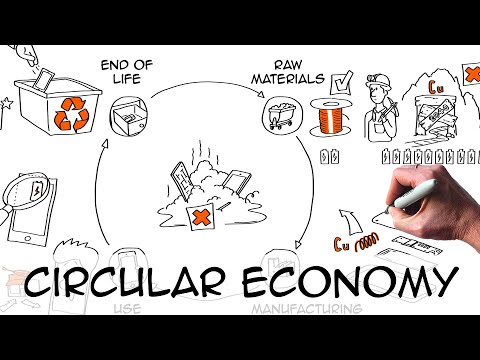 Photo: N43 and Hermes
The circular economy is simple in principle — keep materials in use — but the engineering is hard: separating joined materials fights entropy, contamination degrades recycled streams, and tracking substances through global supply chains requires infrastructure that barely exists.
Video reference: Circular Economy Explained: Definition & Examples in 2026 — Sustainability Illustrated. Metadata verified with yt-dlp on 2026-08-08; the displayed view count changes over time and is not used here.
01Separating what was joined
A smartphone contains over seventy elements, bonded, soldered, laminated, and sealed into a device designed to be compact and durable. The engineering that makes it thin and waterproof also makes it almost impossible to take apart. Separating the cobalt from the lithium, the rare earth magnets from the aluminium frame, requires processes that are energy-intensive and yield materials at lower purity than virgin sources.
The circular economy promises that end-of-life products become new raw materials, but the physics of joining is the physics of entropy. Once materials are mixed, unmixing them costs energy. The more intimately they are combined — alloys, composites, co-moulded parts — the steeper the energy gradient to separate them.
02Thermodynamics and entropy
The second law of thermodynamics sets a floor on the cost of circularity. Every time a material is recycled, some fraction degrades: fibres shorten, polymers cross-link, contaminants accumulate. Downcycling — turning a plastic bottle into a lower-grade product — is the norm because the energy cost of restoring the original quality exceeds the value of the material.
This does not make circularity impossible, but it sets the terms. Recycling must be designed for, not assumed. The materials most compatible with closed loops are those that can be reprocessed without quality loss: metals like aluminium and steel, glass, and simple mono-material polymers. Complex multi-layer packaging and composite materials face fundamental thermodynamic barriers.
Material value degrades through recycling cycles — entropy imposes a quality cost at each turn.
03Design for disassembly
If entropy makes separation hard, design can make it easier. Design for disassembly means building products with reversible fasteners instead of adhesives, modular subassemblies instead of integrated composites, and clear material identification so that sorting systems can recognise what they receive. The goal is to move the separation decision upstream — from the recycler's furnace to the designer's drawing board.
This is harder than it sounds. Reversible fasteners add weight and cost. Modular assemblies may sacrifice performance for serviceability. Clear material marking requires standards that cross manufacturers and borders. Every design-for-disassembly choice trades a property the consumer cares about today against a recovery option that pays off years or decades later.
04The contamination problem
A recycled plastic stream is only as valuable as its purity. A single PVC bottle in a PET recycling batch can discolour and weaken the entire output, making it suitable only for low-grade applications. Food residue on paper packaging can contaminate an entire batch of recycled fibre. The economic value of recycling depends on collection and sorting systems that prevent contamination at every stage.
This is a systems problem, not a technology problem. The sorting technology exists — near-infrared spectroscopy, density separation, electrostatic sorting — but it works only if materials arrive at the facility in a condition the technology can handle. Consumer behaviour, collection logistics, and product design all determine whether the technology succeeds or fails.
Separation asymmetry: easy to mix, hard to unmix — the thermodynamic challenge of material recovery.
05Tracking materials through the economy
You cannot reuse what you cannot locate. A circular economy requires knowing where materials are, what they contain, and who is responsible for them at end of life. This information is largely absent. A manufacturer may know what goes into a product, but once it is sold, the trail goes cold. Decades later, a recycler receives a product with no material declaration, no disassembly guide, and no information about toxic additives.
Digital product passports — QR codes or RFID tags that carry material composition, repair history, and recycling instructions — are one proposed solution. The EU has mandated them for batteries and is extending them to textiles and construction products. But the infrastructure to create, maintain, and query these passports at scale does not yet exist.
06Scaling repair and remanufacturing
Repair preserves more value than recycling because it keeps the product intact. But repair requires spare parts, service manuals, skilled technicians, and products designed to be opened. The trend in consumer electronics has been the opposite: glued batteries, soldered memory, and software locks that prevent independent repair. Right-to-repair legislation is pushing back, but the engineering culture of sealed units is deeply embedded.
Remanufacturing, which disassembles a used product, cleans and replaces worn components, and reassembles it to original specifications, captures even more value. Caterpillar's remanufacturing division recovers end-of-life engines and components, selling them at lower cost with equivalent warranties. The challenge is scaling this model beyond heavy industry to the consumer goods that dominate waste streams.
07The infrastructure gap
The circular economy requires physical infrastructure that does not exist at the necessary scale: collection networks that reach every household and business, sorting facilities with the precision to separate thousands of material combinations, and reprocessing plants that can turn sorted waste into feedstock at quality and cost that compete with virgin materials. Building this infrastructure is an investment measured in decades and trillions of dollars.
The gap between the vision and the infrastructure is the central engineering challenge of the circular economy. The idea is mature; the systems are not. Closing that gap will require not only technology but policy, financing, and a willingness to rebuild the physical backbone of how materials move through the economy.
References
- Ellen MacArthur Foundation, Completing the Picture: How the Circular Economy Tackles Climate Change
- Reuter, M. et al., Limits of the Circular Economy: thermodynamics and material constraints
- European Commission, Ecodesign for Sustainable Products Regulation
- Platform for Accelerating the Circular Economy (PACE), Circular Economy Action Agenda
- Circular Economy Explained — Sustainability Illustrated
By N43 and Hermes for Sailor Bob News.


